Tell us about your new book.
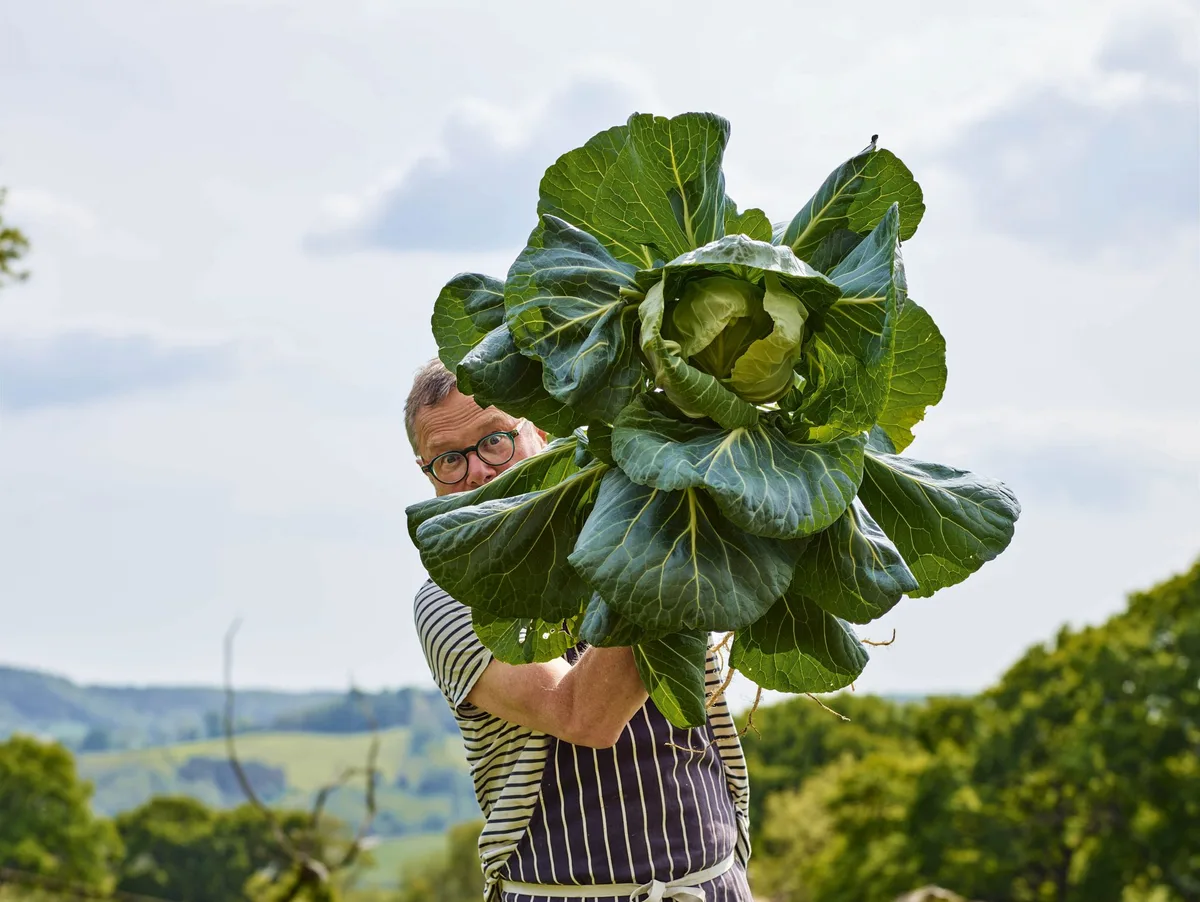
I wanted to help people get more fibre into their diet, using the vegetables we usually have in our fridges, larders or freezers – or on the veg plot, of course. They tend to be the standby veg, boiled and on the side, but actually we can cook with them in fun and delicious ways – recognizing their value as star ingredients.
I often mix what I'm growing in the garden with stored staples. From June to August I have freshly podded peas, but have organic frozen peas in the freezer all year round, along with spinach and sweetcorn, and tinned beans and tomatoes alongside my own homemade passata.
Buy Hugh's new book from Waterstones.
I get very excited about tomato varieties. A midsummer tomato harvest can take you right through into the autumn. Because I grow so many, I make a roast tomato passata with my homegrown tomatoes. I put them in big roasting trays with olive oil, garlic, bay leaves and thyme, and roast them slowly for three or four hours until they pulp. I freeze many litres of it. When I get it out, it's sweet and delicious, but I actually like to add a tin of plum tomatoes to it, because that gives it that rounded out flavour for a really good tomato sauce, especially if I'm doing pizza. For a half-litre tub of my roast tomato nectar, I like to crush a tin of really good organic plum tomatoes, then simmer and break them down for 10 or 15 minutes for a particularly well balanced combination.
What do you like to read?
I tend to read fiction on holiday and non-fiction at other times. I like [farmer and author] James Rebanks and my friend John Wright wrote a brilliant book called The Forager's Calendar, which I like to dip into. When I'm on holiday, I'll grab a couple of novels that people have recommended. I usually wait until about three people have told me something’s really great. I'm a big fan of Rohinton Mistry, who wrote an amazing book, A Fine Balance. I'm also a fan of Marion Keyes and Karl Ove Knausgard. I mix it up.
What other media do you consume?
Even though post quite a lot on socials and do all my own content, I don't have Instagram on my phone. My great team at River Cottage post for me because I would be too distracted by scrolling. What I do do on my phone is listen to music, often plugged into a speaker. I use YouTube as a jukebox. When I listen to a new song or one I haven’t heard for a while, I like the option to have video as well. It might be something that us slightly older folks do.
What first sparked your interest in gardening?
My mum and dad moved out of London in 1970 when I was five or six and moved to a rented farmhouse in Gloucestershire, which had a lovely garden. My dad got into growing veg and my mum got into planning the rest of the garden. She studied landscape architecture and became a garden designer and writer about gardens. I take more after my dad. I hadn't done much of my own growing until the very first River Cottage series, when I took on the cottage outside Bridport and created a small veg garden from scratch. I was digging up flowers and shrubs in order to make room for veg. I'm lucky now that we've got enough space - and just about enough knowledge - to have both.
What would you describe as the best part of your job?
I've had the opportunity to do so many different things - to make TV shows, write books and create our restaurant and cookery school here in East Devon at River Cottage HQ. All these things are highly collaborative and I might have my name on the book or above the door, but only because I've been lucky enough to work with really amazing people, including TV directors and publishers.
For over 15 years I've been collaborating with my brilliant food editor Nikki Duffy and still work with Gil Mellor, who was our head original head chef at River Cottage and has done some wonderful books of his own. With Nicky and and Gil and Stuart Dodd, who runs River Cottage with me, it's been a privilege to be able to do so many different things. Gil and I have been working together for over 20 years and it's brilliant to see how he's created such a distinctive way of cooking and writing about food. He teaches a cookery course at River Cottage and helps me on a lot of the shoots for my books.
Can you share a growing mistake or a failure?
I have slightly sad almond tree, one of two that I was given for my 50th birthday – it has some dead and some living branches. I've got a little nut plantation that I created with the help of Martin Crawford (of the Agroforestry Research Trust) - he helped me choose the varieties of hazelnut and chestnut. I didn't consult Martin on the almond trees. For a couple of years they both produced an abundance of blossom, but, like apricots, they bloom very early and quite often the nuts don’t set. One of the trees died and the other is hanging on, but it gets peach leaf curl every year. It's hard to get proper juicy nuts from a tree in England, but I had a brilliant tip from Yotam Ottolenghi – in midsummer, when they look like hard furry green peaches, you can slice them and mix them into salads before they even form a nut.
Seeds just want to grow. Also, the soil can do a lot for itself
Is there something you wish you'd known earlier about growing?
Seeds just want to grow. Also, the soil can do a lot for itself. No-dig is not only a bit less work, it also allows the soil to do its own recovery. It is not just about not disturbing the soil - it's not compacting the soil, too. The best no-dig beds are quite narrow – not much more than 1.2m wide, so you can reach everything in them from both sides. I used to fling a lot of chicken manure pellets around but if you're not disturbing or compacting your soil and mulching it over winter, it's capacity to rejuvenate its own fertility is extraordinary. I think there's a lot to be learned from that in commercial agriculture. The regenerative farming movement is starting to teach those lessons in a really useful way. Even growing organically, we sometimes overfeed and and overstress when we can let nature take its course and still get very good yields.
Do you have a guilty growing secret?
I struggle with carrots a bit. Having said that I did do better last year – I grew them in in a big troughs filled with a mixture of topsoil and a bit of bit of homegrown compost. I used to try and get an early an early crop but germination was patchy until May or even early June, so now I think of them as an autumn crop. They overwinter really well – I pulled the last ones out of the trough in March and they were really big. We always say that a few frosts make parsnips sweeter and I think the same may be true of carrots. They had almost lost their green tops, but the carrots themselves were still orange and crisp and the flavour was fantastic.
I’ve given up trying to grow blueberries. I grew them in pots because I didn't want to acidify a whole bed in the garden in case I then wanted it for something else. Even a decent sized pot dries out really fast and for a few years I was watering and fertilising and pruning them and had a few handfuls of delicious blueberries, but I don't think I ever harvested enough to get them into the kitchen. I've moved on and made more space for old-school raspberries and strawberries.
What is your favourite garden or landscape to visit?
The West Coast of Scotland and the Hebridean coastline, where there are amazing empty beaches and high cliffs. We have a lovely coastline here in Devon but the scale and wildness of the Scottish coastline has an extra dimension and drama to it.
Who would you most like to show around River Cottage HQ?
Elizabeth David. She was a food hero of mine growing up as my mum had her books, and I met her, amazingly, when I was working as a chef at the River Cafe in the late Eighties. I did quite a lot of desserts in those days and one of the things on the menu was Elizabeth David's chocolate cake, which had a little bit of coffee in it. I was told to cook it because we knew she was coming in for lunch, and of course she ordered it. I was summoned to her table and she said, “I've just eaten what you have called Elizabeth David's chocolate cake. But you've changed the recipe, haven't you?” I told her that I had actually been adding a bit more chocolate as we were serving it as a dessert. I wasn't sure whether I was about to be told off, but she said, “Well, that a very good idea, because it's absolutely delicious.” Showing her around River Cottage HQ and maybe cooking a little something for her would be incredible, as she influenced the way I cook and think about food.
What else are you up to?
We’ve got a range of seeds out with Seed Revolution. There are 19 different vegetables to kick off the range and we hope to build on that. I’m looking forward to an abundance of radishes and the first broad beans and asparagus and just that amazing flush of early summer veg. I'm going fishing in my boat for bream and bass and maybe putting my lobster pots in the water. Combining food from the land and sea on the plate is always very exciting.