When I started out in garden design, I would do rather naive black-and-white sketches in an attempt to convey my design ideas. They were hit and miss. One client asked if I would colour in my sketches so they could get more of a feel for the garden. I was reluctant, because how could I even start to conjure up the garden in all its different guises, and across its entire lifespan?
Somehow I managed to convince them of my design, and went on to build the garden, but I shall never forget their faces when the plants turned up – little pots of seemingly bare soil and twigs. It wasn’t the instant garden they were hoping for. But three years later, almost to the day, I got a call to thank me. “We get it now,” they said. “The garden is wonderful.”
You may also like:
- Talking gardens podcast: Miria Harris
- A zero waste garden designed by Miria Harris
- How to grow a sustainable garden
These days, seductive CGI images show picture-perfect gardens you can even fly through on screen. Add in the many influencer videos on social media, and it adds up to quite a skewed perspective on how quickly and easily a garden can be transformed. So it doesn’t come as much of a surprise when some clients expect their gardens to be amazing on day one.
It is a strange set of conflicting ideas to resolve. On the one hand, there is nature, unfolding at its own speed; and on the other, there is the fast pace of modern life, where cheating nature is commonplace. When we decide we want something, we pretty much want it yesterday. And yet, when we are increasingly conscious of negative impacts on the environment, the quest for a perfect, easy, instant garden is definitely at odds with less wasteful, more sustainable goals.
Advocating for ecologically thoughtful design is not always straightforward. How do we deal with that old-fashioned summerhouse that’s in the way of a new wildlife-friendly border? Or ensure that when a tree is planted, someone else won’t uproot it to make room for a hot tub in a few years’ time? How do we incorporate what has gone before and consider what will unfold in the future, while creating something new, and fast? These are the perennial challenges that have to be navigated, on a path that is not always clear.
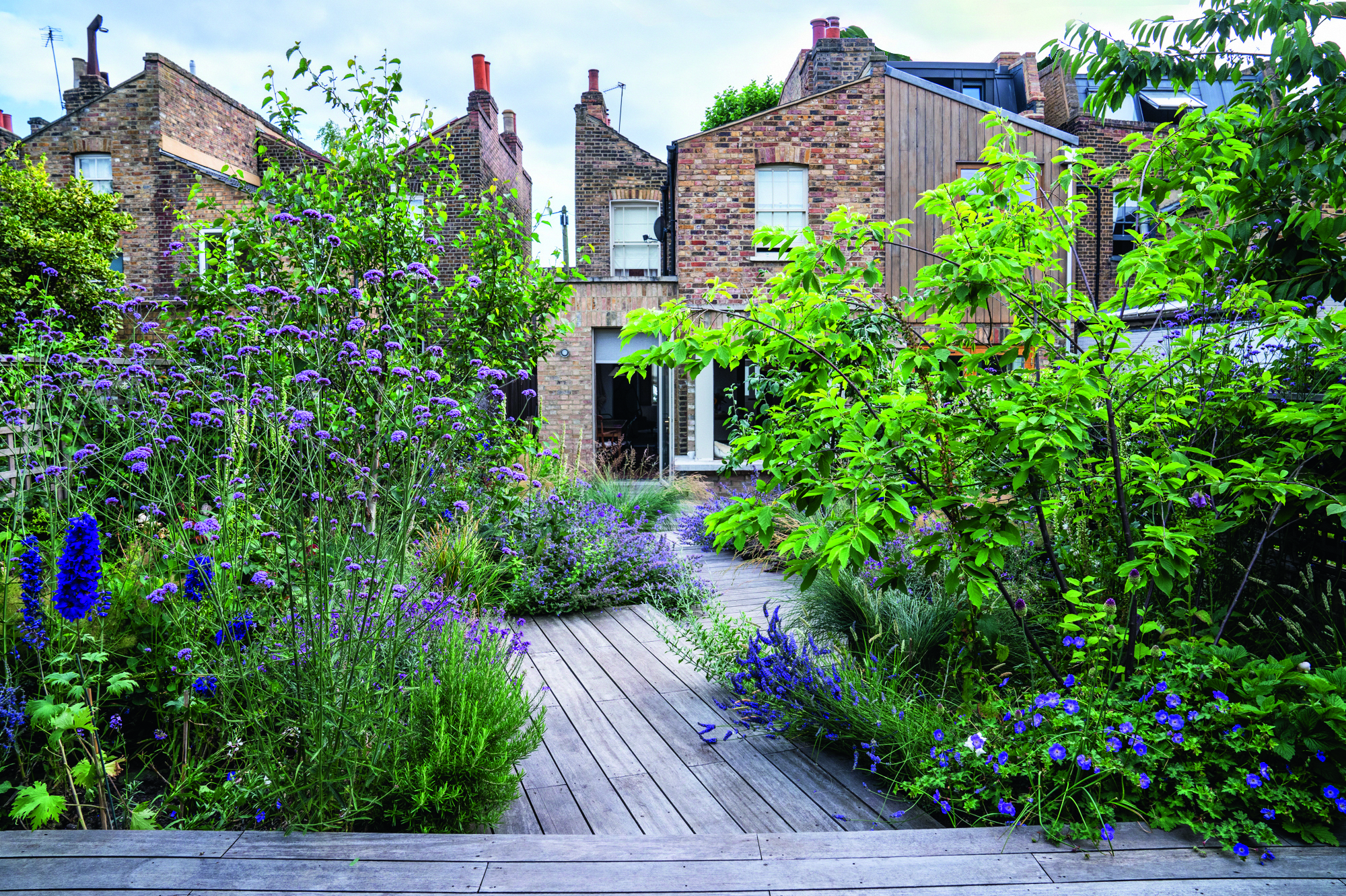
On a recent urban garden project, I set myself a zero-waste goal, largely because the starting point was a mature garden – an instant garden of sorts, just not the type my client wanted. The sheer waste of ripping out a garden that had already been made and grown really bothered me. But so did the realisation that whatever I designed and made, it could and probably would be changed in the future, and the future could be as little as a few years away.
My goal had to be more than just minimising waste in the present, but instead trying to ensure anything added to the garden (built or grown) would not be wasted in the future. As such, choice of materials, the methods of construction and the ultimate sizes of plants became crucial parts of the design equation, along with climate resilience and adaptivity – not just in the planting matrix but within the garden as a whole.
Adaptive reuse and regenerative design are becoming new cultural buzzwords, and when applied to landscapes and gardens, we’re talking about designing built-in flexibility rather than in-built obsolescence. Instead of prioritising immediate desire and quick fixes, it’s about creating a blueprint that enables future generations to take ownership of their gardens and landscapes. It’s about giving them the freedom to renew or reverse what has been built and grown, in tune with a changing climate and with minimal environmental harm.
One of the key ways to do this is to manage expectations; to explain gardens are made slowly, over long periods of time and by many hands. Moving towards a different kind of aesthetic by illustrating the not-so- picture-perfect garden is important too – one that is more relaxed, less polished and where a bit of mess isn’t frowned upon, but celebrated.
We need to talk about gardens and landscapes as communities; places that are there not just to be looked at, but to support wellbeing and to be shared with wildlife. We have to show that growth, evolution and change are an intrinsic part of a garden’s beauty.
Guessing what will be desired in the future and designing for a world we can’t see or imagine is difficult. We don’t have the horticultural version of a crystal ball. But we can call time on the idea of the instant garden, and resist the need for speed in everything. Maybe, in the process, we can find the joy in dancing to a slightly slower beat.


