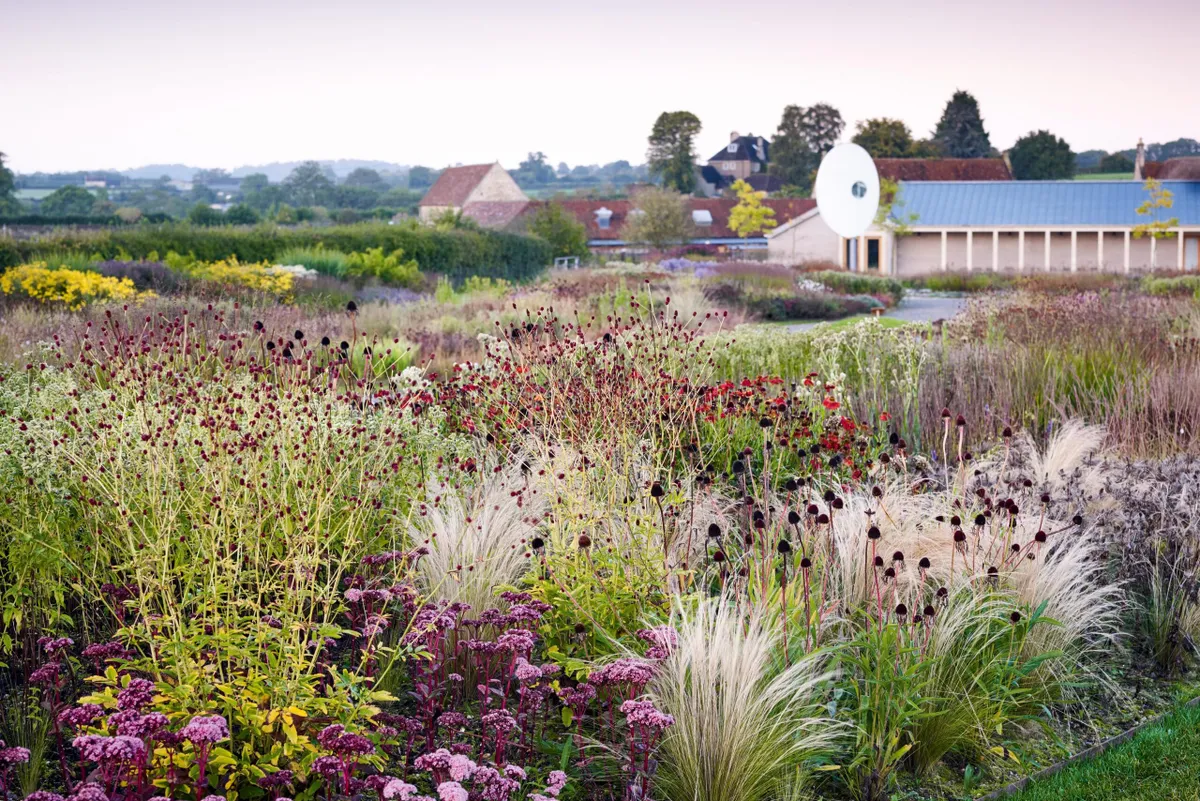
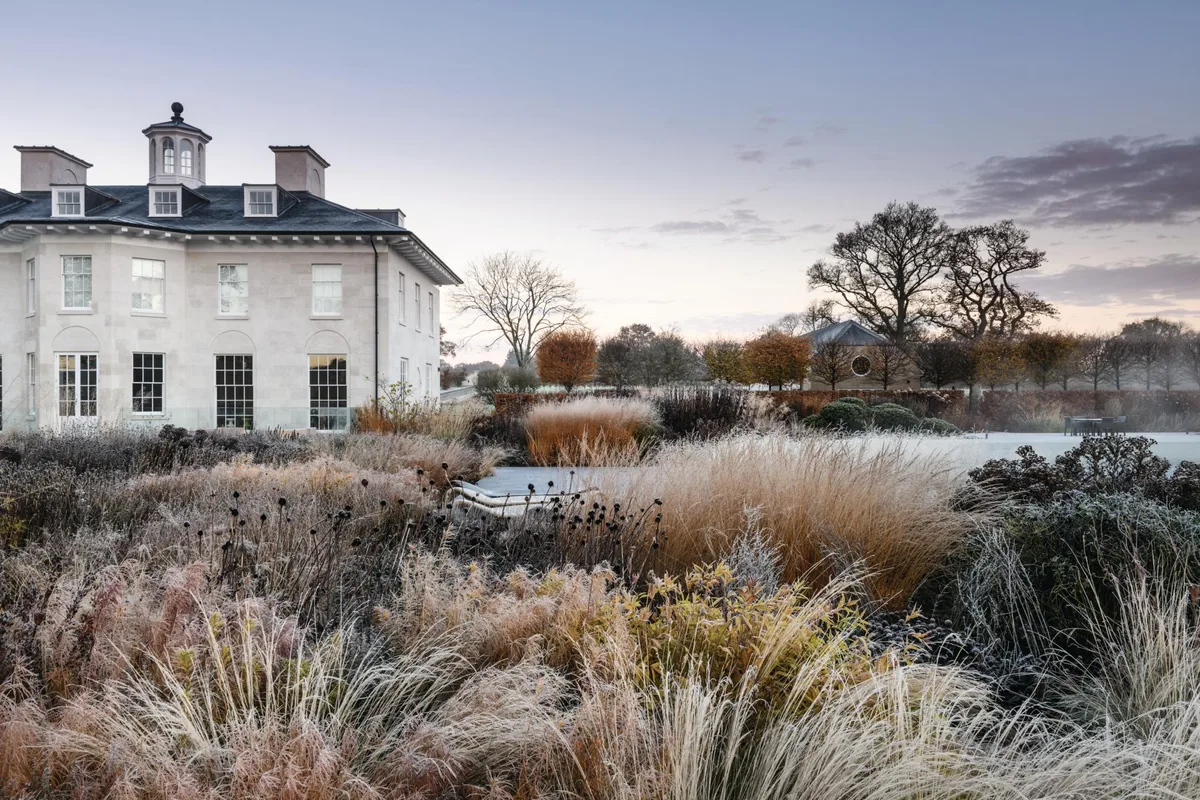
The holy grail for garden owners and designers alike is to plant an outdoor space that looks beautiful 365 days a year, but few pull it off. Unless, of course, your name is Piet Oudolf, the legendary Dutch plantsman and designer whose signature combinations deliver a breathtaking spectacle through all the seasons – even in the depths of winter, when many gardens offer little to tempt us outside.
Piet’s work at a private garden in west Berkshire – three acres, within a 60-acre landscape – is testament to his art. The garden is on the site of a former poultry farm, which the owners bought 20 years ago with a plan to build a new house surrounded by gardens. Piet’s design blends tough, hardy perennials and feathery grasses, woven into waves of colourful flowers and foliage in summer, which then transmute into a sepia landscape of sculptural stems and seedheads as temperatures fall.
You may also like:
- Talking Gardens podcast with Piet Oudolf
- Piet Oudolf: A life in plants
- How to build a natural swimming pond in your garden
- Discover Will Tomson's garden with natural swimming pool
“I was brought in by the owners about ten years ago, just before the new house was built,” says Piet.“ They had my books and loved my work, and asked me to create borders around the house, as well as a swimming pool, vineyards, a meadow, ponds and a Japanese maple woodland garden. We talked about plants and styles they liked, but overall, they gave me free rein. They also have great taste, which made my job easier.”
On the east side of the house, Piet has designed a linear swimming pool and large dining terrace, flanked by lawns and planting beds. To the west, a large swimming pond is accessed via one of a network of curved concrete paths that weave through the garden. The planting that wraps around the composite-timber- edged pond is enclosed by a semi-circular silvery Pyrus hedge, designed to protect plants and people from the strong winds that whip across the flat landscape.
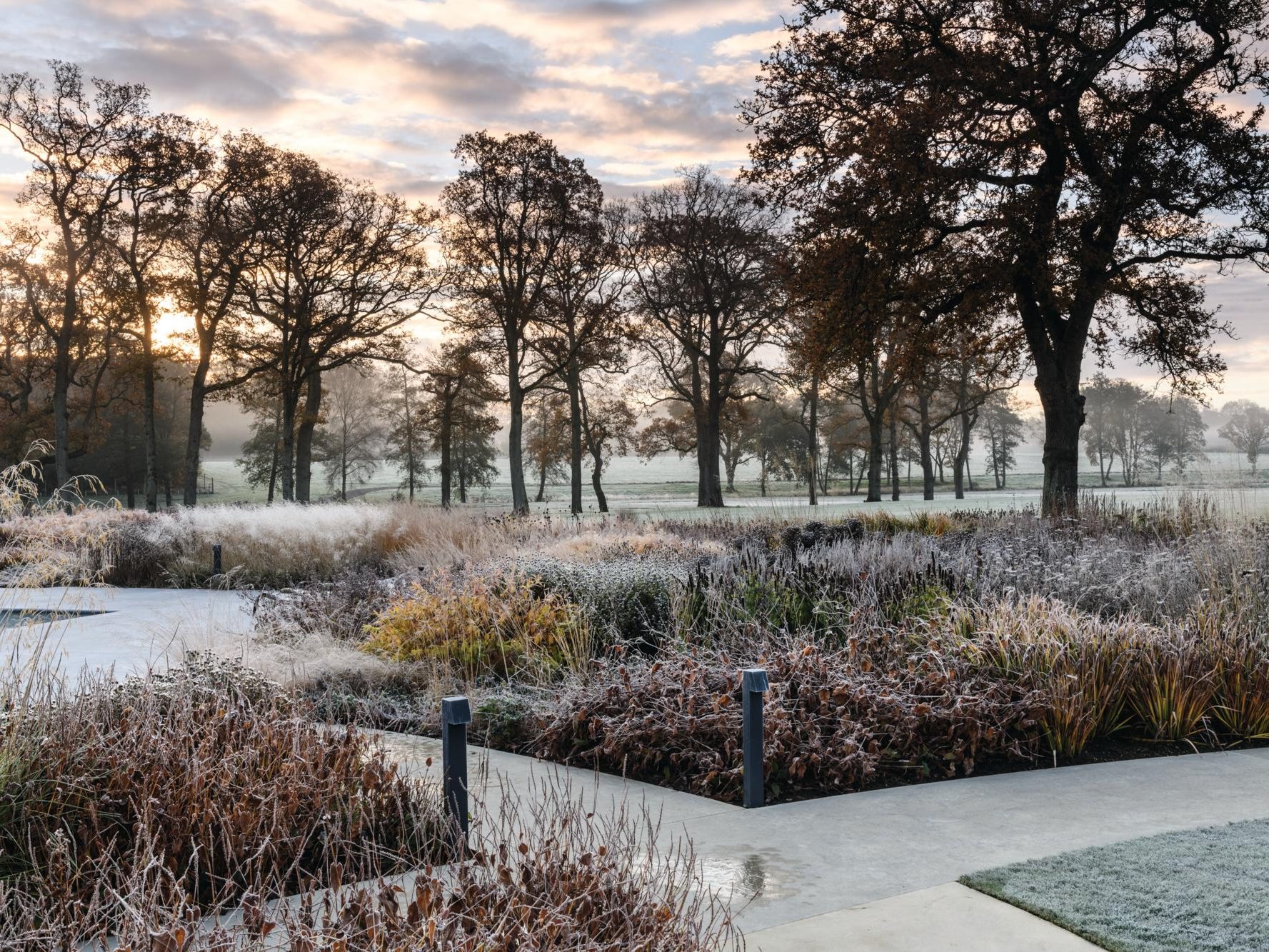
The narrow pathways through the garden create an intimate connection with the plants and wildlife, allowing visitors to reach out and touch the flowers and seedheads, while offering views from different perspectives. “I’ve created tall perennial borders using large plants such as Eupatorium, Rudbeckia subtomentosa ‘Henry Eilers’ and asters that immerse you in the garden, and shorter, meadow-like areas that you can see over and make a connection to the fields and woodlands beyond,” says Piet.
The low winter sun shines through the plants, illuminating their shapes and textures.
The garden has been developed over several years, with Piet initially working with Adam Hunt of Urquhart & Hunt Landscape Design on the technical details and planning requirements for the project. More recently he has collaborated with horticulturist James Hitchmough to establish a flower meadow beyond the swimming pond, and he brought horticulturist Emily Adcock on board to establish new beds. “I was working with Emily on the new Oudolf Landscape at RHS Garden Wisley and was really impressed with her planting skills and knowledge,” says Piet.
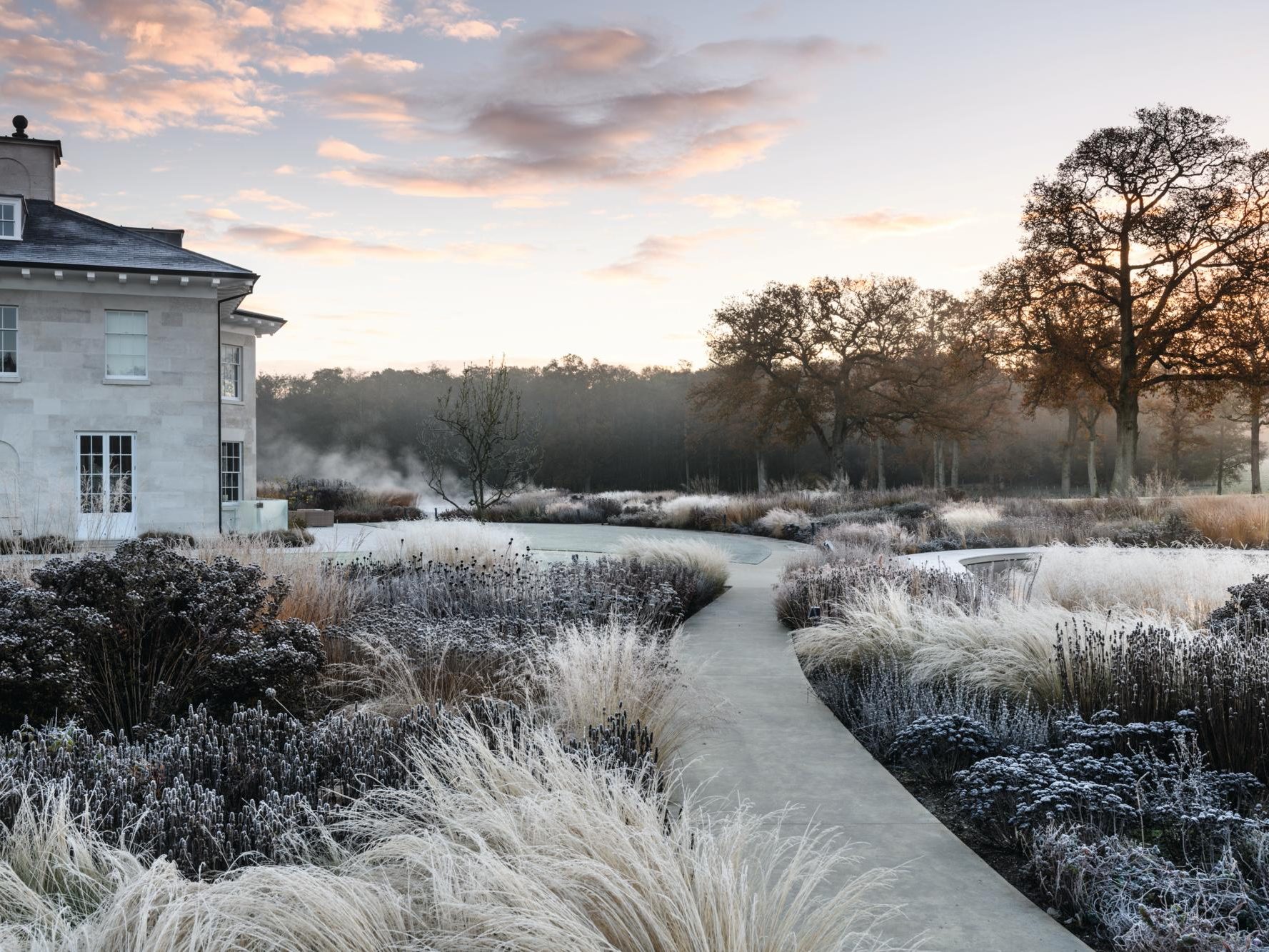
Emily, who now works alongside head gardener Youri de Jager and is overseeing the ongoing care of the plants, explains how subtle changes in planting styles mark the transition from garden to grassland, with large swathes or blocks of individual species close to the house and a more naturalistic matrix style in the outer beds. “Matrix planting mingles small groups of perennials and bulbs between large swathes of grasses, inspired by the way plants naturally self seed,” she says.
“The garden is animated by pollinators from spring to late autumn, with huge numbers of moths and butterflies, including peacocks, tortoiseshells and brimstones, plus every type of bee you can imagine. The birds also love the garden, feasting on the seeds in autumn and winter and feeding the insects it attracts to their chicks in spring.”
Tall perennial borders immerse you in the garden, while shorter, meadow-like areas create
a connection to the woodlands beyond.
The plant displays start in late winter with snowdrops in the woodland areas, followed by crocuses, daffodils and camassias in the main beds. Later in spring, the species tulips and alliums appear, flowering against a backdrop of emerging perennial foliage and grasses, such as Sesleria autumnalis and Sporobolus heterolepis, their vibrant new leaves sparkling in the warm sunshine.
“In summer, the garden is awash with flowers of every colour, from peach-coloured Papaver ‘Queen Alexandra’ and the magenta spikes of Betonica officinalis ‘Hummelo’, to elegant Echinacea pallida and fiery Helenium ‘Moerheim Beauty’. These warm hues are cooled by blue Eryngium, the starry blooms of Amsonia hubrichtii and white Penstemon digitalis, to name a few,” explains Emily.
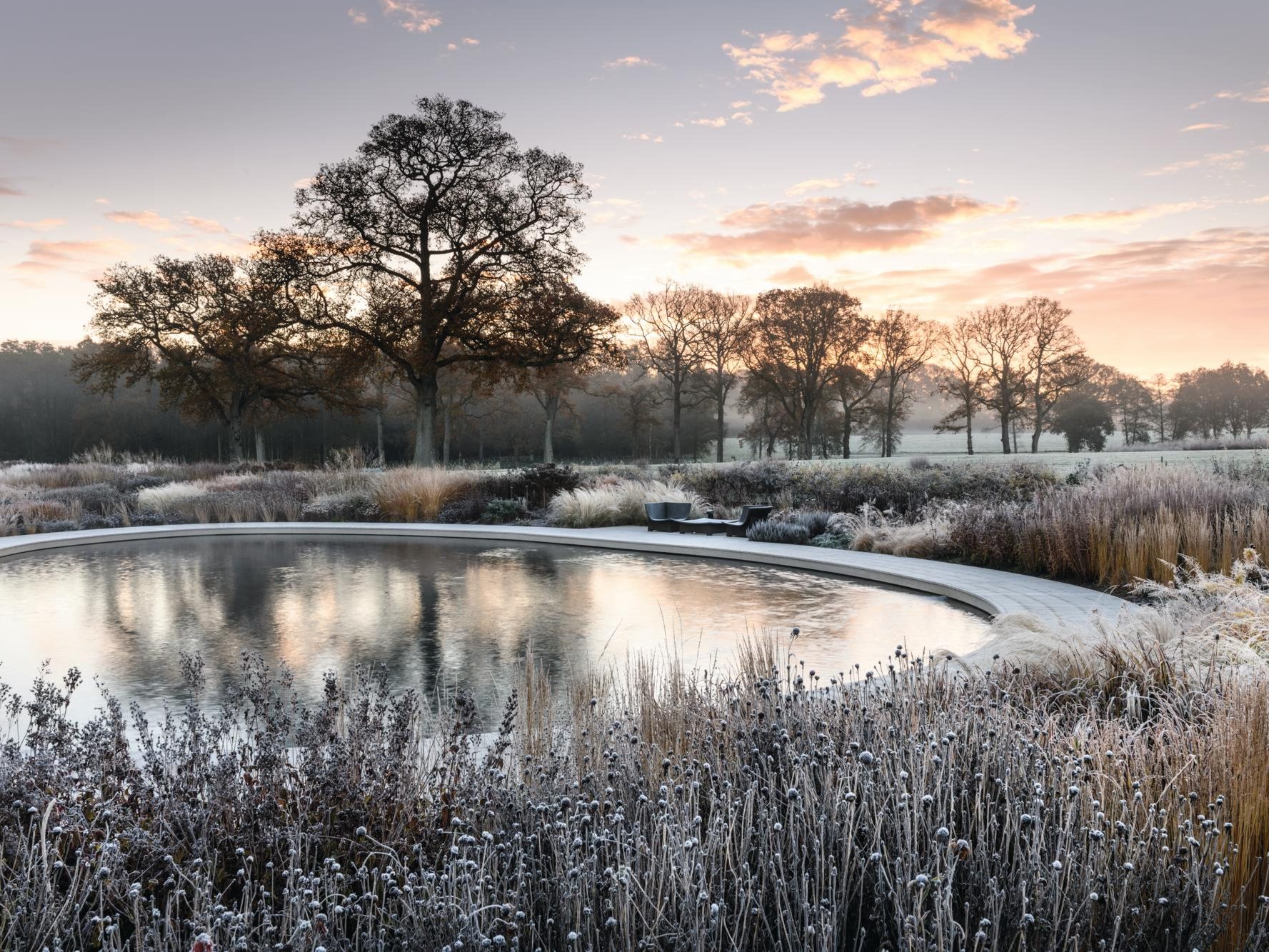
The flowers have been carefully chosen to evolve into dark chocolate brown, ochre and beige seedheads that form the backbone of the winter garden, their sculptural forms contrasting with feathery cream and bronze grasses, such as Molinia caerulea, Stipa lessingiana and Deschampsia cespitosa ‘Goldtau’.
“The low winter sun shines through the plants, illuminating their shapes and textures,” says Emily. “We’re lucky, too, that the open site offers two golden hours, one as the sun rises in the east and another when it sets to the west, infusing the garden with a radiant glow.”
Maintaining the garden is simpler than it may look, as Piet’s strong-stemmed species require no staking and the densely packed planting means weed seeds struggle to get a foothold.
The open site offers two golden hours, one as the sun rises and another when it sets, infusing the garden with a radiant glow.
“The main job is cutting back all the perennials and grasses in late winter and early spring, which in a garden of this size takes a while. Piet also pops over a few times a year, and we take stock, identifying plants that are working well, and the occasional failure, which we then substitute for something more resilient,” says Emily.
Piet admits that the hotter summers we now experience can be a problem for some plants, particularly while they are establishing, but his planting palette for this garden, which he says is one of his favourite UK projects, withstands the cold, windy conditions here.
He also says it can be adapted to any size of garden. “Try flowers with beautiful seedheads such as sedums, Echinacea, Monarda, Sanguisorba,” he advises, "together with ornamental grasses, spreading them through your borders to paint a winter picture as beautiful as any summer garden in full bloom.”
Useful information
Find out more about Piet Oudolf’s work at oudolf.com