It was while filming an episode of Lewis in an Oxford college garden that Tom Simpson fell in love – and within moments decided to abandon his peripatetic life in film and retrain as a garden designer.
His mother Ruth was thrilled. A keen gardener and accomplished plantswoman, she was delighted to have passed on the gardening gene. His father Mark, who much preferred sailing to working the land, was, frankly, baffled.
Ten years on, Tom is now an established designer with a string of RHS Gold medals to his name. The woman Tom fell for is now his wife. And Mark has become an enthusiastic and knowledgeable gardener, not only caring for a large and challenging garden, but with a head full of plans and projects of his own.
You may also like:
- Gardens to visit in Devon
- A former Devon farmhouse with cottage planting designed by Alasdair Cameron
- Conrad Batton's climate change planted Devon space
- Arabella Lennox Boyd's bold garden with a contemporary twist
Just as Tom went off to London to study, his parents bought a plot of land in a deep south Devon combe a few miles from the sea, and started building a startlingly modern house, with a butterfly roof and vast picture windows looking out to the hills. So Tom’s very first project as a newly fledged designer was to find a way of anchoring his new family home in this ancient, verdant landscape.
The site was large – four acres, mainly of cow pasture. It was difficult, with vertiginous slopes plunging down to a stream in the valley bottom, thick with brambles and riddled with springs. The house occupied the only flat piece of land, and it was here that Tom started, creating a pair of broad, simple terraces that echoed the strong horizontal planes of the architecture.
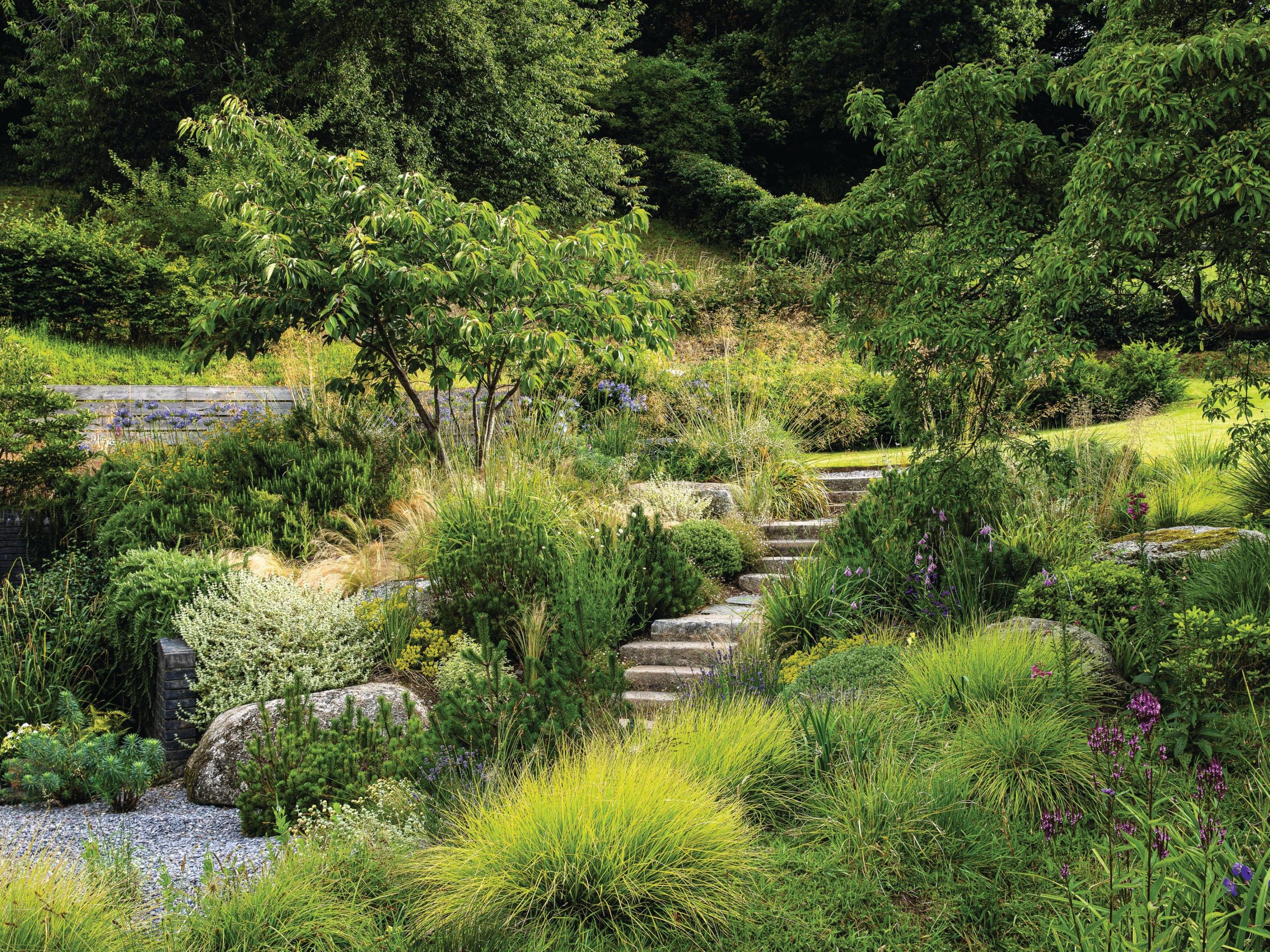
“A contemporary house like this could easily feel like it’s been dropped from space,” reflects Tom. His solution was to surround it with boulders – huge rounded chunks of Dartmoor granite cleared from a nearby farm. “They pin the house into the landscape, and make it feel like it has always been there. It feels like the house is built round the boulders rather than the other way round.”
Tom drew up a plan, which he now concedes was far too ambitious. “We didn’t really stick to it – which is how it goes when you make a garden yourself, and do it over a number of years. It’s a family garden, with three people involved in it – and our three personalities are all expressed in different ways in the garden. While there was a plan, it became a team effort and a shared family passion.”
Although the house was completed early in 2016, planting did not begin until July 2018, and even then it was somewhat random. “I had done my first show garden at Hampton Court,” recalls Tom, “and there were thousands of plants left at the end of it that nobody wanted. So my dad just crammed as many as he could into a Luton van, and our garden evolved from the largely Mediterranean planting scheme I’d done for that show garden. Over the next couple of years I did a couple more show gardens, and the same thing happened. My parents always helped me with the build-up, so they certainly earned those plants.”
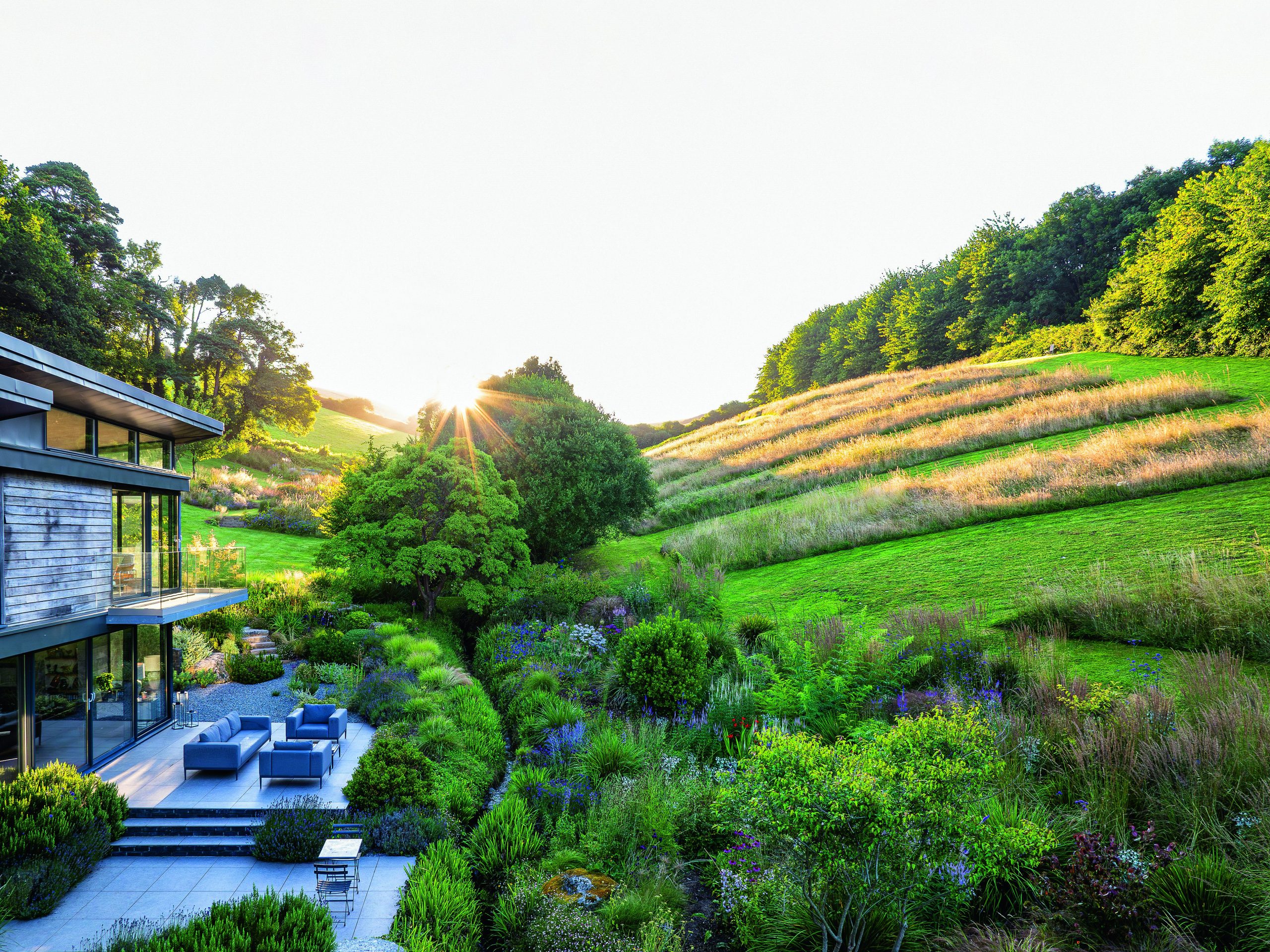
Mark vividly remembers planting literally thousands of plants through a baking-hot August. Happily, the water flowing through the site keeps the soil moist and planting looking lush even in the hottest summer.
While this Mediterranean planting might not have been part of Tom’s masterplan, it works exceptionally well. Generous hummocks of lavender, cistus and euphorbia soften sharp architectural lines; rosemary has grown into tumbling cascades; Pinus mugo brings substance and structure to fluid grassy plantings. The forms work perfectly with the rocks, and especially with a flight of granite steps, cleverly worked by local landscaper and stone mason Duncan Nuttall from reclaimed kerbstones.
While there was a plan, it became a team effort and a shared family passion
Perhaps it is no surprise that the plants have grown so well: Coleton Fishacre, famous for its exotic borders, is just around the corner, while at neighbouring Greenway, half-hardy trees have grown to a prodigious size.
There are hints of Provence in the geometric blocks of hedging that march along the driveway and neatly clipped balls of santolina and Teucrium fruticans. But there are also echoes of the most adventurous of Devon gardens, for like Keith Wiley at Wildside, Tom has moved thousands of tonnes of earth, sculpting the land into new shapes, and has exploited the Devon shillet to create varying drainage conditions for different groups of plants.
It’s a lovely spot, so we wanted to draw some of that landscape up to the house, to keep it all quite soft and flowing
High Springs is also, like Wildside, to some extent a garden of memory. Ruth Simpson died in January 2023. “She never quite saw it finished,” says Tom. “It became a way of honouring her memory as a family, to keep gardening, and important to my father to see it through to the end.” Ruth remains the tutelary spirit in the garden. “It was Mum who chose the site, who saw the potential in that place,” says Tom. “It’s hard to think about the garden and not think about her.”
Since her death, Mark has willingly applied himself to learning his plants, and the never-ending labour of weeding. But of all garden tasks, the one he likes best is mowing. The slope facing the garden is too steep to cultivate and too fertile to grow wildflowers successfully, yet it dominates the outlook from the house.
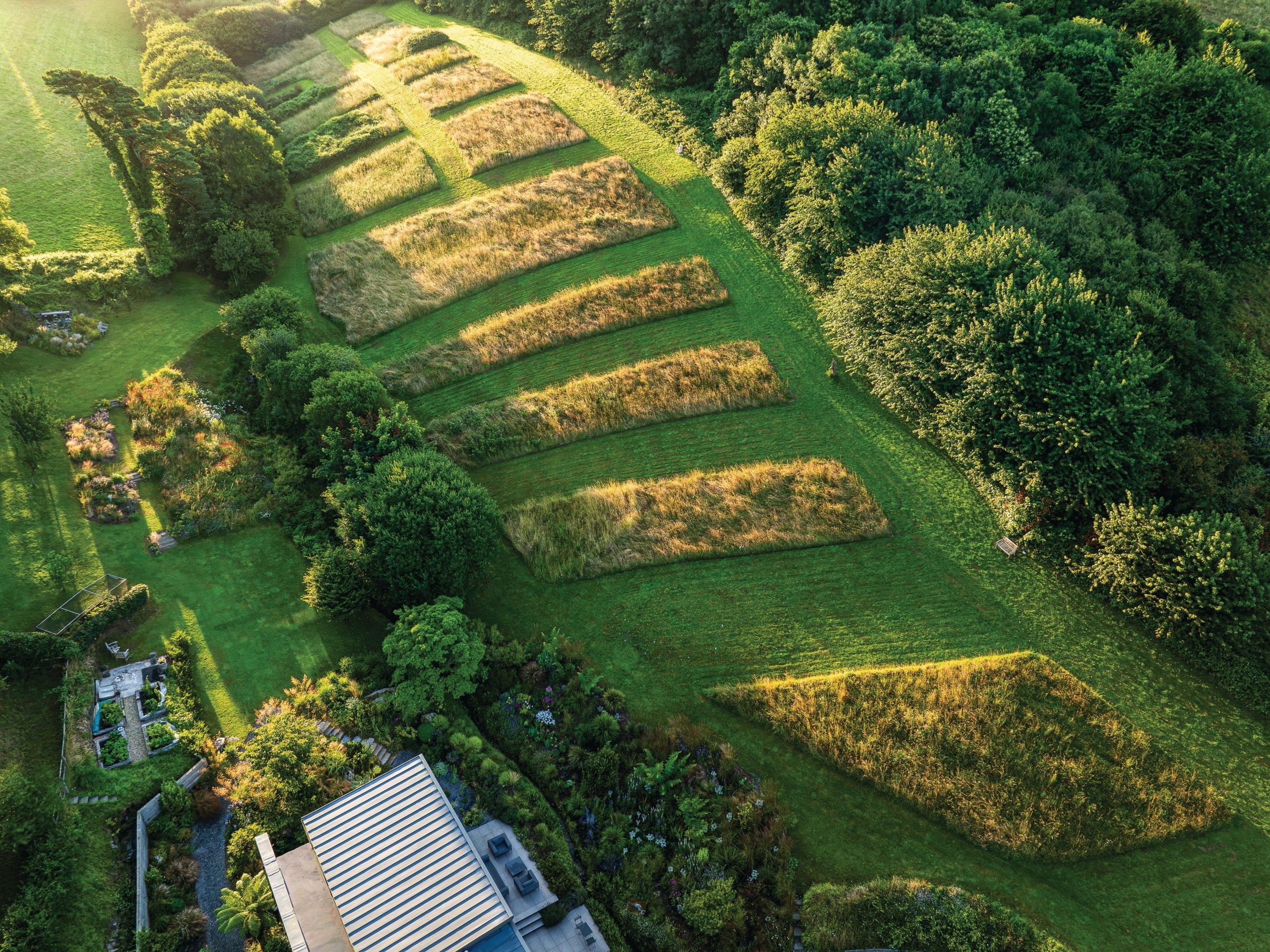
To introduce some interest, Tom had the idea of mowing the native grass into ripples, inspired by the ripples formed by dropping water droplets onto a page. “But because Dad is who he is, the ripples became straight lines and geometric patterns – squares and triangles and tessellated shapes with mown strips in between. They catch the light at dawn when it gets all dewy – and he varies the pattern every year.”(Mark is more prosaic. “It helps to keep the bracken down,” he says, matter-of-factly.)
The ripples in the grass became straight lines and geometric patterns that catch the light at dawn
“This garden is not a showpiece,” insists Tom. “It hasn’t got the manicured look of a professionally executed and maintained garden. But that’s part of its character, and what makes gardens interesting; they are a reflection of the people who look after them. And it was important to us to get it to where it is after Mum died.
“It has atmosphere, it has presence – partly because of the setting and location, and partly because of the way we’ve approached it. I’m proud we’ve enhanced that special atmosphere, and made more of it. I think Mum would be pleased.”
Useful information
Find out more about Tom Simpson’s work at tomsimpsondesign.com


