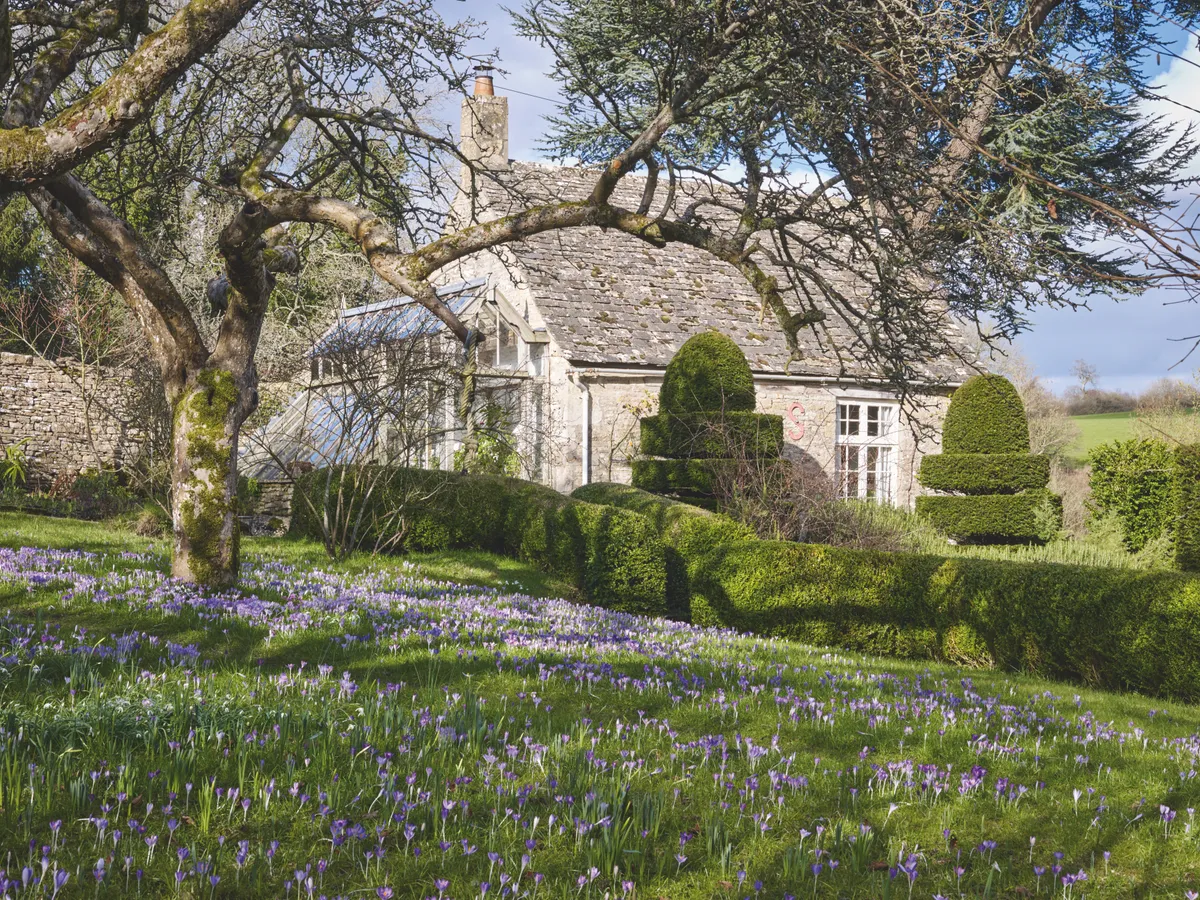
How does a fledgling garden designer showcase her work? She creates something amazing on her own patch, naturally. While Emily Crowley-Wroe was studying at the Cotswold Gardening School in 2020, she used her own garden as a testing ground for her emerging talents.
“I wrote a brief, like you would for a client,” she says. This approach paid off. Today, Emily has the garden of her dreams, and runs an award-winning practice, April House Garden Design, from her home in the Cotswolds. In 2024, she won the Fresh Designer Award for emerging talent from the Society of Garden and Landscape Designers.
This maiden project saw Emily transform her unexceptional front garden – 30m x 10m, with a large, flat lawn, narrow borders and a functional path from her parking space to the house – into an immersive plant haven. This plot is bigger than her back garden, and was prime for transformation, having served as a play area with the obligatory trampoline when her two daughters were younger.

You may also like:
- How to design your garden
- 7 garden design rules you can break, and one you never should
- 6 secret tricks of garden designers
- 8 quick and easy hacks to make your garden look good
Emily kept the path but widened the borders and ripped out the lawn, opening up space for a seating area near the house and a greenhouse at the opposite end. In between, she added a snaking path that invites a slower pace and sensory appreciation of richly planted borders. “I wanted to feel like I was pushing past plants and slightly dwarfed by everything,” she says. “I wanted it loose and free and a little bit wild and experimental. It was amazing to see it come off the page.”

Emily enclosed the garden with hedges of laurel, field maple and hornbeam. Within this green envelope, a patchwork of mature trees, shrubs and tall perennials combine with swaying grasses, ground-hugging evergreens and snugly placed pots to create an atmosphere of space and seclusion all at once.
I like to think of a garden as a painterly composition.
Structure is counterbalanced by looseness, light by shade and a kaleidoscope of greens by splashes of floral colour. Like all good gardens, there’s a sense of mystery about what’s around the corner. It’s impossible to tell that just a few metres away, abutting the garden’s west side, is the large and busy car park of a leisure centre.

The enchantment starts as you pass through the metal entrance gate, framed by a glossy cloud of cherry laurel. A corridor of shade-loving plants, crowned by an arch of Rosa ‘Veilchenblau’ and Rosa ‘Phyllis Bide’, leads you all the way down the garden. You have just taken the original path, but as you reach the house a new journey awaits. This one takes you through the garden in the opposite direction (north to south) along Emily’s snaking path.
With rich planting and a nature-friendly approach, there is no lack of seasonal highlights.
The display of pots framing the porch has a thrilling mix of shapes, textures and colours: sculptural Agave americana and Aloiampelos striatula, blowsy hydrangeas, colourful heucheras and electric-blue agapanthus. “They’re my mini Great Dixter pots,” says Emily, who loves nothing more than experimenting with plants. “I have lots of fun changing them around.”

Nearby is a circular seating area, itself encircled by planted beds. Duos of grasses – Stipa gigantea and Calamagrostis x acutiflora ‘Karl Foerster’ – hold sway over mounds of evergreen shrubs and sedums rub shoulders with Japanese anemones and Echinops bannaticus ‘Taplow Blue’.
As you walk along the path, your senses tune into the new environment. There are romantic touches: David Austin roses in shades of pink, yellow and apricot, including Rosa The Poet’s Wife (= ‘Auswhirl’), R. Olivia Rose Austin (= ‘Ausmixture’) and Rosa Gertrude Jekyll (= ‘Ausbord’); light-pink specks of Geranium Dreamland (= ‘Bremdream’); and clusters of Phlox paniculata ‘Bright Eyes’.

Elsewhere are more vibrant brushstrokes, with fiery crocosmias, Salvia guaranitica ‘Black and Blue’ and, boldest of all, Rudbeckia Sunbeckia Series ‘Mia’. But nothing takes over visually. It’s all finely composed, with welcome additions of self-seeding marjoram, Linaria purpurea and Lythrum salicaria.
As you reach the greenhouse, the planting gets even more vibrant. Emily’s seed-sowing experiments spill out into a small raised bed opposite, hosting yet more floral beauties including the charming cup and saucer vine Cobaea scandens, wigwams of sweet peas and trails of nasturtiums.
At the end of summer, some of the taller plants start to lean and bend, but Emily is fine with it. “I don’t mind a bit of flop – it kind of works here.” Thanks to her rich planting and nature-friendly approach, there is no lack of seasonal highlights. “I like to grow annuals, to keep the garden going,” says Emily, who spends much of her leisure time in her greenhouse experimenting with plants.
Recent successes have included the stunning Spanish flag, Ipomoea lobata, with its vibrant cascades of red and orange flowers, and another duo-tone stunner, sweet pea Lathyrus odoratus ‘Cupani’. “In spring, when the grasses have been cut back, you can really see the shapes. I like that. It feels like a different garden.”
Later in the year, the garden’s two Acer shirasawanum ‘Aureum’ turn a rich orange-red and pair beautifully with the plum tones of the two Prunus cerasifera ‘Nigra’. Together they set the tone for the autumn garden, which starts to harbour a cast of seedheads. Spiky echinops baubles, the turned legs of phlomis, feathery whisps of rosebay willowherb and cushions of sedum welcome goldfinches and other seed-loving birds and insects. In the depths of winter, pink-breasted male bullfinches brighten
the show – yet more flecks of colour in this ever-changing picture.
I wanted to feel like I was pushing past plants and slightly dwarfed by everything.
“I like to think of a garden as a painterly composition,” explains Emily. “My course tutor, Caroline Tatham, was always encouraging us to look at favourite works of art for inspiration. The artist has done all the groundwork in terms of the composition, light, texture and colour, so it helps.” Emily has more than done the groundwork in her own garden. What started as a trial ground has become a seedbed for her creativity. It’s her own living canvas.

I love working in there,” she says. “For me, it’s a time to switch off from doing other people’s gardens. I sow seeds and watch things grow, and then put them in my garden. Then I get the joy of seeing the plants flower and of photographing them.”
Some of the colour combinations in her garden are the results of these experiments – bold juxtapositions of bright blues and oranges, including Cosmos sulphureus ‘Sunset Orange’, coupled with softer pairings of pinks, apricots, yellows, deep purples and crimsons, such as Knautia macedonica.
Emily’s spring and autumn seed-sowing also supplies her nearby allotment. “Originally I grew vegetables, but I quickly turned to flowers. I’m going to do more cut flowers, also shrubs and maybe trees, buying whips to heel in. It will be like a little nursery,” she says.
Useful information:
Find out more about Emily Crowley-Wroe’s work at april-house.co.uk