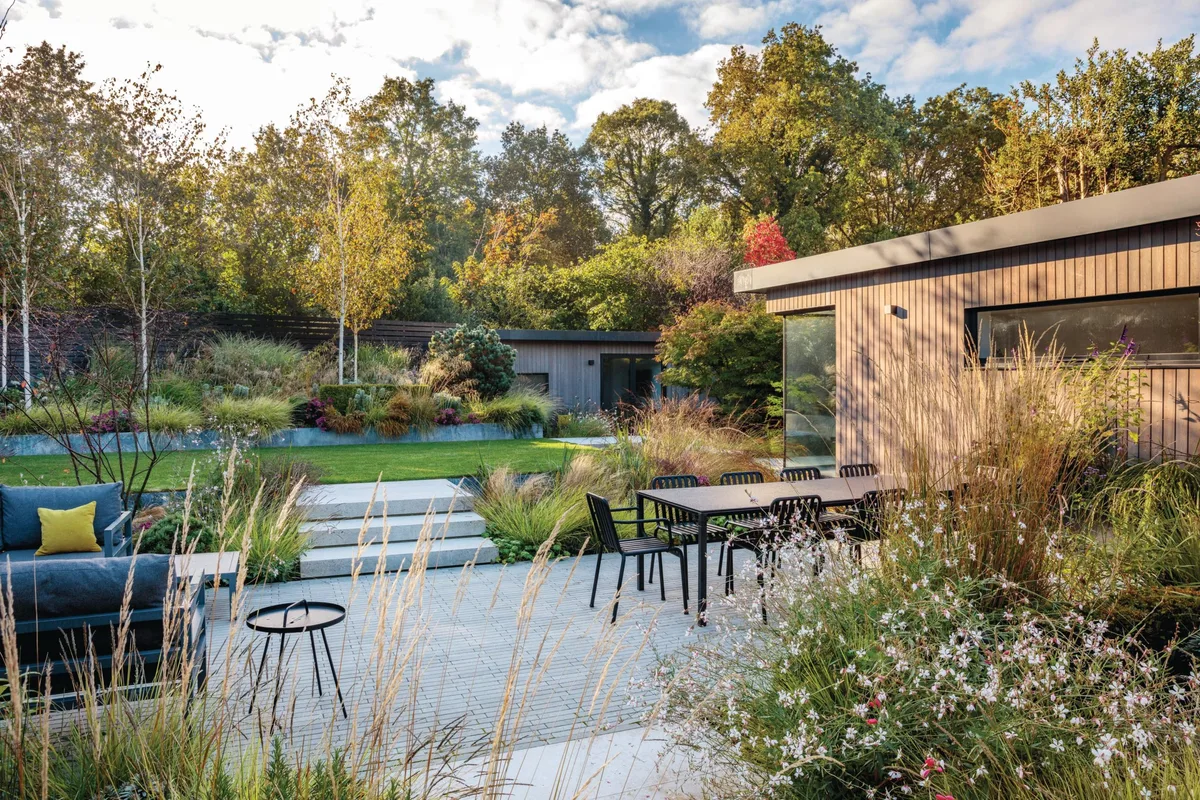
Behind a high beech hedge, where southwest London meets wild common land, garden designer Lucy Willcox has created a hidden sanctuary blending mid-century structure with contemporary naturalistic planting.
Lucy designed the 22m x 21m garden (which narrows to 9m) at the same time as her single-storey 1960s house was redesigned by Ruff Architects. The garden had to meet the needs of Lucy, who works from home, her husband and their two school-age children, plus their silver labrador Roxy (who is trained not to dig up the lawn or flowerbeds).
She wanted flexible spaces to entertain up to 12 people outdoors for long lunches and dinners, with smaller seating areas offering a quiet space where one or two people could sit and read a book or enjoy the views.
You may also like:
- The best gardens to visit in London
- Explore a wildlife-friendly meets urban London garden
- A small garden in London
Lucy was also keen for the garden to fit into the mid-century history and refurbishment of the house, while reflecting the wildness of a neighbouring common. She achieved this by using hard landscaping materials that give a nod to the 1960s radical architecture era, combined with modern planting.
In doing so, she was able to experiment with new materials and a planting style that she might not have been able to ‘trial’ in a client’s garden. “I wanted it to feel contemporary, but have a timeless quality,” she says. “The house sits well in the garden. It feels of its place.”
The planting also needed to create privacy for the bedrooms, as the new U-shaped footprint of the house means most rooms look out onto, and have access to, the garden. “I set about creating almost individual outdoor rooms, and considered how those ‘rooms’ would be viewed, used, and connect to the house and other areas of the garden, and the views beyond,” she says.
The bones could be quite Brutalistic, but I needed the planting to have that wildness. It’s the juxtaposition between the two that works well.
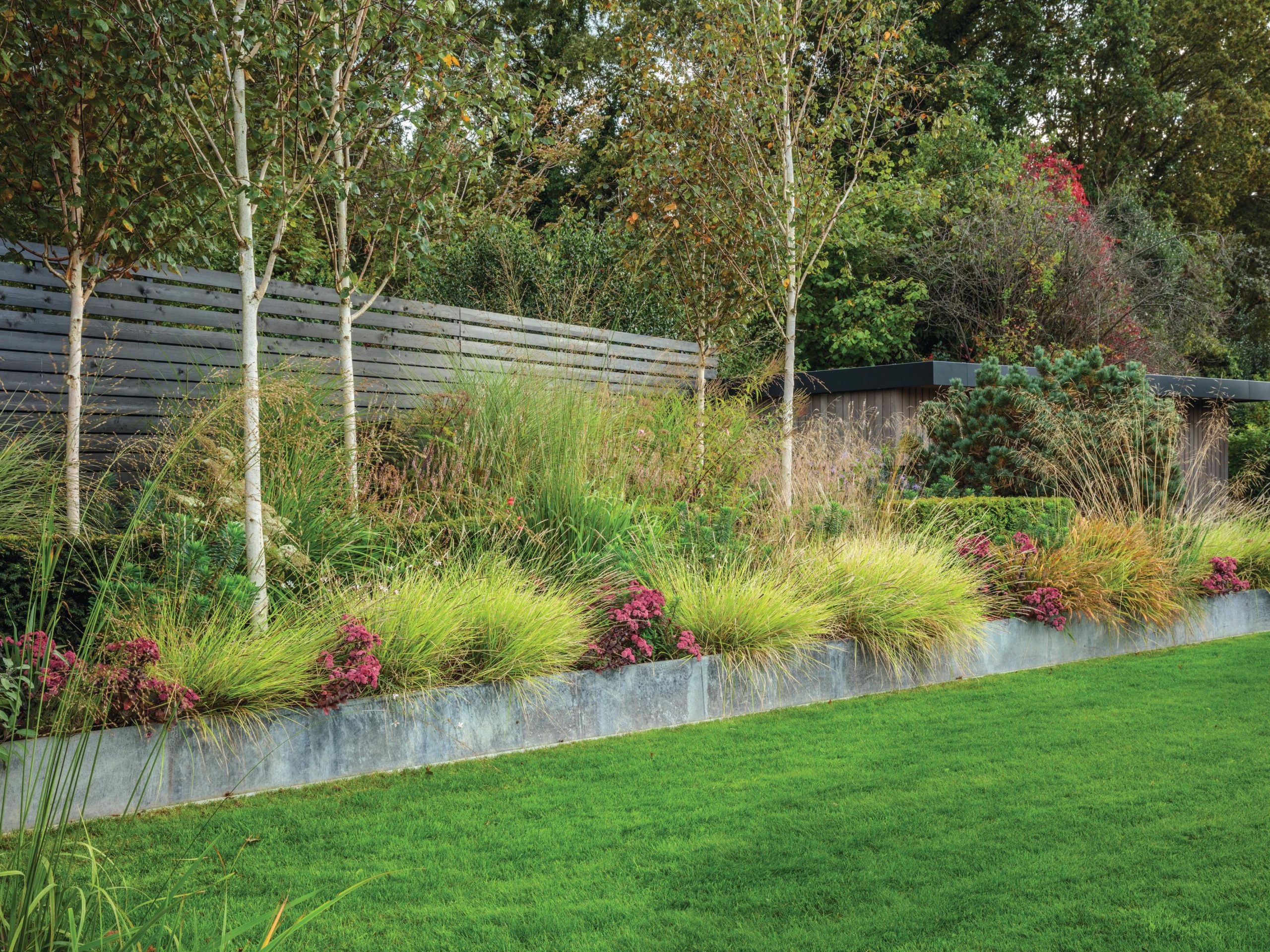
Originally, the garden was on two levels linked by a slope, but Lucy’s design has created three. On the mid level is an immaculate lawn, supported by sheets of galvanised steel. Sitting below this, near the house, is a generous terrace. At the rear there is a large west-facing seating area that catches the early evening sun in one corner, and a garden studio is tucked into the other.
Linking these is a raised herbaceous border where five pale-barked Betula utilis subsp. jacquemontii sit alongside clipped Buxus sempervirens (which Lucy moved from near the house), Taxus baccata and domes of Pinus mugo ‘Mops’, which is well suited to the sandy, slightly acidic soil, mixed with softer grasses and perennials.
Flowering interest starts with a successional bulb display, beginning with snowdrops and Iris ‘Pixie’, moving on to tulips, including Tulipa ‘White Triumphator’, daffodils Narcissus ‘Thalia’ and fragrant N. ‘Sir Winston Churchill’, then alliums including towering white ‘Mount Everest’ and ‘Purple Sensation’, gladioli and Fritillaria persica.
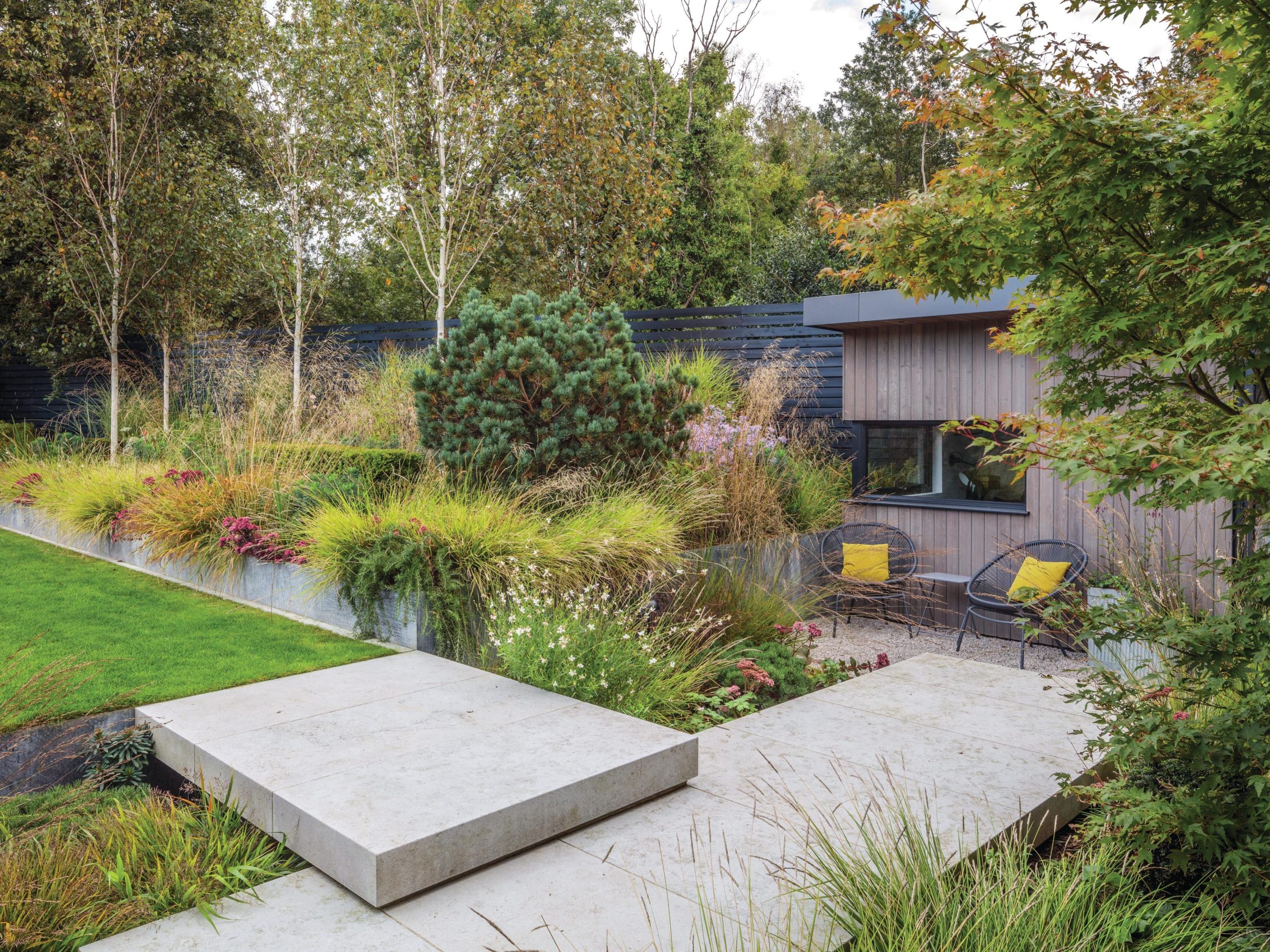
These are accompanied by the lime-green flowers of evergreen perennial Euphorbia characias ‘Humpty Dumpty’ and followed by the pale-primrose blooms of Rosa Kew Gardens (= ‘Ausfence’). By the end of summer, the evergreens have been swamped by billowing grasses, including frothy Deschampsia cespitosa, as well as double-flowered pink anemones, the bottle-brush plumes of Bistorta amplexicaulis ‘Rosea’ and umbels of Hylotelephium ‘Matrona’ and Hylotelephium telephium ‘Purple Emperor’, which suffered in this year’s heat. In contrast, Hakonechloa macra has done so well that Lucy plans to pull out clumps to prevent it from stifling other plants.
I wanted it to feel contemporary but have a timeless quality. It feels of its place.
Closer to the house there is a small wildlife pond and the planting includes the autumn moor grass Sesleria autumnalis, Molinia caerulea subsp. arundinacea ‘Transparent’ for screening, Oenothera lindheimeri – “so floaty and it flowers forever” – and Astrantia major subsp. involucrata ‘Shaggy’. There is also a white Rosa Kent(=‘Poulcov’) beside Salvia ‘Nachtvlinder’, which has been shown to help with blackspot because of its sulphurous qualities.
If it’s a nice day, I’ll be out here having a cup of tea or coffee – even in winter.
All combine to create the “contemporary wild” planting style Lucy loves. “I knew the bones could be quite Brutalistic, but I needed the planting to have that wildness,” she says. “It’s the juxtaposition between the two that works well.”

Every element in this garden has been carefully considered, right down to where the joins are in the steel. For Lucy, who retrained in garden design in 2006 (after an epiphany moment while training a clematis), the space is a magnificent calling card. It’s also a sanctuary for her to enjoy.
When taking a break from designing gardens for others, she loves nothing more than to pop out into her own garden. “If it’s a nice day, I’ll be out here having a cup of tea or coffee – even in winter,” she says.
Useful information
Find out more about Lucy Willcox’s work at lucywillcoxgardendesign.com