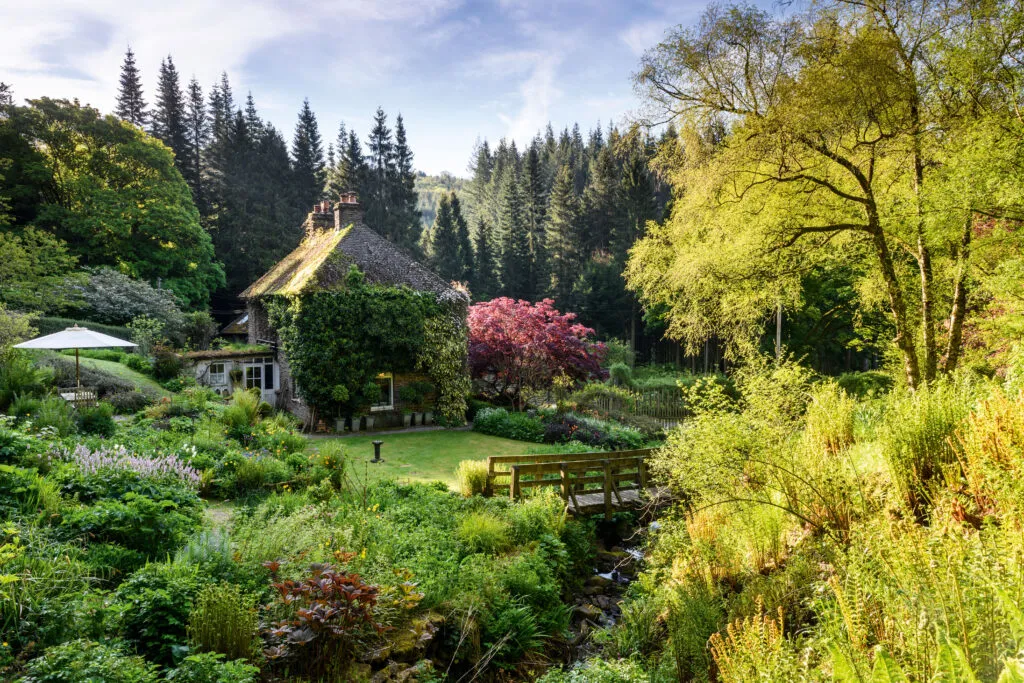
Hidden in the hills beyond Chepstow in southeast Wales, there is a little-known Arts and Crafts garden undergoing an amazing renaissance. Under the stewardship of Arne Maynard, and supported by its passionate owners, Mounton House is finally becoming the garden its creator, Henry Avray Tipping, could be proud of.
Mounton’s story began in the early 20th century, towards the end of the Arts and Crafts movement. Tipping and the Chepstow-based architect Eric Francis embarked on a grand project to design and build the property above a limestone gorge, which affords views of the Severn Estuary and the countryside beyond.
The 70-acre estate they created was the perfect home for Tipping, then the architectural editor of Country Life magazine, and allowed him a country retreat that was far enough from London to feel apart, but close enough for him to regularly go for work, and keep up with like-minded colleagues such as Edwin Lutyens, Gertrude Jekyll and William Robinson.

His dream was to create a country home that would be recognised as one of the most impressive in the land, and where he could host high-society guests and peers. But the First World War and the subsequent decline of grand country estates meant that Mounton House never fulfilled its potential.
The recent restoration of the house and five-acre garden, from 2016, has been sympathetic to the original design and Tipping’s planting ideas, with everything on the project being done in a meticulous, thoughtful way, and with real passion. The paths, walls, statues and structures have been repaired and replaced, using locally sourced materials where possible, and with specialist craftspeople carrying out the sensitive work.
Many trees and plants have survived the years since Tipping left Mounton, and been lovingly retained, including a stately Persian ironwood, beautiful magnolia trees and a Banksian rose. Arne has made great use of the historical records available, such as Country Life articles written by Tipping himself, to create a classical planting style using plants including tulips, roses, dahlias and asters in complementary shades of pink, white, purple and blue.

I came on board as head of gardens in 2023. On my interview day, arriving early, I ventured down to the village below the garden, and came across an idyllic scene with a full-flowered handkerchief tree. A stream alongside ran through what appeared to be a garden dotted with majestic conifers and mature ornamental trees. This, I found out later, is the original Tipping Water Gardens, which predate the house. It had such an effect on me that as I wandered through the meadow, in my finest shirt and tie, I decided this was where I’d like to create my next chapter.
My career to date seems to have built towards this place. I have worked everywhere from coastal gardens in Australia to Park of Monserrate in Sintra, Portugal, and Osborne House on the Isle of Wight to Folly Farm in Berkshire. All the experience I’ve gained since I did my diploma at Kew are being tested here at Mounton as we push the garden forward, with our core ethos of high standards, exquisite spaces and healthy plants.

The dominant features of Mounton House are softened by the plantings of both Henry Avray Tipping and Arne Maynard, to allow the garden and house to blend into the surrounding countryside. In spring, flowering cherries, lime-green Euphorbia amygdaloides var. robbiae and Wisteria floribunda bloom among the topiary, fine lawns, borders and Rock Garden.
I’m a practical gardener. I love leading new projects, of which we have many still ongoing, and getting involved in garden maintenance and management. On any given day, you might find me wading around among the waterlilies, planting a rare species from a specialist nursery or pottering around the glasshouse.
Being able to work with Arne on a multi-year design and construction project was an opportunity I couldn’t turn down, and I’ve been offered a lot of freedom to develop the gardens and, importantly, build a team who can take it to new heights.

The garden itself is a series of delightful ‘rooms’, each with a different feel and purpose, but blending seamlessly into one another with repeat plantings of daphnes, roses and Arne’s signature topiary. They include the Pergola Garden, with a free-standing wisteria pergola enclosing a tranquil, rectangular lily pool, and the Southern Terrace, which is full of irises and Mediterranean flora that like to bake in the summer heat.
Rosa ‘Constance Spry’ provides the perfect backdrop to the Pergola Garden’s lily pool with a water-spouting statue of a dolphin-carrying cherub at its centre. In early summer, the beds beneath the pergola’s stone pillars are dotted with Campanula takesimana ‘Elizabeth’ and Iris ensata ‘Rose Queen’.

In late summer, the Pergola Garden becomes a romantic and secluded space where one can enjoy the arching seedheads of Dierama pulcherrimum ‘Blackbird’, the impressive foliage of Rodgersia pinnata ‘Superba’ and the blooms of Rosa Scarborough Fair (= ‘Ausoran’) in the rose beds beyond.
The Bowling Lawn is painstakingly nurtured into a lush green carpet and enriched with a series of clipped yew and copper-beech forms. It provides the catwalk for the herbaceous border, full of roses, aconites, geraniums and phlox, repeated to lead the eye down its length. In early summer, delphiniums tower above them.
The Southern Terrace above features an original Magnolia grandiflora, clipped Enkianthus perulatus, Clematis ‘Black Prince’ and urns planted with Salvia Love and Wishes (= ‘Serendip6’).

The Rock Garden, into which more than 250 locally sourced puddingstone boulders were laid, has been embellished with candelabra primulas, Japanese maples and alpine jewels such as erodiums, saxifrages and cyclamen.
In autumn, the turning leaves of Acer palmatum ‘Dissectum’, Carpinus betulus ‘Pendula’ and Parrotia persica add spectacular fiery colour.

Arne has also added structure throughout the garden. Yew hedges have been retained, beech topiary and well-placed hedges added, and a wonderful pleached copper beech hedge brought in to frame three sides of the croquet lawn beside the Tea House – an intriguing building in the garden that has been fully restored.
The garden team is lucky enough to have a Garden Courtyard to work in with the potting shed of our dreams, a glasshouse and a cart shed – complete with an original pine tree popping up through its roof.
On the edges of the garden, further from the house, mature specimens of false acacia, wild cherry, pine, oak and maple have been retained, and a new Winter Garden is establishing. Beyond these main garden areas, the estate becomes a series of woods and cattle pastures as it dives down into the steep valley to the brook below. The woods, although affected by ash dieback, have been selectively thinned and made safe for access with meandering paths and steps throughout.
Tipping would, I believe, see all that has been done as a worthwhile and successful representation of his original plans. Now, as he would have wished, Mounton is a garden for the romantic, a place of peace. And the restoration of this Arts and Crafts gem has been, and will continue to be, a great adventure.
USEFUL INFORMATION
The garden opens for a limited number of group visits each summer. Follow Tim Stretton on Instagram @mountonhousegardens.
Words Tim Stretton
Photographs John Campbell