Pot one: Houseplant collection

It was the Garden Museum’s head gardener Matt Collins who uncovered this tiled sink from within the brambles of Benton End’s front garden; its glazed tiles still brilliant after years buried in the Suffolk soil. It took the strength of five builders to heave it back up the front steps into the house.
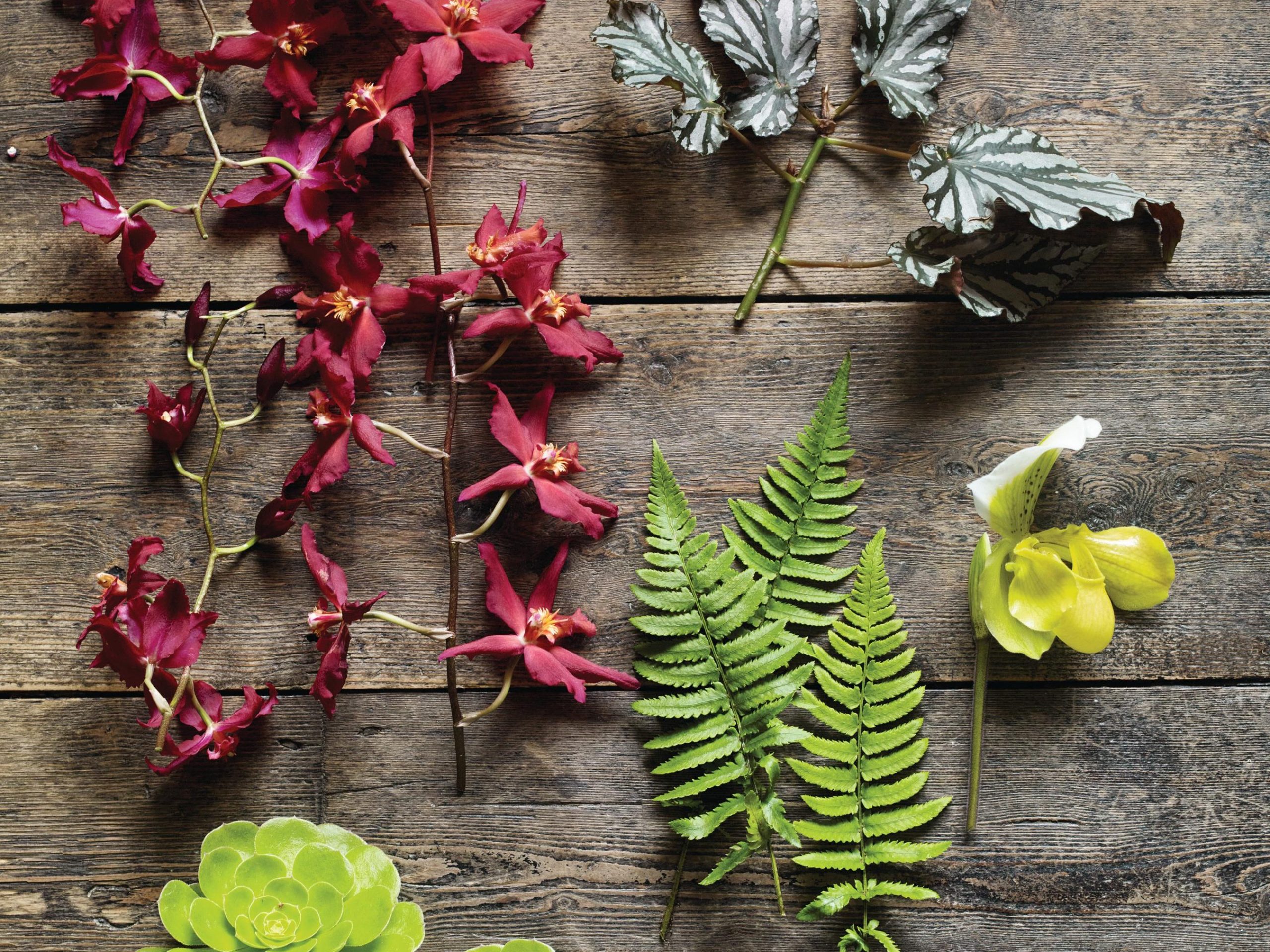
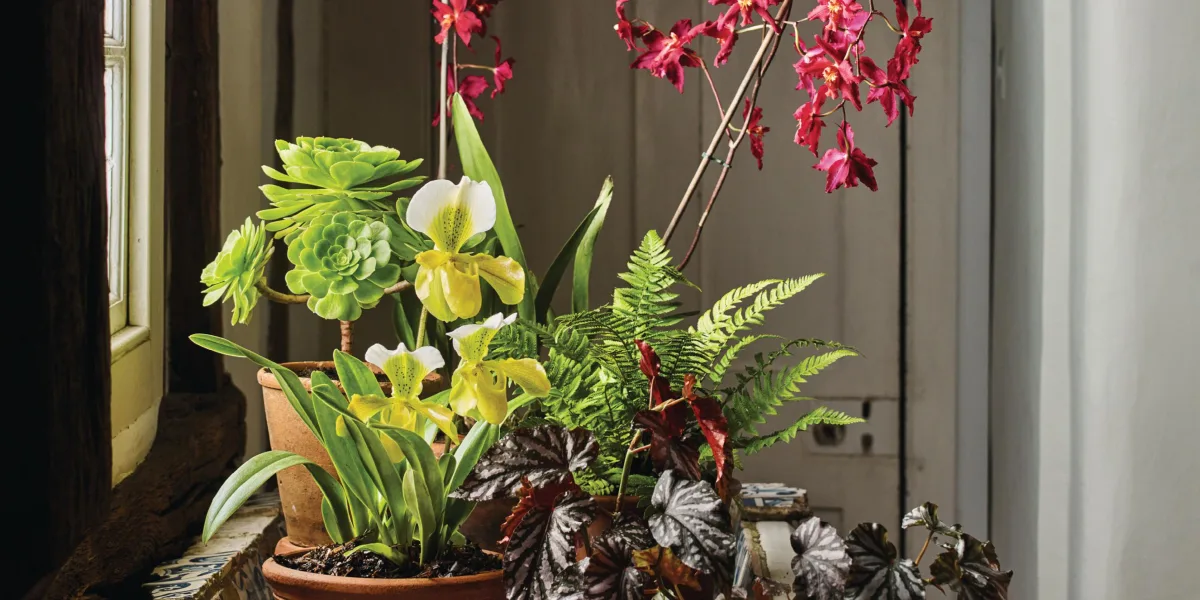
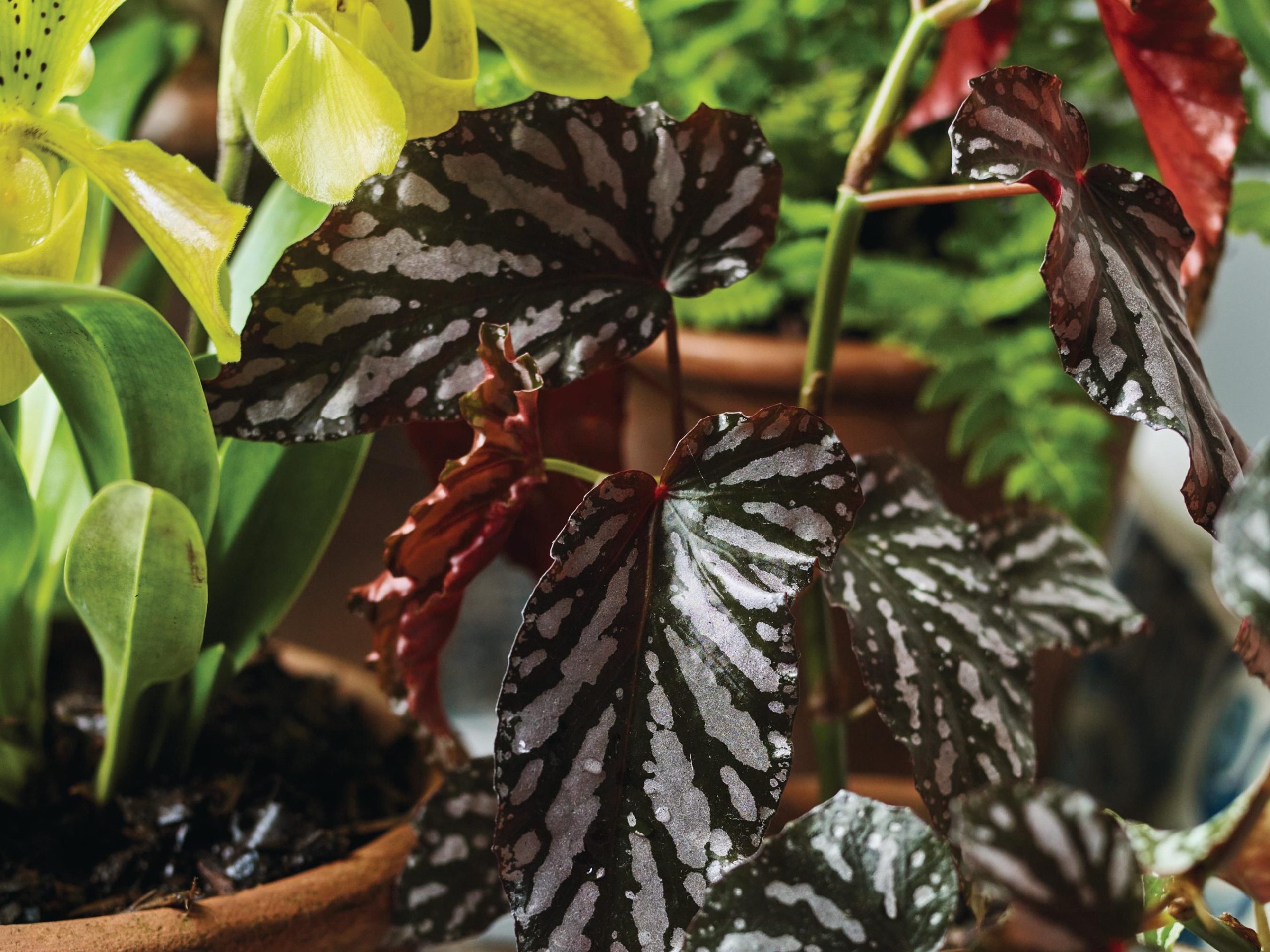
For this arrangement, I’ve used several medium-sized terracotta pots that sit comfortably next to the decorative tiles. The two orchids are both botanically compelling, and I’ve placed them along with other plants that possess a strong form. The marbled foliage of the red-leaved cane begonia in particular has a wonderful dialogue with the pattern on the tiles.
Plants used

1 Oncidium ‘Queen of Hearts’ A fuchsia-rose orchid hybrid registered in 1984. Height and spread: 70cm x 30cm. RHS H1A, USDA 9a-12†.
2 Aeonium ‘Blushing Beauty’ Perfectly formed rosettes on a bushy compact stem. 40cm x 30cm. AGM*. RHS H1C, USDA 10a-12.
3 Begonia ‘Down Home’ Easy-to-grow cane begonia with red leaves and stems. 50cm x 50cm. RHS H1B, USDA 10a-11.
4 Polystichum tsussimense Evergreen fern with bright-green fronds. Lots of texture. 50cm x 50cm. AGM. RHS H6, USDA 6a-9b.
5 Paphiopedilum insigne Orchid with wonderful, proportionally oversized flowers of an extraordinary plasticity. 60cm. AGM. RHS H1A, USDA 9a-12.
*Holds an Award of Garden Merit from the Royal Horticultural Society. †Hardiness ratings given where available.
Cultivation and care
Successfully flowering orchids year after year can be tricky. You need to grow them in bark, imitating their epiphytic nature, ideally in high humidity. Once flowering is over, you also need to move them somewhere that night temperatures will be around 12C, to induce them to form a flower spike for the following year.
Placing this arrangement in good light but not hot sunlight is best. The aeonium, fern and begonia are all potted in a loam-based potting mix with added leaf mould. Watering once a week is ample. Cuttings of the begonia are easily made by putting a stem cutting, about 5cm long, into a pot filled with a free-draining potting mix, and placing it inside a sealed food bag in a warm place for around ten weeks.
Pot two: drought tolerant container for all seasons

My first two summers at Benton End have given me a potentially misleading idea of its climate, with unusually high rainfall in East Anglia – a region of the UK that is commonly the driest of all.
In future we expect drought in spring and summer, and when this is coupled with the garden’s sandy loam soil that drains well, we will need to grow plants that like it lean. In this arrangement, which you can start off outside, shape has been key to composing a boxful of drought-tolerant plants.

Even though these metal containers have an aged patina, which I like, their simplicity of shape gives them a clean and stark quality. To create greater depth, I’ve placed the two boxes perpendicular to one another and continued the graphic aesthetic with the choice of plants, including a needle spiked yucca and a young agave, which brings an important touch of dark green to the other shades of apple green.
These plants have been grown from seed and will get much larger as they mature, but it’s fun to be playful with them while they’re small. I’ve softened the edges with a small fragrant-leaved pelargonium, which tumbles over a corner of one of the boxes, as well as the grey-leaved Mediterranean coastal plant Jacobaea maritima. The tubular, bright-scarlet flowers of the pineapple sage Salvia elegans ‘Sonoran Red’ strike through a tapestry of greens.
Plants

1 Salvia elegans ‘Sonoran Red’ A salvia that may flower too late for many but great for milder areas. 90cm x 60cm. RHS H2, USDA 9a-10b.
2 Agave montana Can be hardy if given sharp drainage in winter. 1m x 1m. RHS H4, USDA 8a-11.
3 Pelargonium x fragrans Tiny shrubby pelargonium with foliage that smells like Old Spice. 30cm x 40cm. RHS H1C, USDA 10a-11.
4 Aeonium spathulatum A branching, evergreen succulent with rosettes that flush red in bright light. 40cm x 20cm. RHS H1C, USDA 9a-12.
5 Aeonium haworthii A green-leaved compact aeonium species from the Canary Islands. 20cm x 30cm. RHS H1C, USDA 9b-12.
6 Jacobaea maritima Hardy evergreen foliage plant for full sun and dry areas. 30cm x 50cm. RHS H4, USDA 7a-10b.
7 Yucca angustissima A yucca I’ve grown from seed acquired from the Colorado-based seed seller Alplains. 1m x 1m. RHS H5, USDA 5a-10b.
Cultivation and care
All these plants require sharp drainage and will be damaged by prolonged water-logging, so they need drainage holes and a soil mix made up of loam-based compost, sharp sand, 2-8mm grit or a similar waste aggregate.
For both aesthetic and cultivation reasons, topping the container with 20mm of grit or waste aggregate will keep the collars of the plants dry and also help to prevent any weed seeds germinating. If the weather does quickly get colder, as it can at this time of year, these shoe box-sized containers can easily be moved inside and enjoyed for longer.
Pot 3: Bringing the outside in

The making of this fireplace arrangement was inspired by Cedric Morris’s 1959 painting Winter Flowers. His still-life paintings offer key clues as to what he grew in Benton End’s garden, and it feels exciting to create a planting combination that has a direct link to one of his paintings. Many of these plants were no longer present when I started the renewal project. In fact, they were long gone, thanks to Cedric appointing a plant executor, but now, many of them are on their way back.
This willow basket, which I made several years ago, has an elegant shape that lends itself to being filled with flowers. Its colour is perfectly autumnal, and its texture feels distinctly comforting. To use it as a container I’ve had to line it with an old compost bag, turned inside out, to protect the willow and prevent water and soil seeping out.
The inky blue of the salvia works well with the apricot yellow and dark crimson of the abutilon. Also key is the pewter-coloured foliage of the fuchsia, which acts like a base filler in the arrangement. It has a horizontal growth habit that is useful in extenuating the reflexed lip of the basket.
Plants

1 Fuchsia microphylla subsp. hemsleyana ‘Silver Lining’ A 2004 plant discovery by Crûg Farm Plants. 60cm x 1m. RHS H3.
2 Chrysanthemum E.H. Wilson Ivory daisy flowers, daintier than typical chrysanths. 90cm x 60cm. RHS H5, USDA 5a-9b.
3 Oryzopsis miliacea Whorled flower stems retain presence all winter. 1m x 70cm. RHS H5.
4 Abutilon ‘Kentish Belle’ Shrub that can be tender in frost-prone areas. 2m x 1.5m. AGM. RHS H3, USDA 8a-12.
5 Salvia guaranitica ‘Amino’ Hardier than many other late-season salvias. 1.2m x 90cm. RHS H3, USDA 8a-10b.
Cultivation and care

Plants in interiors will always be happier in an unheated spot. The dry atmosphere of our heated homes is not what they’re used to, so it’s likely that this arrangement is going to be a short-term installation. Keeping the soil moist is important, and misting the plants with water would also prolong their freshness. Because I’ve lined the basket with a compost bag, and not cut holes in it to avoid any seepage, water will gather at the bottom of the bag, so water will be available to the plants for longer.
Alternatively, this combination of plants would work superbly for an outdoor container; especially good for urban settings, where pocket microclimates might promote the abutilon to keep flowering through winter.
Suppliers
- Dibleys Houseplants Tel 01978 790677, dibleys-shop.com
- Dyson’s Nurseries Tel 07887 997663, dysonsalvias.com
- Great Dixter Nursery Tel 01797 254044, shop.greatdixter.co.uk
- McBean’s Orchids Tel 01273 400228, mcbeansorchids.com
- Plantbase Tel 01892 785599, plantbase.co.uk
- Studio Amos Tel 07947 919891, studioamos.co.uk