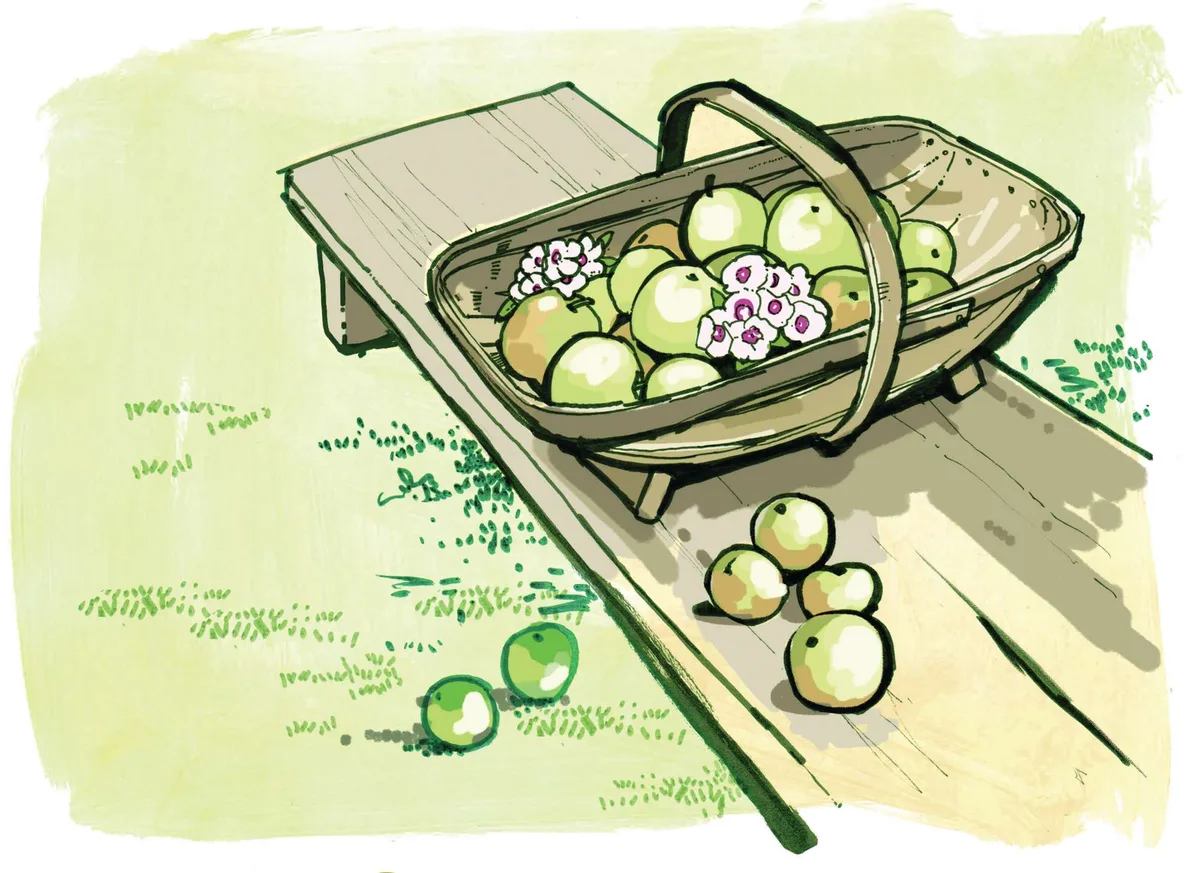
Towards the end of the summer holidays, the apple tree at the bottom of the garden would start to drop its fruit. Each small apple, pink-blushed and tubby as a dumpling, would fall into the flower bed beneath the tree’s canopy. A flower bed full of cerise and lilac phlox. I had little idea of the variety of the apple in those days, but I never forgot their perfume as I bent down to collect the fallen fruit among the powdery-scented phlox.
Many years later, I spotted the same apples in wooden crates in a traditional, local greengrocer. It was like spotting a much-loved toy from my childhood. Labelled ‘Discovery’, I recognised them instantly as the same as those in my childhood garden, and, biting into them, their snow white and pink flesh with
its subtle strawberry notes brought back memories as clear as a bell.
When I planned my own garden, I wanted to recreate that scene, the memory of pale-pink apples among phlox. A small ‘Discovery’ apple was one of the very first trees I planted. Despite several attempts, the phlox I planted refused to thrive underneath the tree’s shade, so I planted it elsewhere in the garden. They are close, but not quite close enough. I have just picked the first of the season’s apples and laid them nostalgically in my wooden trug with two sprays of pale-pink phlox. One sniff, and I am eight years old again.
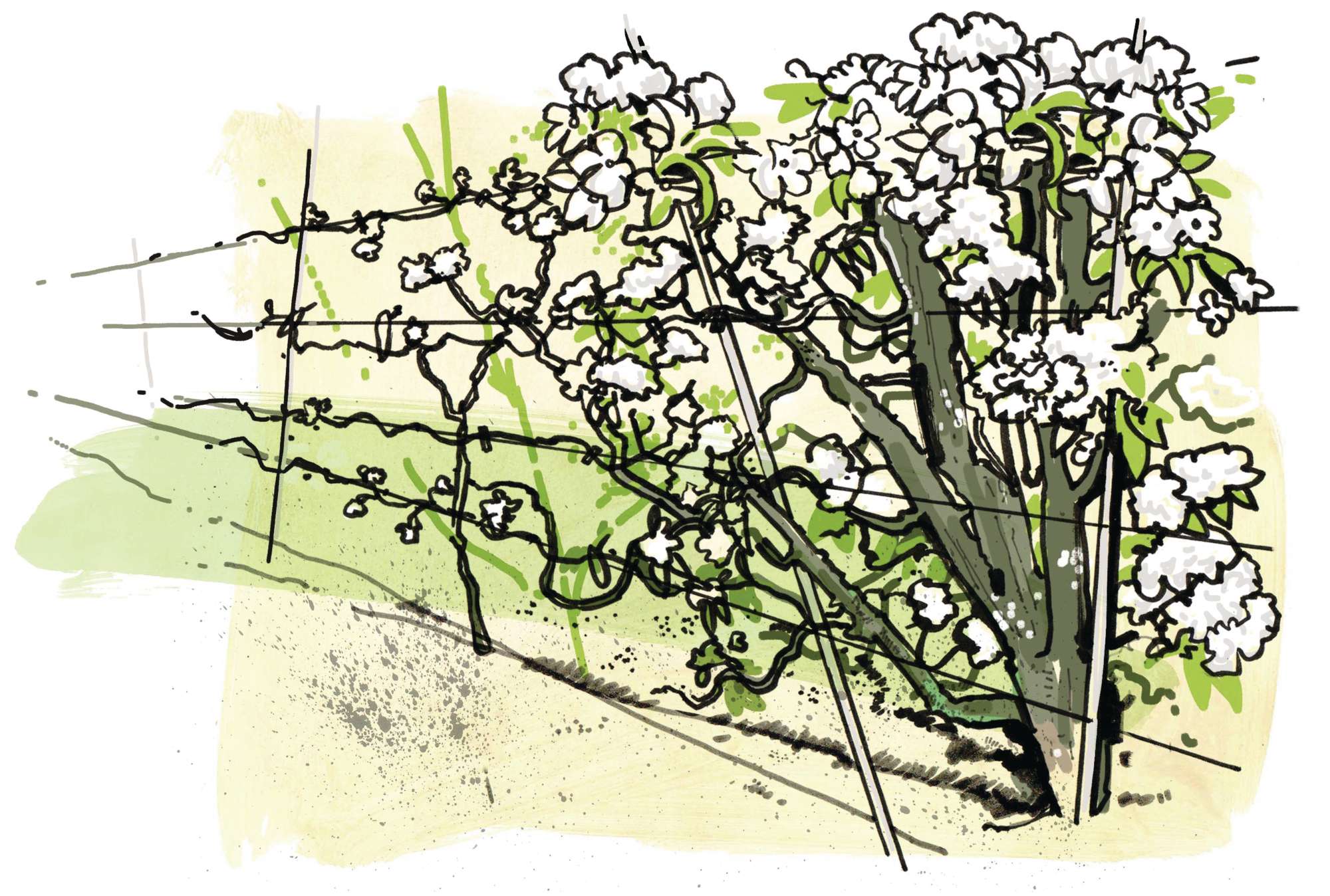
The reason for the existence of my pear tree, now 25 years old, its branches espaliered against a south-facing wall, was not so much one of nostalgia, but more that I had run out of space to plant standalone trees. The vacant wall outside the kitchen door felt like the most appropriate place and my ‘Doyenné du Comice’ has indeed thrived. It has good years and not so good ones, but its blossom is always welcome.
My original handwritten apple and pear list included an ‘Ashmead’s Kernel’, an old French ‘Orleans Reinette’ and the cute dwarf pear ‘Winter Nelis’. The former varieties became too big for a small garden, casting shade on everything else and their roots disturbing the paths, and so had to go. The pear was
initially included because I was told I needed a second pear to fertilise the prolific espaliered ‘Doyenné du Comice’. The ‘Winter Nelis’, always a fragile addition to the garden, gave up the ghost one winter, but the Comice soldiers on regardless.
You may also like
I had long dreamed of an orchard and had gone so far as to research apple trees that would be compatible with one another, whose fruit would follow each other through the season from August to November. I planted a small cluster with scant knowledge, and without regard to how much sun they would need to ripen the fruit or with enough space to grow a decent canopy. The blossom was magical, from white to softest pink and plentiful, but none that led to fruit for several years. Not that it mattered. The trees were handsome enough, and in those days, I was a more patient gardener.
Each winter I would prune them to leave enough space in the centre ‘for a pigeon to fly through’, or, at any rate, a blackbird or two. I fed them for a while and each winter, around 6 January, I would toast the trees with a glass of hot cider. I’m not sure it did much to ensure a good harvest but the event was fun on a grey winter’s day. I did draw the line at wassailing at the top of my voice though. There is only so much pain you can inflict on your neighbours.
Last year both the apple and pear drew a bumper crop, which I thinned out to produce chubbier fruit. I watched their progress, eagle-eyed, pressing them gently every day to gauge their passage towards ripeness. The fruit grew plump and beautiful, but on the morning of harvest day, I woke to find every single one had vanished. Fox, squirrel or a trespasser, I will never know, but the culprit did a very efficient job of it, without so much as a stalk or pip left behind.
I am now officially past tree-climbing age, but I do rather miss not having a huge ‘Bramley’s Seedling’ to climb
This year’s fruit is misshapen and knobbly, which may be due to lack of water during the especially hot summer, or perhaps a virus. Either way, the espalier is still a thing of beauty, whose whippy branches I wind around their supports each year, and whose snowstorm of white blossom I have duly photographed. The delights don’t even stop there, with leaves that turn to rust and gold in the autumn. The architecture of the trees in winter is quietly beautiful against a grey sky, especially when their roots are surrounded by bunches of snowdrops and golden crocuses.
You may also like
The apple and pear trees that have endured are both on the small side, with easily reachable fruit. Their size is perfect for a small garden. The espaliered pear has stopped at two metres in length and the ‘Discovery’ apple has never grown more than head height. I miss the other varieties, their ancient names and crisp, sweet flesh, but I think one of each is enough for a garden of this size, especially as I am now officially past tree-climbing age.
I do rather miss not having a huge ‘Bramley’s Seedling’ to climb. We had a beauty in the garden in which I grew up, planted in a hole cut in the lawn, a popular look at the time. It had proper climbing branches, strong enough to take both me and my father each autumn when we would pick the huge fruits to store over winter.
The sheer economy of picking a fruit the size of a pudding bowl, filling it with sweet mincemeat or simply butter and sugar and baking it in the Aga is the most basic and brilliant of puddings. The flesh of the Bramley (and other ‘cookers’, such as ‘Peasgood’s Nonsuch’) fluffs up like a cloud, softer and more soufflé-like than any of the smaller apples, though all except ‘Discovery’ and the russet family are probably worth baking. Honestly, is there a better autumn pudding to come in to after sweeping up the leaves?