Apparently, three-quarters of UK adults say they’re not gardeners, despite readily admitting to ‘doing the garden’. You don’t need an RHS qualification to be a gardener, but sometimes we all feel we’re not doing it ‘right’.
When expert gardeners and designers create a garden, they make sure to stick to a handful of golden rules. You don’t need special tools, years of experience or fancy science for success if you make these your guide, and they will work for gardens of all shapes and sizes.
Golden rule #1: Right plant, right place
We’ve all done it. A trip round the garden centre, visiting a friend or a jaunt to a stately home and before you know it, you’ve fallen in love. It’s big, its blousy, it has a fragrance to die for and foliage that lasts for months. And it’s totally wrong for your garden. But you buy it regardless, and then watch as it struggles and wilts, never to achieve the glory of your first encounter.
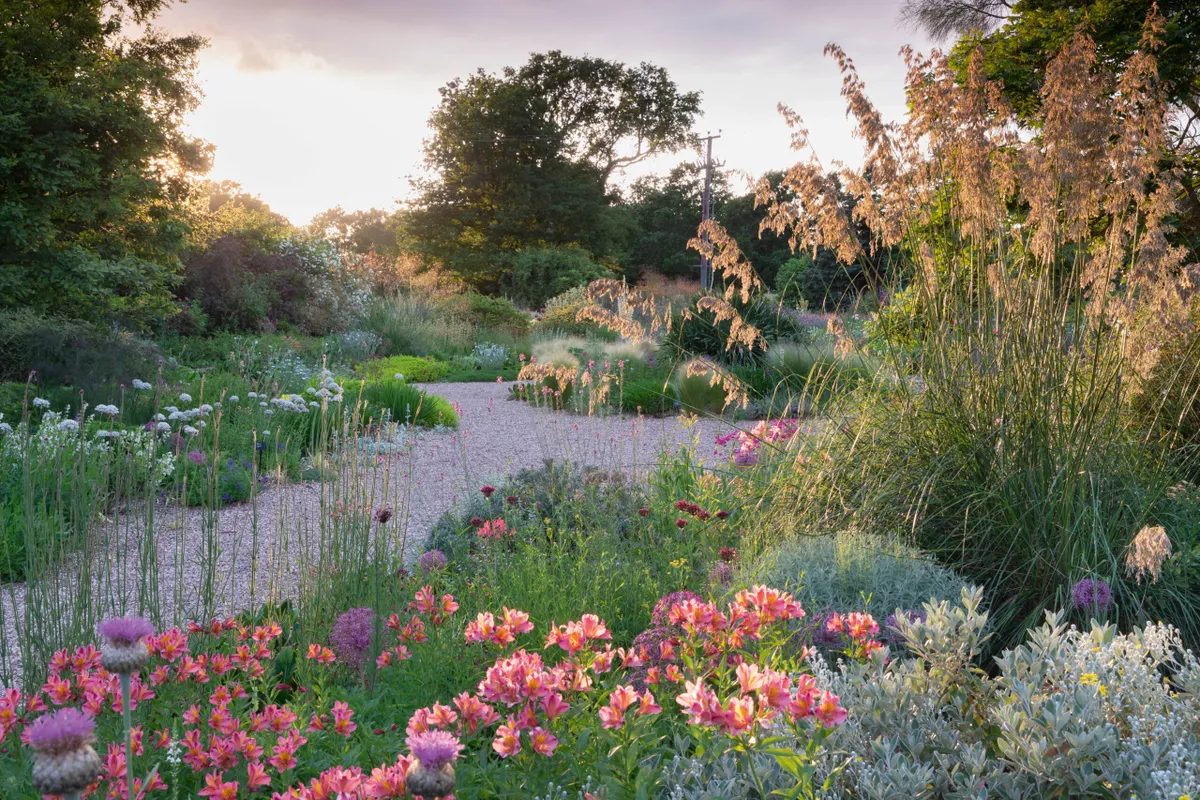
Right plant, right place was a mantra popularised by the late, legendary plantswoman Beth Chatto, who famously created a gravel garden on the site of a car park at her nursery in Essex. With her husband, Andrew, she devoted considerable time to understanding where plants came from, how they thrived in their natural habitat and whether or not they could cope with different conditions.

If you are trying to grow a fern in full sun on free-draining soil; or a Mediterranean plant like lavender on moist clay, it’s not likely to work out for you. The key to all of this is to understand where a plant is originally from. If you can offer it the conditions it naturally likes to grow in, you’re on to a winner.
Golden rule #2: Start with your soil
Your soil is both literally and figuratively the foundation of your garden. Understanding soil type and how to work with it is the pro gardener’s secret weapon. But if pH testing kits and soil moisture meters take you shuddering back to school, you’ll be relieved to know that understanding your soil isn’t complicated.
You may also like
- 7 garden design rules you can break and one you totally can't
- 6 secret tricks of garden designers to make your garden look great
Boiled down to essentials, soil is usually along a spectrum of two types: clay or sandy. How can you tell what you have? Simple – give it a squeeze. If it clumps together and holds its shape, you have clay soil. If it crumbles, it’s loamy or sandy.

Credit: Getty Images/Henry Arden
Sandy soil is free draining. Drought-tolerant plants will do well for you but you’ll need to think about regular watering for thirstier specimens. Clay retains moisture so you don’t have to wield your hose as much, but it is prone to flooding in heavy rain and can set like concrete in hot weather.
There are other things to consider with soil, from nutrient level to where it sits on a scale of acid to alkaline, but if you know your soil type, it’s a really great start, as it means you can adapt how and what you plant to your plot – a recipe for success.
You may also like
Without serious landscaping and financial investment, you can’t completely change clay to sandy and vice versa, but you can help the soil you have be the best it can be.
You don’t even have to break your back or your bank balance. Charles Dowding, no-dig gardening expert and prolific vegetable and flower grower, advocates for leaving your spade alone and covering the soil with a thick layer of mulch. The worms do the digging for you.

Dowding insists this method isn’t just kinder on the gardener, it preserves essential soil biology meaning plants access more nutrients and enjoy a better soil structure to help them thrive. Shop-bought mulches, well-rotted manure and home-made compost or leaf mould will help when it comes to improving your soil.
But if you want an easy life, and a happy garden, go back to rule #1 and stick to plants that suit your conditions, and therefore need less care, attention, water, feed and, therefore, work.
Golden rule #3: Observe, observe, observe
Now you know what soil you have, you may be ready and raring to go down to the garden centre and start choosing plants - but hold your horses. First, it’s a good idea to sit back and observe your garden. A lot.
See where the sun shines, from morning to evening, and through the year. What trees will cast deep shade when they’re in full leaf? Does that bare patch of soil hide a multitude of spring bulbs and established perennials? There’s nothing worse than diving in, all guns blazing, to plant a new shrub and realising you’ve inadvertently dug up a lovely patch of naturalised snowdrops or put a pricey and sun-loving plant in the thick summer shade.

The wait-and-see approach might be frustrating, but you’ll be glad of looking before you leap, particularly when it comes to structures or focal points. You may think your garden path would look very chic running down one side, but if you wait a couple of months your footprints may have traced an entirely different route to the shed. Understanding how you view and use your space as the seasons change can make a real difference to your overall design.
Even after you have laid out the garden the way you want, it’s best to keep observing all the time, as TV gardener Frances Tophill told us. “Watch your plants and observe them,” she advises. “See how they change, ask why they might have changed. Has the light changed or the moisture level? Like our friends, when we listen to our plants and read their body language, we can begin to understand them.”

Credit: Andrew Maybury
Golden rule #4: Plan for year-round interest
It’s easy to forget when the garden is in full spring or summer flush that the bare days of winter are just around the corner. Since no-one wants to stare at mud for four or five months, it’s important to think what you can plant for interest and colour all year round.
Even the smallest garden can include a shrub or small tree with colourful foliage for autumn, such as Amelanchier – which also has beautiful flowers in spring. A crab apple such as Malus ‘Evereste’ will offer blossom in spring, autumn colour and bright fruits into winter too.
Dutch garden designer Piet Oudolf is known for his naturalistic style, planting with large clumps of low-maintenance perennials, and leaving everything up in the garden over winter instead of chopping them down in autumn. This means you can enjoy buff grasses and copper-tinted seedheads through the colder months, especially when dusted with frost.

Credit: Jason Ingram
Even in deepest winter gardeners can enjoy scent, structure and blooms. Shrubs including Choisya, Daphne and Sarcococca confusa positioned by the door bring a welcome dose of floral loveliness.
Bulbs and hardy perennials are often a go-to for early spring colour, from snowdrops, cyclamen and hellebores to winter aconites and Iris reticulata, as well as sweet violets, before the daffodils and crocuses shows their faces.
It’s certainly a challenge to find many plants as extravagantly in flower in the winter months as their summer counterparts, but you can still find points of interest in foliage, structural seed heads, evergreens, grasses and more.