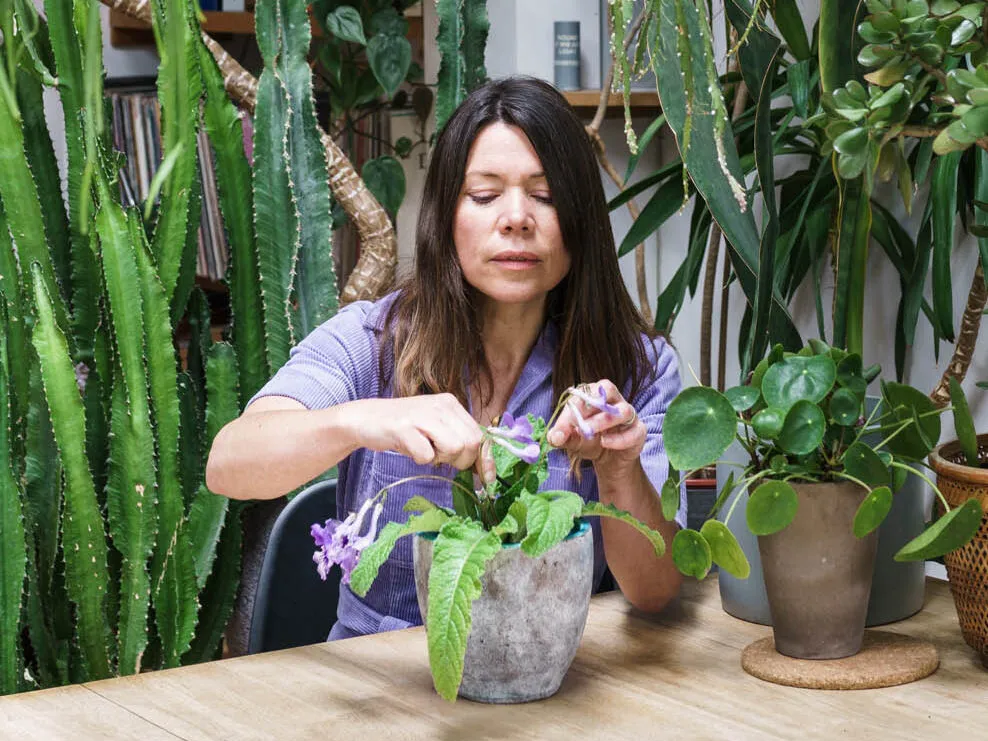
It’s a rare thing to meet someone with true panache, but it’s the quality I see immediately when I meet Francine Raymond on a cool autumn day. The acclaimed gardener, fowl fancier, designer and writer welcomes me into her newly built eco-home, which sings with a harmonious yellow hue. “I like the way it makes me feel,” she says. “I’m a nester; someone who sets great store by my surroundings, almost as a means of artistic expression.”
A pioneer in living, growing and eating well – from foraging to fruit trees, animal husbandry to farmers’ markets – Francine’s intuition for what’s coming is her talent and secret power. It’s one that’s still going strong as she evolves into later life.
You may also like:
- Explore the contemporary Cumbrian garden designed by Julie Toll and Ian Kitson
- Elizabeth and Ross Murray have breathed fresh life into Llanover Garden in southeast Wales
- This is how you make a modern cottage garden
- An Airbnb with its own natural swimming pond
In 2024, she divided the back garden of her Arts and Crafts bungalow in Kent in two, and downsized into a self-designed, beautifully built home. Its beneath a 120-year-old oak tree surrounded by the orchard she herself planted, of apple, persimmon, damson and the most “extraordinarily prolific greengage”.
Crafted entirely out of wood by her sons, Jacques and Max, there’s no cement, no concrete, no plaster, but there is triple glazing with perfectly framed views, a carefully planned rainwater distribution system and a contemporary compost loo. “I wanted just one room for living and one for sleeping.”
In each period of her life, Francine has recorded her “high spots and low moments” through her home, garden and animal-care books, newspaper columns, magazine features and latterly a video, podcast and article series: How My Garden Grows.
Born in India and schooled in Belgium, Francine ignored her career teacher’s advice to become a bilingual secretary, instead graduating with a degree in fashion and textiles. “It was a time to be young and I was arty and rebellious,” she says.
In 1969, she headed to Milan, “working as a fashion illustrator in the publicity department for a very posh shop” and meeting her late French-Canadian husband, Jean-François Raymond. “It was an exciting time, working in the city and weekending on Lake Como.”
They returned to London in 1974 to the power cuts and candle-lit nights of the three-day week. “We left the capital in 1986 for Church Cottage in Troston, our weekend house that we loved so much we had to live there,” she says. “Moving to Suffolk with kids at school, I embraced country life.”
I’m a nester; someone who sets great store by my surroundings, almost as a means of artistic expression.
To kick-start a new career, she took the role as buyer at The Leaping Hare, a stately home owned by the American-born Carla Carlisle with a vineyard, café and country store. Inspired by her experiences there, Francine started her own enterprise five years later.
The Kitchen Garden included a shop in the “little piggery” with a William Morris edict to only sell products that were ‘useful or believed to beautiful’. She also opened the artful garden she had designed, complete with vegetable plots, fruiting orchard and, good-laying Buff Orpington chickens with their beach hut-style coop.
It was a celebration of a productive life that epitomised the zeitgeist of the day, and people came in their droves to see it. “I never quite know where I get the confidence to do these things,” she says. “I think I’m an introvert with show-off tendencies.”
Documenting this country lifestyle became a passion and a means. “I wrote a book called Keeping a Few Hens in Your Garden. Country Living came and did an article and put a little note at the bottom of
the piece, saying: ‘If you would like Francine’s book, send a cheque for £4.95 in the post’. We sold about 500 copies, and then, eventually, in the end, 50,000.”
Thirteen books followed on bees, ducks, geese and pigs. How-to courses came next, as well as the annual Hen Party hosting amateur breeders and enthusiasts. Her tag ‘Chicken Woman’ became indelible, with her regularly appearing on TV and radio, and writing for The Sunday Telegraph and other publications. “Looking back now, I was rather pigeon-holed in a role,” she says.
The ominous fear of avian flu in 2006 resulted in the launch of the Henkeepers’ Association, a network for small-scale poultry owners, offering support with health and management; lobbying on their behalf for the protection of small garden flocks; and campaigning for improved welfare conditions within the poultry industry. Her single-mindedness found her at the heart of House of Commons meetings and receiving letters from the then Prince of Wales in support.
Flying the Coop, her last self-published book, charts the move from Suffolk to Whitstable in Kent to join her son Jacques and his family “before age and decrepitude turned life into a burden rather than a joy”.
An Arts and Crafts villa became a new base camp for a bountiful and fowl-friendly garden, albeit on a simpler and smaller scale. It also acted as the community hub for the Joy Lane Open Gardens, a glorious and eclectic collection of gardens, minutes from the sea, that last year raised £5,000 for the National Garden Scheme.
“I do love gardens that portray somebody’s personality and have an atmosphere. I like the look of things that have a bit of a patina, a bit of age.”
And that’s what How My Garden Grows, hosted online at The Modern House, is all about. “I have visited hundreds of gardens, some for work and others for pleasure, but what excites me most about gardens is the stories they tell,” she says. “I want to explore real gardens going through the seasons; gardens that have been grown with passion and patience.”
Francine’s optimistic observations and wit, her stylist’s eye and her deep sense of community activism continue to delight and inform. As author Raffaella Barker once wrote: ‘She has a peculiar gift for turning everyday activities of living into art.’
Useful information
Find out more about Francine’s How My Garden Grows series at themodernhouse.com
Words: Rhoda Parry
Portrait: John Campbell