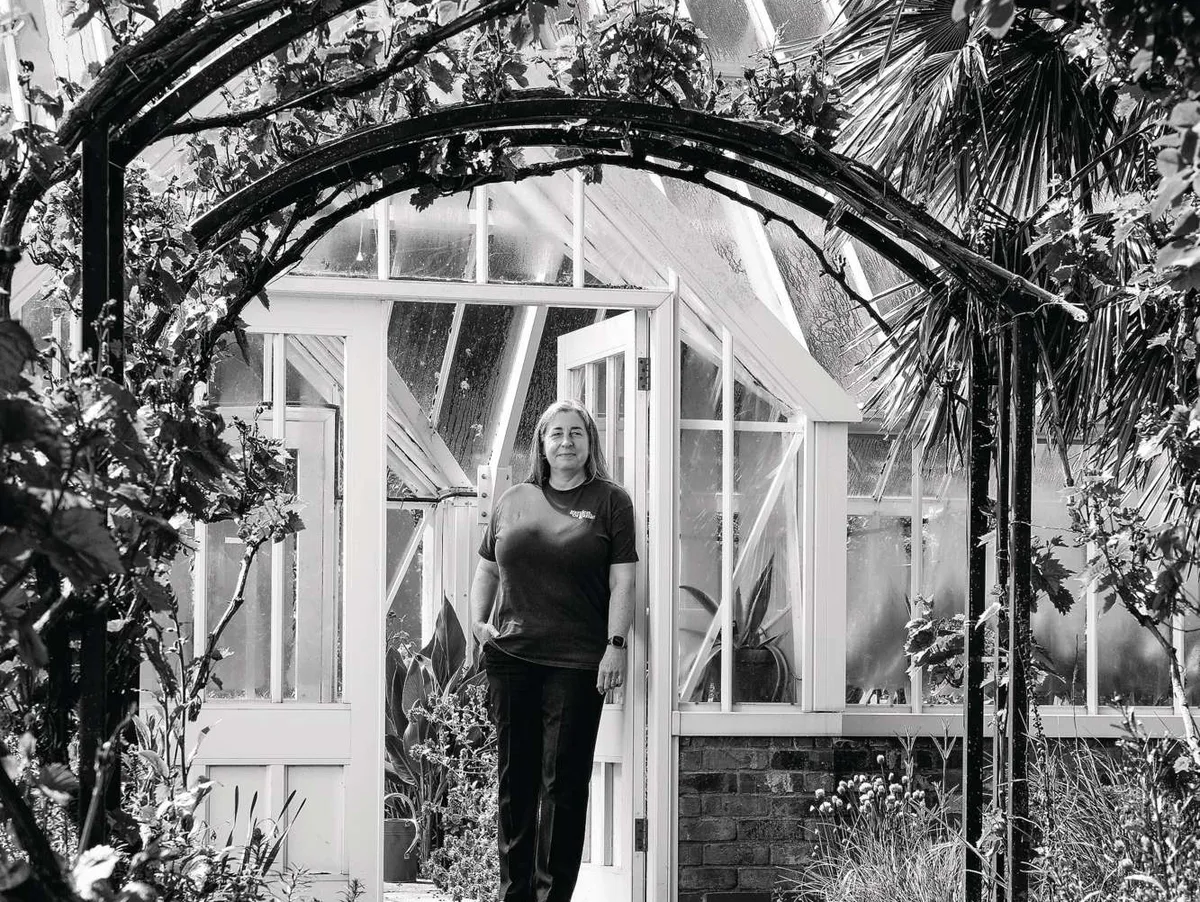
As a kid, I did one of those school job questionnaires and I got lumberjack, which baffled me at the time,” says Catrina Fenton, head of Garden Organic’s Heritage Seed Library (HSL), based near Coventry. “I don’t think I even knew where seed came from as a kid. I certainly never pictured this job. But it’s such a privilege to be responsible for all this legacy.”
Catrina’s background is far from seeds. As a working mum with two young daughters, she took herself to the Open University to study psychology to master’s level. “It was a long process. It took over 11 years and goodness knows how I found the energy. I’m not sure I could do it again now, but it allowed me to pay for it myself and I’m hugely proud of that. I am a super-fan of the Open University and the access to education it gives.”
I got the role, it was a really steep learning curve, but I knew this was where I wanted to be
It’s clear that this sense of being able to make a difference to people matters hugely to Catrina, because it was also how she was drawn to working for Garden Organic more than 15 years ago.
“I’ve not got a technical botanical background. I worked in local government before the HSL, but I wanted to find a job that involved community, education and projects.” So when one came up to work in the education department at Garden Organic in 2010, she decided to change careers. “The ethos at Garden Organic – the growing, learning, working with schools – was just right. I loved being in a charity devoted to helping people to grow more sustainably and to care for the environment, and that makes a difference to people’s lives.” Being part of Garden Organic meant her path often crossed with the Heritage Seed Library, so when a seed officer job came up, she jumped at the chance to learn new skills.
“The minute I got the role, it was a really steep learning curve because seed production is a very different kettle of fish to garden growing, but I knew this was where I wanted to be,” she says. So, just six months into the role of seed officer, when the job for head of the library came up, she applied.
The seeds are not books and can’t just be accessioned and put on a shelf; each one has to go through a cycle of regeneration. Every seed in the collection, all 830 vegetable varieties, is regularly grown out depending on how long the seed can stay viable. Then there’s the testing, reselecting, drying, sorting and storing.
It’s a really hopeful thing to be a library and extraordinary to be a living one
And it’s not just about housing the physical seed, but their stories too. “It’s heritage that you can hold in your hand. We never forget that someone stood there with the seed and decided to save it, to share it, and part of its value is very much in its story,” says Catrina. She speaks of seed that has come from extraordinarily different places, handed to soldiers from those fleeing conflict, from shipwrecks and back gardens, and ex-commercial seed that someone loved and refused to give up, as well as amateur breeding experiments.
HSL is 50 years old this year and is the oldest community seedbank in Europe. As with many charities, its work is done “by an army of volunteers”, growers, seed guardians and members who report back on taste tests and germinations rates. Catrina says they are absolutely essential to the library. “They probably do half of the conservation work at the charity.” During Covid, even Catrina and her team dutifully dug up their gardens to grow the seed library vegetables and ensure viability wasn’t lost.
You may also like
- Discover the beautiful National Dahlia Collection and the person who helped save it from disappearing
- "The reward from making plants for nothing is immense": Meet Sarah Byham, trainee gardener at Benton End in Suffolk
The rest of the library is managed by a surprisingly small team of six who aim to be a “centre of expertise” for seed production. There’s a sense of responsibility to carry forward the library, but also to innovate practice, to expand, to find better ways to produce. “Little nuggets and changes for quality assurance,” she says. It is a point of great pride to Catrina that the library sits among the best universities and institutional seed collections for quality assurance. “It’s always reassuring that we are the same standard as the big guys. Yet, we can do something different because we bridge the gap between the formal and the informal,” she explains.
These are not commercially available varieties. They are not managed for economic reasons, but for their stories, for their locality
Like many charities, there are challenges. The HSL relies on donations, funding is complex and seed saving as a skill is less and less practised. “It’s a really hopeful thing to be a library and extraordinary to be a living one,” Catrina says. “We’ve lost so much through the industrialised food system and we’re in a real position of power to be able to share and maintain all the seeds and their stories. The more diversity we can find and reintroduce into our food system, the greater our resilience to future pressures in a changing environment.
“These are not commercially available varieties. They are not managed for economic reasons, but for their stories, for their locality,” Catrina continues. “They were carefully selected by someone, whether that’s a community that settled in this country and brought their culinary heritage, or because someone wanted to create a new crop or variety, or some heirloom that was never more widely grown than in a village. And we’re the one place to pull all that history, knowledge, flavour and expertise together.”