If you follow Pollyanna Wilkinson on Instagram, you will be pleasantly surprised to discover that the studio garden where she films many of her reels is just as picture perfect in real life.
The garden is part of a larger family plot with a terrace, a big lawn for her sons to play football and a traditional herbaceous border planted in romantic cottage-garden style with roses, geraniums, Salvia nemorosa ‘Caradonna’, Nepeta racemosa ‘Walker’s Low’ and Alchemilla mollis. But as soon as you walk through the hornbeam hedge that divides off the final third of the garden, it is quite a different proposition.
While clients often request low-maintenance planting, Pollyanna’s own studio garden is a place where she can experiment. Around a charred-timber-clad, minimalist building from the company James Gray, she and her team have designed a contemporary Mediterranean-inspired courtyard garden with an English twist, where sinuous gravel paths weave between beds edged in mild steel.
These curved beds – intended to feel quite different from the rectilinear lines of the house, terrace and upper garden – were designed on paper, then modified when they were laid out. Planting includes a seven-son flower tree (Heptacodium miconioides), deep-plum Knautia macedonica and pale-lemon Cephalaria gigantea in the foreground.
Read more:
- From saunas to pickleball courts: the biggest gardening trends for 2026
- The 40 plants that garden designers always use
“I wanted it to be somewhere you could wander around these floating islands,” Pollyanna says. This was the first part of the garden to be completed, while the house renovations were still underway. It helps that her partner, Colin Boggon, is a former landscape gardener turned full-time designer, who was able to do the landscaping himself.
To one side is an elegant Alitex glasshouse with a bronze manganese frame mirroring the black of the studio. “They are meant to be friends,” says Pollyanna. “I didn’t want them to compete.” She knew she didn’t want a traditional brick base, which would have looked out of place, so opted for a new wainscot base that Alitex was developing at the time.
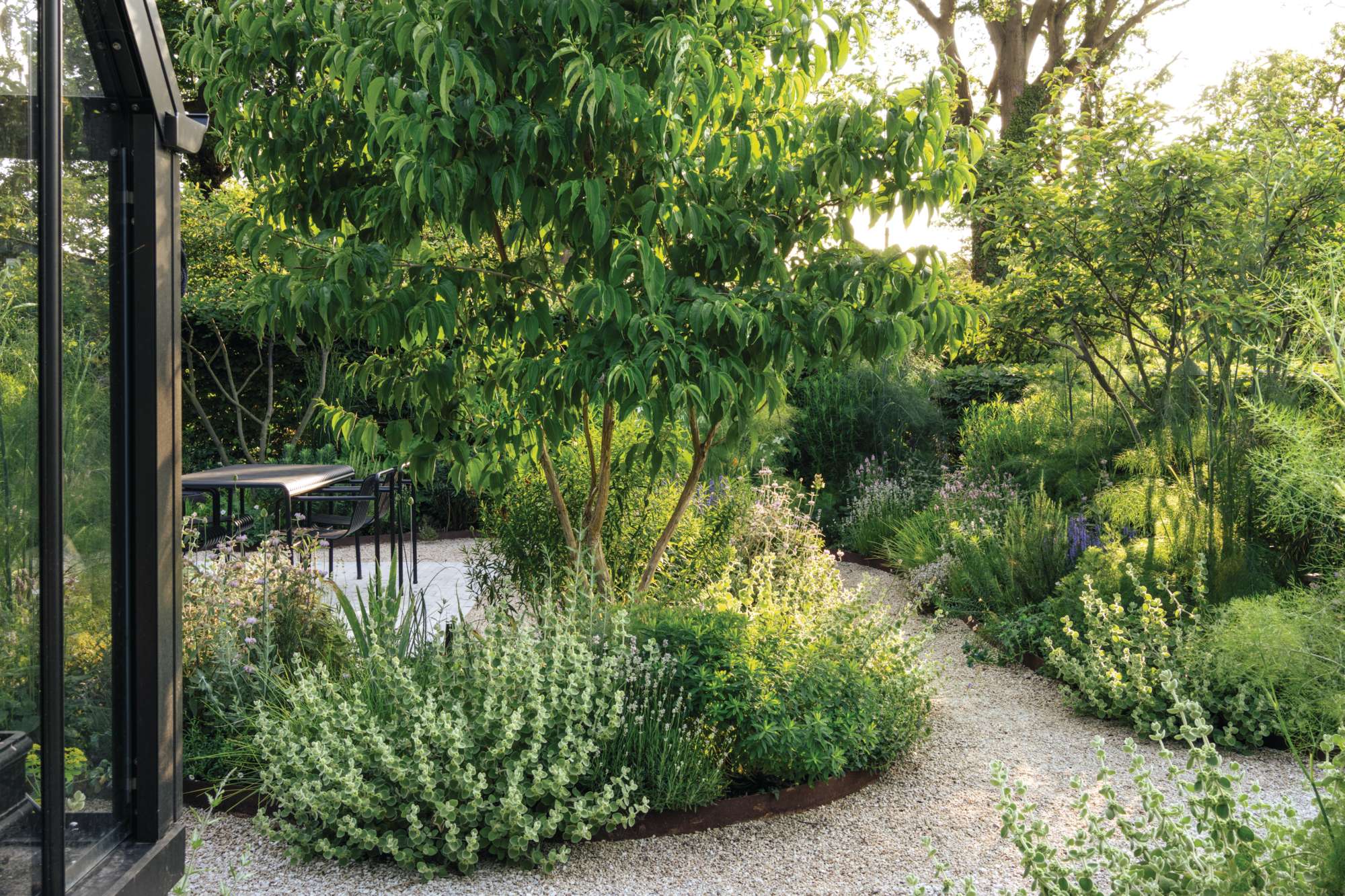
The garden is half in sun, half in shade, so Pollyanna had to come up with a planting design that allowed for this, while at the same time appearing cohesive. One other challenge she had to deal with – but also an opportunity – is the sandy soil, a contrast to the clay she is used to gardening on.
In a central bed, seen from the house, is a Heptacodium miconioides tree, which by the end of summer will be covered in clusters of small, white, fragrant flowers. “I wanted it to be at the heart of the garden, because I just think it’s a great late-summer tree,” says Pollyanna.
For interest earlier in the season, there is a pair of amelanchiers – repetition is key – and a “really spectacular” Cornus kousa ‘Weisse Fontäne’ – covered in white bracts in May. A water feature from Torc Pots sits beneath one Amelanchier x lamarckii.
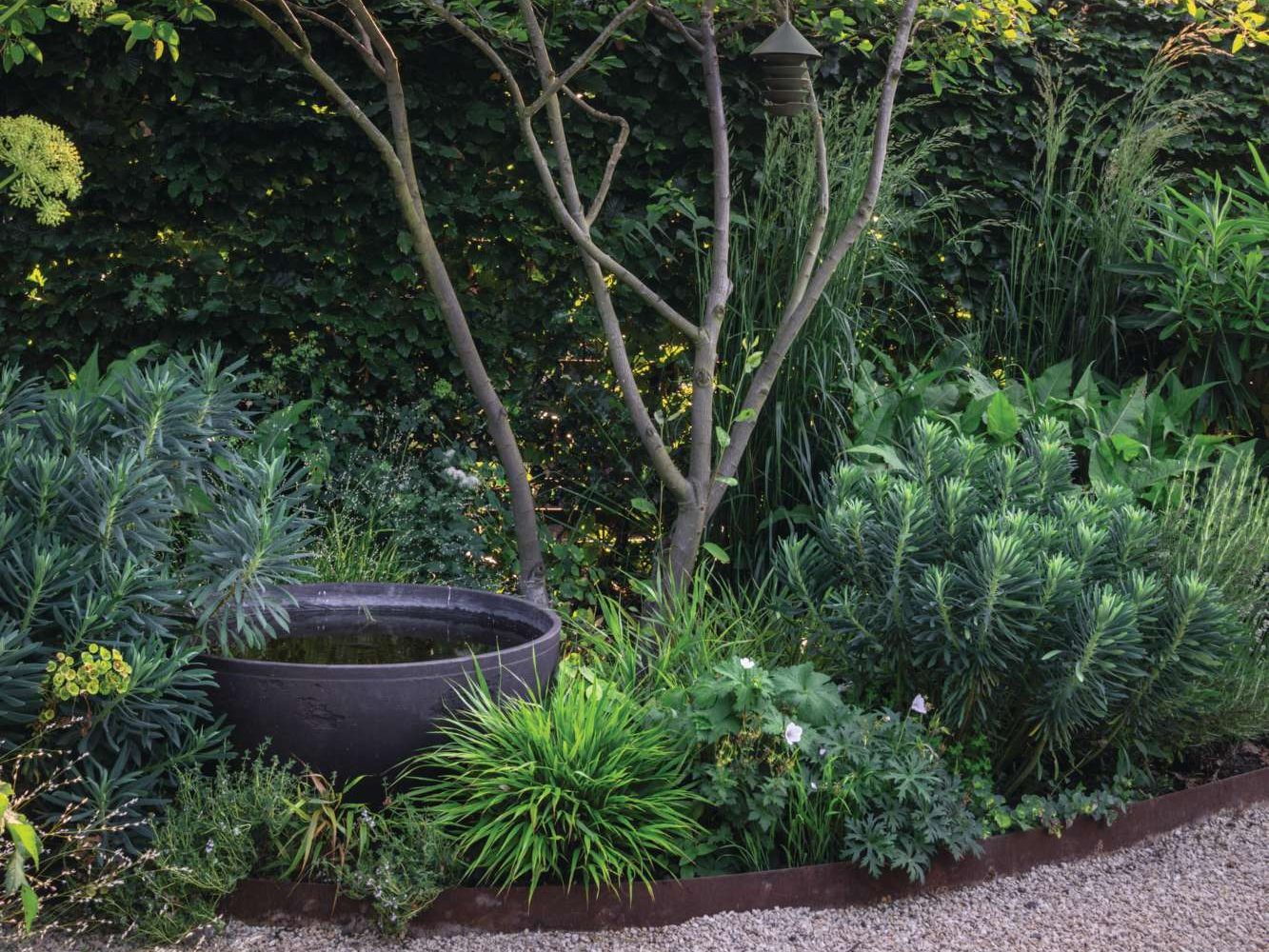
There are also five different species of spurge, including zingy lime-green Euphorbia characias subsp. wulfenii; diminutive E. epithymoides; E. mellifera, with honey-scented brownish flowers in late spring; E. palustris; and E. seguieriana subsp. niciciana, an idea borrowed from the walled garden at the Knepp Estate.
Clients often ask Pollyanna to use a lot of purple in her colour schemes, but for her own garden she wanted to change it up, and used pale pinks instead, including pink lavender and Betonica officinalis ‘Rosea’, which Pollyanna describes as “possibly my favourite plant in the whole garden”. There are also pale blues, including flowering rosemary and Cupid’s dart (Catananche caerulea).
A Hay Palissade table and chairs sit on a terrace paved with setts from Artorius Faber. It is a place for Pollyanna and her team to have meetings, surrounded by drought-tolerant Mediterranean planting, including Euphorbia mellifera and the pastel-pink Betonica officinalis ‘Rosea’.
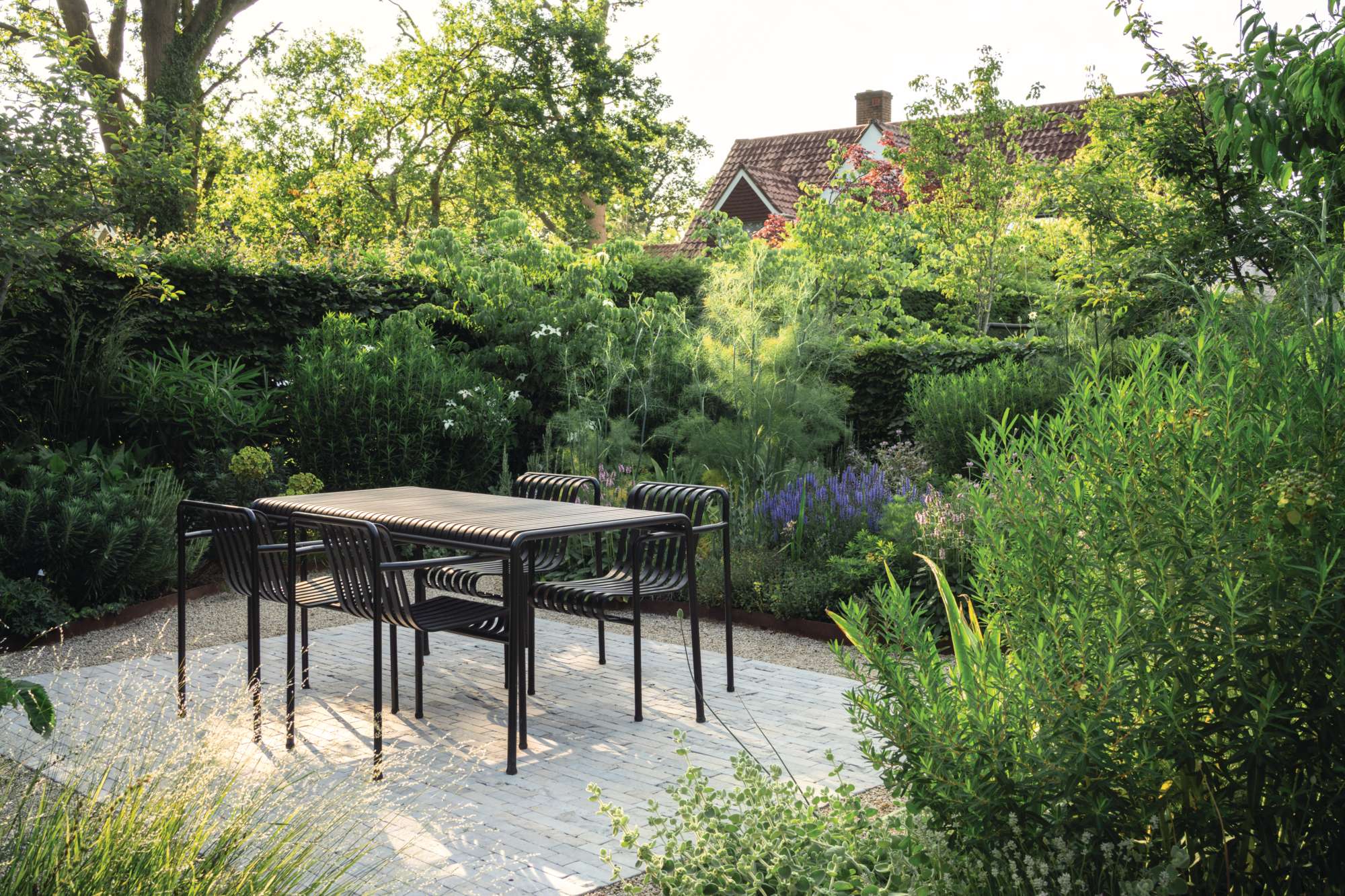
Silver-leaved plants are another theme in sunny areas, including Pseudodictamnus mediterraneus, Phlomis italica, Cerinthe major ‘Purpurascens’ with its glaucous foliage and deep-blue flowers, and Artemisia abrotanum ‘Coca-Cola’, a hardy, aromatic, deciduous shrub with feathery greenish-grey foliage.
In a shady bed closest to the studio, Pollyanna has planted three evergreen sweet box (Sarcococca confusa) “very intentional for winter scent”, along with architectural angelica, which shoots up and contrasts with the black wood. There is also compact Tellima grandiflora with racemes of tiny, creamy, bell-shaped flowers emerging from low-growing lobed leaves; the delicate Siberian grass Melica altissima ‘Alba’; and, for later in the season, white-flowered Anemone x hybrida ‘Honorine Jobert’.
The garden was irrigated for the first year to give plants a chance to establish, but now they must be able to survive in the sandy soil without supplemental watering.
Even the most perfect garden must have a working area, and Pollyanna’s is behind her studio, backing onto a bucolic patch of woodland, with raised beds for cut flowers. This is the bit we don’t get to see on social media, but as for the rest of it, she is happy to let her followers in. “I’m passionate about sharing knowledge and helping people have more beautiful gardens,” she says.
IN BRIEF
What A contemporary Mediterranean-inspired garden with an English twist
Where Surrey
Soil Pure sand
Size 14m x 10m
Climate Typical southeast, neither wet nor dry, no frost pockets
Hardiness zone USDA 9
USEFUL INFORMATION
Find out more about Pollyanna Wilkinson’s work at studiopollyanna.co.uk


