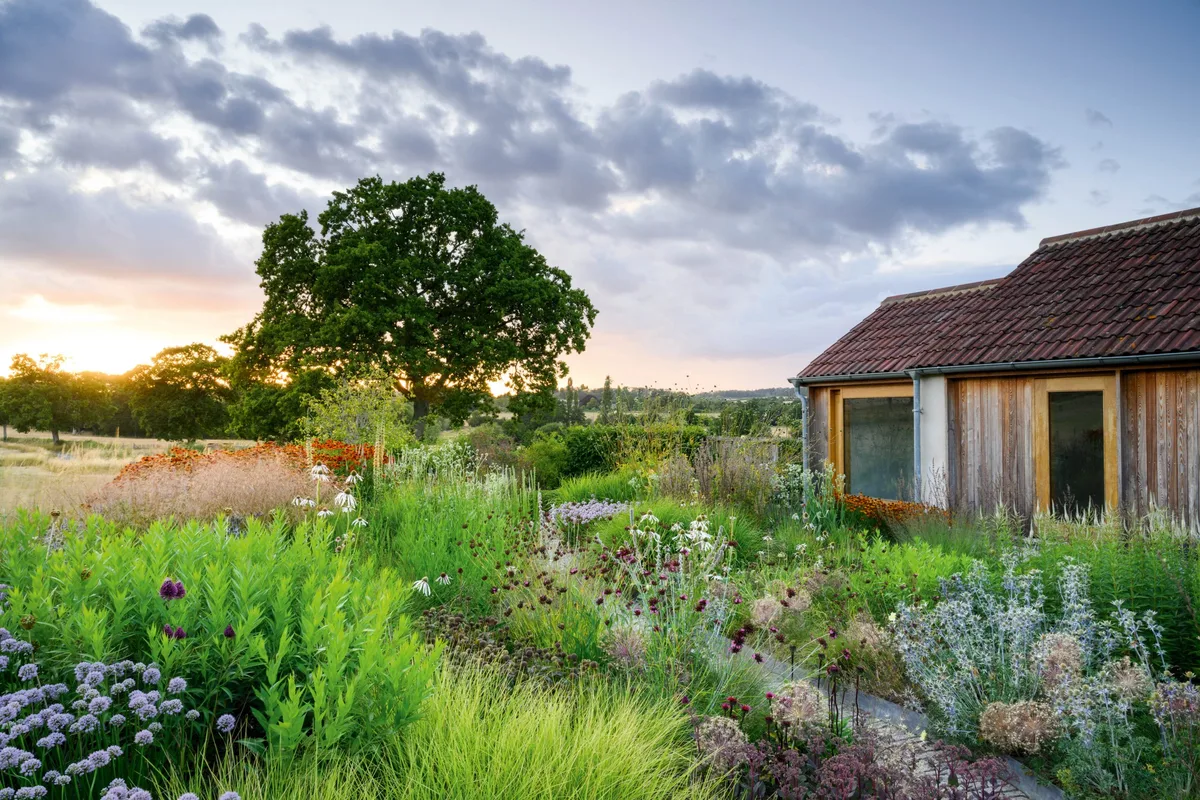
When landscape designer Sheila Jack and husband Paul Barnes were looking for a bolthole in the country, their viewings included properties with several acres, and large houses that would need major renovations. But when they stood in the broken-up yard of a disused dairy and looked out at the sloping fields and distant woodlands of Wiltshire’s Nadder valley, Sheila was instantly smitten. “I thought, oh my God, this is great. It’s tiny and there isn’t much garden, and what there is is under concrete, but it’s south-facing, in a beautiful setting and super quiet.”
Now the barn had been rebuilt as a larch-clad, three-bedroom home designed by James Grayley Architects, and the narrow garden is a triumph of naturalistic planting. It gently slopes up to the adjoining field and maximises the view – a delight for the couple all year long.
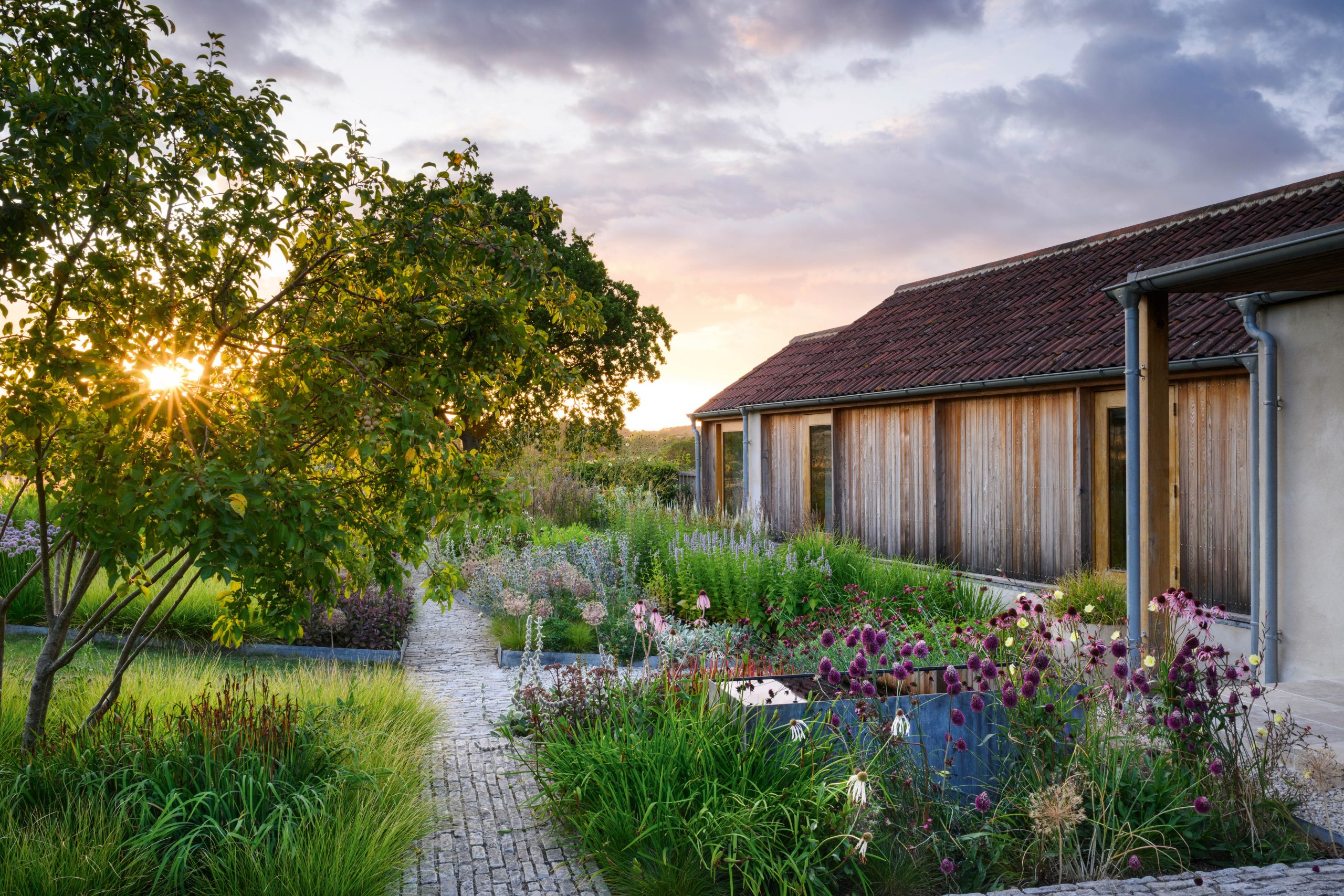
Sheila approached the design as if her husband were the client, drawing up plans that carved the awkwardly shaped plot into three areas. First, a utilitarian entrance, where two strips of hornbeam hedges screen off parking and a septic tank hidden in a slope of wildflower turf. The middle section, entered through a gap in the hornbeam, is where the garden widens and offers views up a grassy slope, framed by four multi-stem crab apples, Malus ‘Evereste’, underplanted with a meadow of Sesleria autumnalis. And finally, two organic-shaped beds filled with a relaxed mix of grasses and perennials, and a “beautiful, slightly wonky” mature oak in the field beyond.
The narrowest part of the garden at this western boundary – formerly a dumping ground for farm materials on compacted, sticky clay – presented the most challenging growing conditions. It is now a celebration of open-flowered species roses with eye-catching hips, such as Rosa canina, Rosa ‘Geranium’, Rosa rugosa, Rosa spinosissima, Rosa x odorata ‘Mutabilis’ and Rosa glauca, and self-seeders such as common valerian (Valeriana officinalis) and Sisyrinchium striatum that punctuate the Somerset buff gravel.
You may also like
- A south London garden that's an elegant retreat
- How one man turned a boring lawn into naturalistic planting
Sheila’s choice of hard landscaping materials – pale beige and grey Purbeck pitchers for the terrace next to the house and the main path that creates an east-west axis; galvanised-steel edging for the beds and reflective water tank; and a scattering of limestone boulders from a nearby quarry – help the garden to retain a farmyard feel.
Her use of a simple post-and-wire fence for the boundary is a key device that links the garden to the field and beyond. “When the meadow is high, it’s as if the boundary dissolves and the garden melts into the surrounding landscape,” explains Sheila.
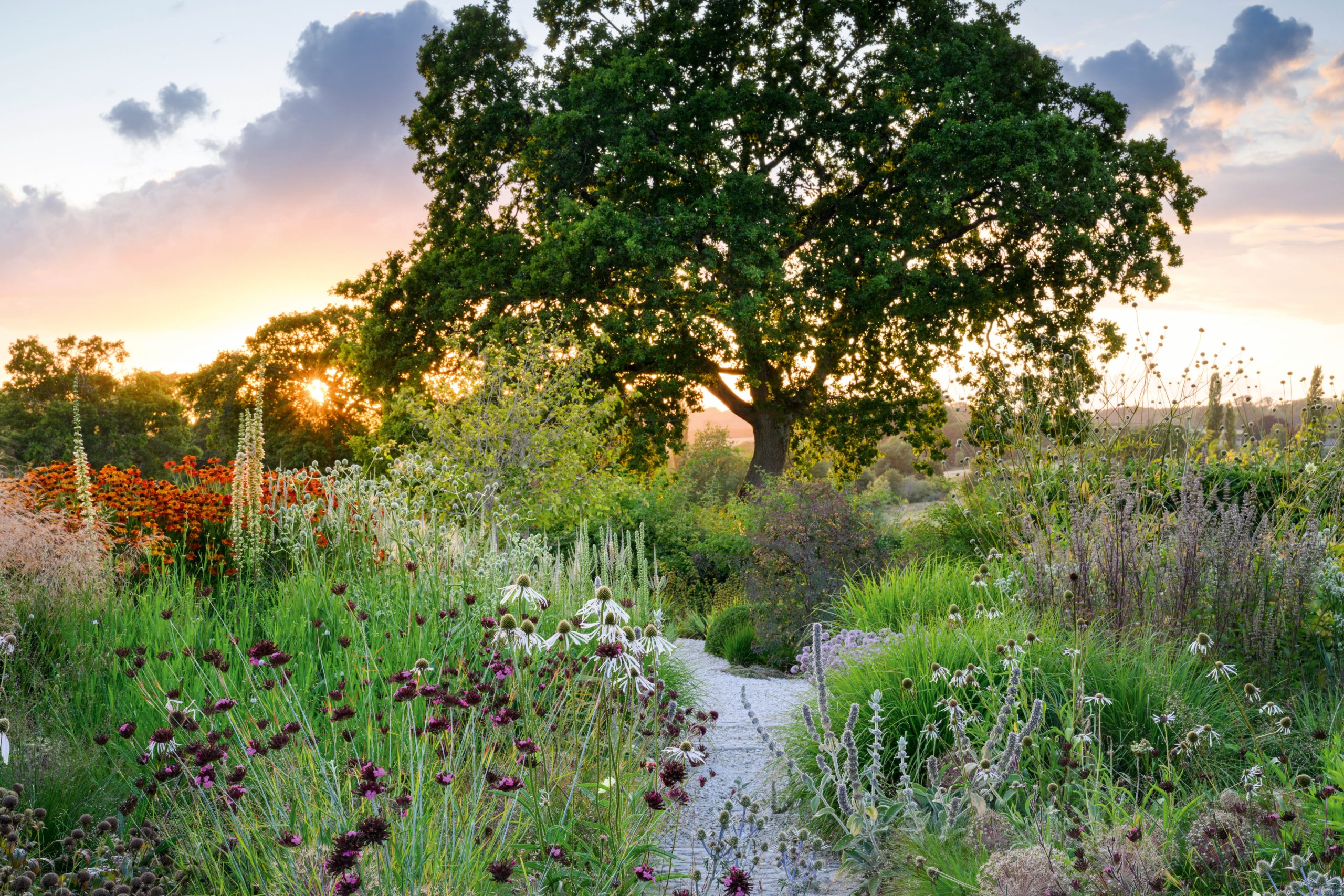
The planting, too, connects in tone and form with the landscape, inspired by plants growing in the local hedgerows, farms and woodlands, and the naturalistic schemes of innovators like Piet Oudolf and James Hitchmough. Sheila makes use of meadow-like grasses such as Deschampsia and Molinia caerulea subsp. arundinacea ‘Transparent’ in the borders, and plants with wiry stems including Agastache ‘Blue Fortune’ and Liatris pycnostachya, or with semi-transparent forms like Echinacea pallida and Dianthus carthusianorum.
The garden’s open, south-facing setting has given her the chance to experiment with drought-tolerant plants that she doesn’t have the opportunity to use in her clients’ part-shaded London gardens. The deep borders allow her to use bigger groups of plants – here set out in groups of 11, 15, 17 and 19 – to give each plant its moment.
You may also like
- Award-winning designer Pollyanna Wilkinson reveals her experimental studio garden — and it looks as good in real life as it does on Insta
- This windswept plot was transformed from a scrappy lawn into an outstanding contemporary garden
From the start, she wanted to grow them hard in the 19 tonnes of reduced-fertility topsoil she and Paul spread across the borders, with no additional watering or feeding once they became established. “I’ve really enjoyed observing the process of how things knit together. Sporobolus, for example, has taken three years to bulk up, and Amsonia has been a slow burner too.”
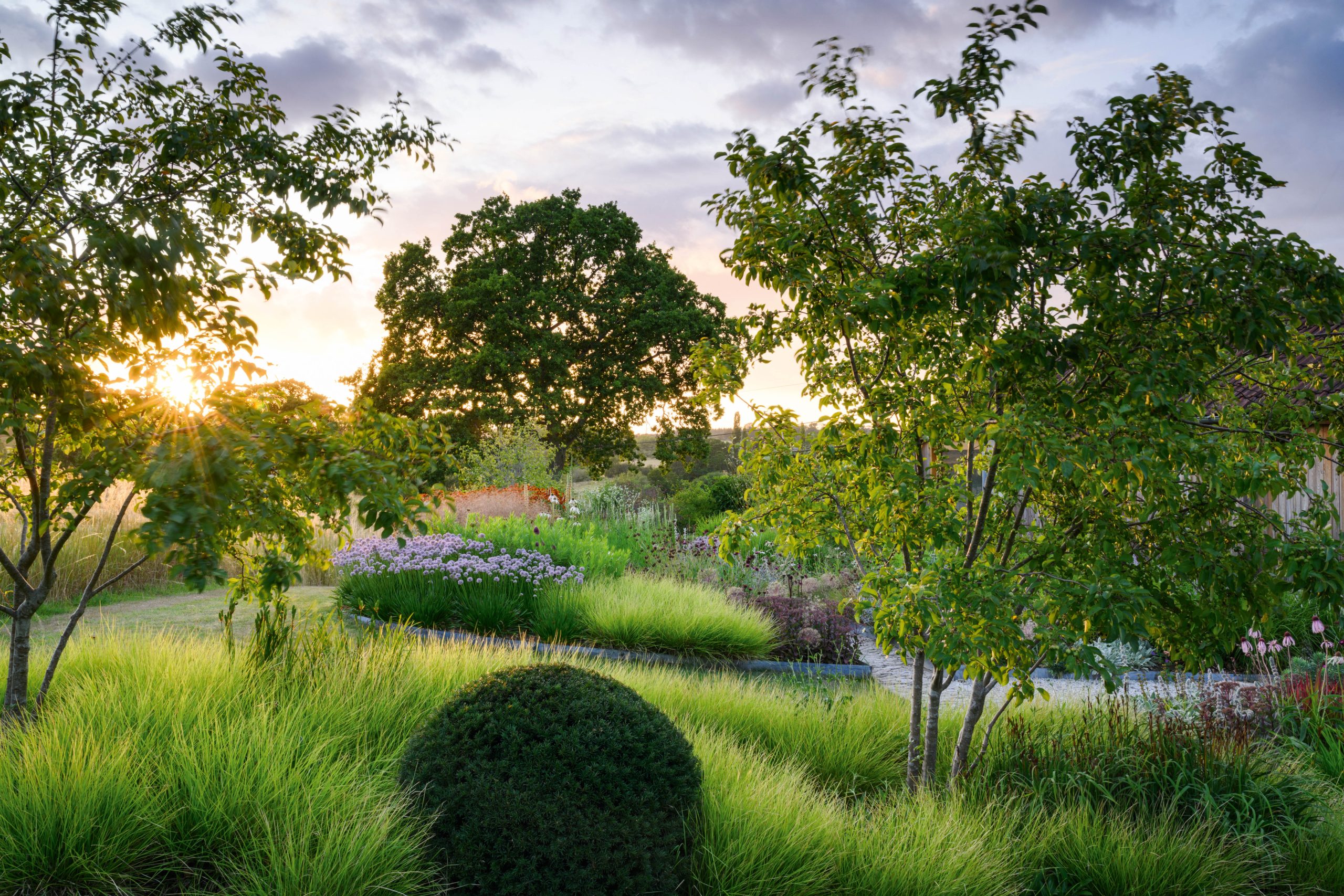
As far as possible, Sheila leaves stems, seedheads and foliage to stand until the end of February. After cutting, the borders come to life with a mantle of species tulips, followed by shots of blue from Camassia leichtlinii. In early summer, starbursts of Allium cristophii herald clumps of pale-blue Amsonia tabernaemontana (with rich-yellow autumn foliage) and lavender-pink Allium lusitanicum. As the season progresses, the spires of Veronicastrum virginicum ‘Album’ and delicate globes of Eryngium yuccifolium float above the grasses.
For the planting beneath the crab apples, which is seen from the kitchen/dining room, Sheila has chosen a simple scheme that relies on an underskirt of Sesleria autumnalis, trimmed in late winter to keep the plants relatively tidy and threaded through with successive hits of just one or two plants, starting with Narcissus ‘Thalia’, then the choice Camassia leichtlinii ‘Pink Star,’ Iris ‘Perry’s Blue’ (its rusty seedheads provide a second hit), devil’s-bit scabious (Succisa pratensis) and Turk’s cap lilies. “It is important these borders have some presence all the time,” explains Sheila, “but it was equally important that I didn’t add too much or overthink it.”
Last winter, Sheila and Paul bought an adjoining field and already, Sheila admits, they have planted more crab apples, extending the avenue effect beyond the fence and creating yet another connection between the garden and landscape.
Find out more about Sheila Jack’s work at sheilajack.com