Trends in gardening move slowly, and while gardening styles have changed dramatically in recent years, favouring a less manicured, more natural look, our gardens are yet to catch up. Many UK gardens are a mash up of the neat and tidy look of the Victorians and Edwardians, a nod to the herbaceous borders and statuary seen at grand country houses and a very large dollop of Ground Force.
The BBC makeover show, hosted by Alan Titchmarsh, Charlie Dimmock and Charlie Walsh, ran from 1997 to 2005 and had 12 million viewers at its peak. It popularised decking, painted fence panels and sheds, water features, bamboo screens, circular patios and pergolas, all still widespread in many gardens.
You may also like
- Grow your own bouquets - two gorgeous arrangements for borders and vases
- You're feeding the birds WRONG say experts - here's how you should be doing it
Terms like “old-fashioned” and “dated” don't just refer to aesthetics, they also refer to practices such as fake grass and other unsustainable gardening practices such as spraying chemicals. As designer Charlotte Harris says, “Gone are the days of perfectly edged, high-maintenance borders and central lawns. We are shifting from the notion of the garden as a perfect and manicured space to a more flexible, ecological approach.”
Of course, our gardens are for our pleasure only, and beauty is in the eye of the beholder. We don’t believe in throwing things out because they’ve gone out of fashion, so if there’s anything in the list below that you own and love, feel free to disagree with us and simply enjoy it. Or maybe line it up for a refresh when the time comes.
27 features making gardens look dated
Decking

Barely an episode of Ground Force went by without at least one part of the garden being given over to decking, and it’s easy to see why – it was economical, covered unsightly areas easily and was quick to install. It’s no surprise that the series was credited with helping the increase in sales of garden decking in the late 1990s and early 2000s – B&Q reputedly had sales rise from £5,000 in 1997 to £16 million in 2001. That said, decking is not ideally suited to the wet British climate – it needs treating to prevent it rotting and can get slippery in the winter months. If you need to replace your own tired decking, lots of interesting, sustainable options are available, including iroko; or go for reclaimed or sustainably sourced stone.
Blue pots

Blue glazed pots were once the height of sophistication. But gardener and writer Tamsin Westhorpe says: “I’ve had an overload of blue fencing and blue glazed pots. Working on garden magazines in the 1990s and early 2000s, they were everywhere, in every show garden, and I just think, no, I'm done with it. I love blue, but not in the garden.”
Designer Jo Thompson has an issue with too much bright blue in the garden in general. “People painting their garden sheds that Moroccan Majorelle blue colour that looks wonderful in Marrakesh, because you've got those skies, but it looks pretty sad under our grey skies,” she says. “And let's face it, our skies are grey for quite a few months of the year and they just stick out like a sore thumb.”
Painted fence

Ground Force also went big on painting fences, often in a shade of pale blue, grey or sage green. Look around your neighbourhood and you’re likely to see a proliferation of orange-stained fences as well. Fence paint or stain can protect your fence and make it look uniform, especially if you are stuck with different fence panels. However a darker colour that recedes into the background works better – or even better, cover it with dense climber, such as Trachelospermum jasminoides. If you’re opting for a new fence, opt for a premium, pressure treated timber that will fade and age attractively with time without the need for a stain.
Water sprinklers

We may have happy memories of dodging (or not) water sprinklers as kids, but they’re a no-no these days as they waste water and spray indiscriminately and inefficiently. “Sprinklers are one of the least efficient ways to water,” says the RHS, which points out that established trees, shrubs and perennials in beds and borders only need watering in extreme drought. It is far more efficient to only water the most stressed plants individually, with a watering can. It is also not necessary to water your lawn in a drought – while it will go brown or yellow due to lack of water, it will bounce back once the rain returns. Sprinklers are banned during hosepipe bans.
You may also like
- 7 expert tips for how to garden in a heatwave, from lawn care to watering (#4 might surprise you)
- There is a WRONG time to water your plants in a heatwave. Experts say THIS is when to water in hot weather
Bare soil

Bare soil under standard roses or a foot of bare soil between bedding plants was the look favoured in the Victorian and Edwardian eras, but times have moved on. Now, it’s all about layering with plants, with different plants of different heights, leaving as little soil bare as possible. So underplant your roses with hardy geraniums, salvias, nepeta or grasses. Not only will this give flowery interest for months on end, but it’s much better for the health of your soil and for pollinators and other wildlife, too. Which brings us to…
Bedding plants

Take a stroll through the nearest park or around your neighbourhood and you’re likely to spot the traditional bedding plants gardeners have relied on for decades: petunias, busy Lizzies, geraniums, begonias and antirrhinums, all offering reliable colour and impact throughout the summer.
These plants offer nothing for pollinators. Emma O’Neill, head gardener at the sustainable growing charity Garden Organic, points out that the long-lasting flowers of many bedding plants are either sterile (so do not offer nectar or pollen) or are double, which makes it much harder for pollinators to access the nectar. They’re also grown using high amounts of energy and water and are potted into plastic containers that are hard to recycle.
The good news is that a few simple swaps can make all the difference to wildlife - and it doesn’t mean discounting annuals. Emma suggests cosmos, slender vervain (Verbena rigida - a moth and butterfly magnet), Mexican fleabane (Erigeron karvinskianus) and marigolds. You could also try single dahlias, salvias and scented pelargoniums. Which brings us to…
Hanging baskets

There’s something cheery about hanging baskets in town centres and pub gardens but again, they often use plants that are not of any value to pollinators – and need a lot of watering. Monty Don isn’t a fan. On the Gardens Illustrated podcast, Talking Gardens, the BBC Gardeners’ World presenter confessed: “I've never willingly had a hanging basket. But I don't mind other people having them if that's what they want.”
A rose border

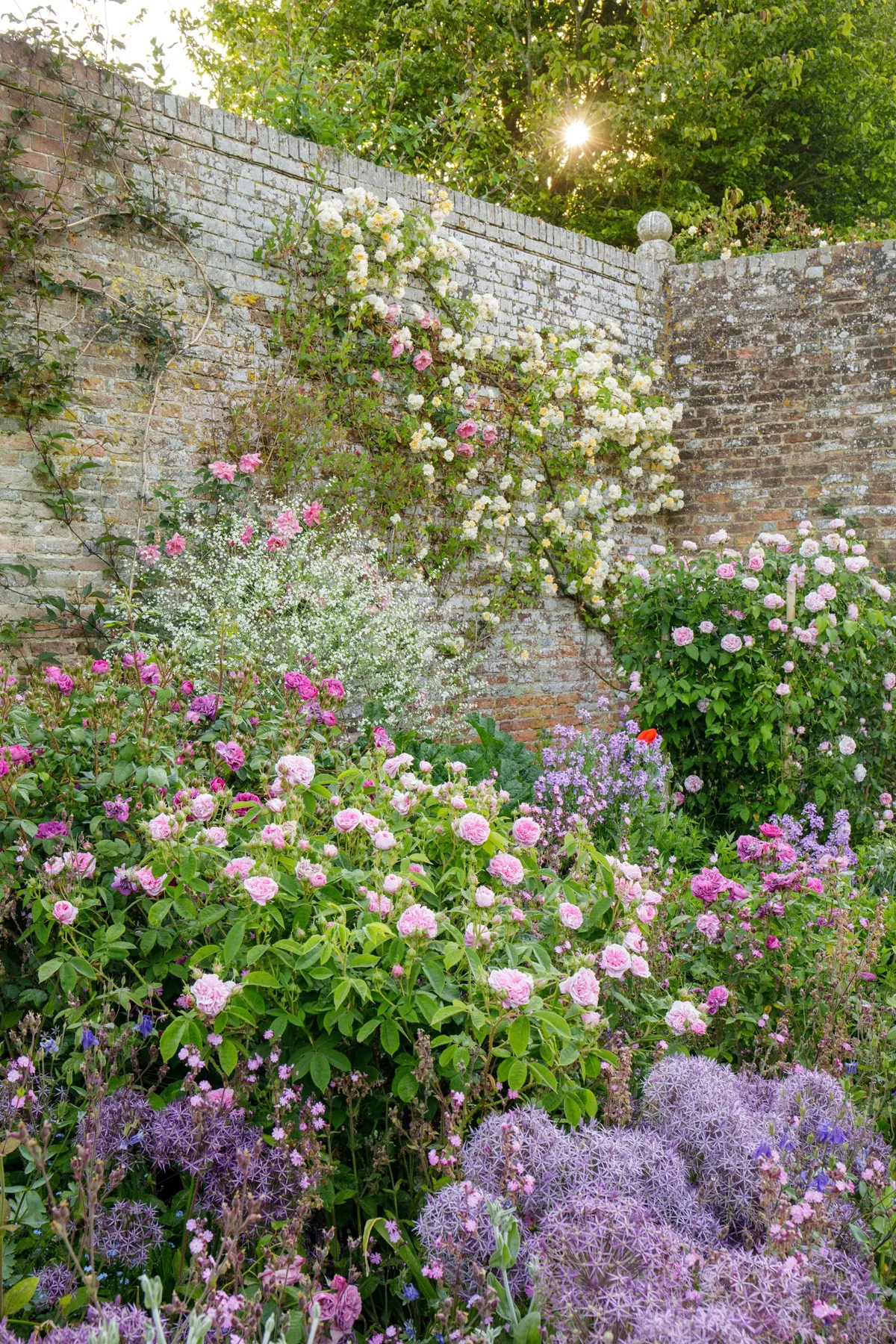
Roses will never go out of fashion but the way we grow them is changing. While large country houses do rose gardens beautifully, a border dedicated to stiff, standard roses or neatly pruned and sprayed bushes (especially with the aforementioned bare soil) is a tad passé in a regular garden. Even the famous rose garden at Sissinghurst is filled with many annuals and perennials as well as roses. It’s now much better to include roses in a mixed border alongside other perennials and shrubs. Go for those that are disease-resistant, flower over a long period, repeat flower, have single flowers for pollinators or have a looser growth habit, such as Rosa glauca or Rosa x odorata ‘Mutablis’, or go for drought tolerant, single-flowered Rosa persica.
You may also like
- Tips for combining perennials and roses
- Want a vase full of home-grown roses? Here are the best roses to grow for cutting with tips from expert rose growers
Buddha

According to the 2021 census, just 0.4 per cent of the UK population identify as Buddhist. However the number of Buddha heads (often combined with a water feature) in UK gardens must vastly outweigh this. Maybe we are desperately seeking a Zen feel? Are we going to get around to meditating one day? Which leads us to…
Cherub statue

Stately homes may be awash with statues of cherubs, angels and naked men and women, but writer Alice Vincent cannot stand figurative statues in the garden. “I have a real thing about garden ornaments, even those very expensive, quite fancy sculptures. I think it’s a rare one that works well, but the ones that definitely never work well are ones with a face… animal sculptures, gnomes. I don’t care if you spent thousands on it and it’s made of bronze. If it’s got a face on it: no.”
Fake grass

Despite what manufacturers claim, fake grass always looks fake – especially when it is poorly laid and wrinkling at the edges like a bad carpet. But its sins go way deeper than that. “It is one of the most harmful things in a garden, says designer Manoj Malde. “It has no beneficial impact to a garden or to human beings and more importantly, no beneficial effects to wildlife. The rubber backing takes forever to break down; then it ends up polluting the environment. Worms have been known to actually move away and out of the soil when plastic grass has been put down. And for people who say, ‘oh, but they're easy maintenance’, they’re so not. If your dog goes and pees on it, you're still going to have to wash it down. You still get weeds growing through it. You have to brush it. You have to clean it. So actually, is it easy maintenance? I don't think so.”
White plastic furniture

It’s uncomfortable, it sticks out a mile, glares in the sun and stains unattractively as it ages. Save up for something elegant, stackable and space-saving such as the Hay Pallisade range, beloved of designers, or look out for decent wooden furniture or vintage furniture.
Tiki huts
Sure, your garden is an outdoor room – but a rainy July day in Macclesfield doesn’t give the same vibes as your holiday in Mexico, Tiki hut or no Tiki hut. Convert it into a potting shed or storage instead.
Paved driveway

In 1995, the Government gave pavement crossovers (or kerb drops) 'permitted development' status and as a result, many front gardens were paved over. This has had serious consequences, including reduced space for wildlife, increased risk of flooding, lower air quality, water pollution and even reduced wellbeing: recent research found that green front gardens can reduce stress at a level equivalent to the long-term impact of eight weekly mindfulness sessions. If you need parking, bear in mind that it is possible to have a welcoming green space and have somewhere to park, too. The key is to keep the parking area as small as possible, include as much planting as you can and to use permeable paving materials.
Log rolls

Those of us obsessed with neatness may have been tempted by a log roll to contain the plants in a border. But do they look neat? They have a tendency to sag, which arguably doesn’t look neat at all. And they are not very durable. Which brings us to…
You may also like
- Plants for flood-prone gardens: the plants that will survive a flood
- Hugh Fearnley-Whittingstall on eating more fibre, his passata recipe and what Elizabeth David thought of his chocolate cake
Border edging

A neatly edged border can be a thing of beauty, but it can also look rigid and unforgiving, especially if it is constrained by plastic or even metal edging. Ditto borders where the edge has been dug out, creating a ditch between the plants and the lawn or path alongside. It is far better to let the plants reach over the border edge for a more abundant and natural look. Which leads us to…
Skinny borders

The classic UK back garden, often seen in garden centre adverts, has borders that are straight and about a foot deep, around the edge of lawn. These are tricky to plant up to look good all year, and just look plain stingy – and they don’t make the garden feel bigger. Designer Tabitha Rigden recommends bringing the planting right into the heart of the garden. “Too often, borders are pushed to the edges of a garden, but in a small space, central planting can be transformative.” If you feel you can’t do this, make the garden feel more organic and abundant by deepening the beds, possibly giving them a more organic shape.
Pots on their side

Pithoi-style Mediterranean pots half buried on their side, possibly with some stones spilling out, are a pet hate of Gardens Illustrated editor, Stephanie Mahon. “It’s giving: ‘I just left my amphora here’,” she says. “As if you popped your terracotta jar of olives down in the garden 2,000 years ago. Not for me.”
Artificial plants

Widely available in garden centres and even supermarkets, the passion for fake plants shows no sign of abating, despite their terrible eco credentials. Designer Tom Massey can’t abide them. “I can't see why you would want an artificial plant in your garden, and I could extend that to anything imitation and plasticky… artificial green walls or hedges, things that are trying to cheat to get a natural effect. It's this idea that our garden should be static and look the same the whole time; my dream garden definitely wouldn't be static. There are just so many things on so many levels wrong with artificial plants. We're already living in a world where nature connection is being lost in many ways, and plastic pollution is in the highest mountains to the deepest oceans - and that is really worrying.”
A large plant in a circle in the middle of the lawn

The classic here is of course the pampas grass, Cortaderia selloana, which used to be a common sight in front gardens in the 1960s and 1970s but fell out of favour, thanks its associations with swinging. That aside, Alan Titchmarsh cannot abide its looks: “It looks like a collection of feather dusters sticking out of a mountain of grass.” The main problem, however, is one of scale - one smallish plant in a sea of lawn. Far better to plant a tree, or a group of trees, widen the borders or just lose the central plant altogether. Other guilty plants include cordylines (cabbage palm) and New Zealand flax (phormium). Which brings us to…
Anything perfectly circular

Watch an old episode of Ground Force and a circular patio, lawn or even a round pergola often featured. These are tricky to lay and fiddly to maintain. It is far better to use principles based on the golden mean, also known as the golden ratio, a mathematical ratio that makes spaces feel both structured and organic. Alternatively, the ‘golden rectangle’ can be used for rectangular raised beds, terraces, seating areas, lawns and pergolas. The ratio of the short side to the long side is equal to the ratio of the long side to the sum of both sides – ie 1:1.6. For example, a lawn could measure 5m x 8m.
Tortured topiary

Nurserywoman Rosy Hardy can’t stand it when plants are twisted out of their natural shape. “I do not like contorted hazels or willows; they really are a no-no. I'm not very keen on the ones which are plaited either. I can understand that look, but you just look at them and think, they just look in pain. They would make instant kindling.”
A lawn

They are a lot of effort and go muddy in winter and brown in a drought, so we’ve started to wonder: do you really need a lawn? Many British and American gardens come with a lawn as standard and mowing, feeding and caring for it is almost seen as a patriotic duty. A striped lawn is a thing of beauty on a tennis court or college quad. But you don’t need to keep a lawn – or mow it – just because everyone else does.
We’re not suggesting that you pave over your lawn, as President Trump did recently at the White House. But there other options. One is to only mow parts of the lawn, leaving some areas to grow long. This is what lawn expert David Hedges-Gower does: he simply leaves part of his back garden unmowed, regularly mowing paths through it. He chops it down once a year, usually in October.
You may also like
Or you could simply replace the grass with plants, enlarging your existing borders, or add new borders or beds. If your lawn is prone to drought, you could consider replacing it with a gravel area filled with drought-tolerant plants. If part of it is prone to flooding or waterlogging, you could plant up the area with plants that are more suited to the conditions, such as bog plants. Or take it one step further and replace part of the lawn with a pond.
Cheap concrete paving

Cheap concrete paving never looks as good as stone, as it is uniform in size and lacks the natural variations, but has been a good budget choice for many of us. If you’re stuck with yours, a good tip is to not pressure wash it – it will eventually acquire a more aged patina. For a less harsh look, try lifting a few of the paving slabs and planting up the gaps with low-growing, drought tolerant plants such as thyme.
Outdoor heaters

Outdoor heaters were all the rage in the 2000s, despite being hailed as ineffective and not environmentally friendly, even at the time. It is far better to burn wood in a firepit or chiminea from a sustainable source (ideally harvested from your own garden, which is carbon neutral), to use an ethyl alcohol burner – or just put a jumper on.
Driftwood

Unless it’s in Derek Jarman’s iconic coastal garden in Dungeness, Kent, driftwood belongs on a beach. If you have some, maybe turn it upright and turn it into a stumpery, planted with ferns. Or make it part of a log pile, a fantastic habitat for wildlife.
Gnomes

The debate on these will run and run, but for the second time in its history, the gnome ban at RHS Chelsea Flower Show was lifted in 2026. The RHS invited celebrities to decorate gnomes to feature at the 2026 Show to raise money for the Campaign for School Gardening, so make of that what you will.