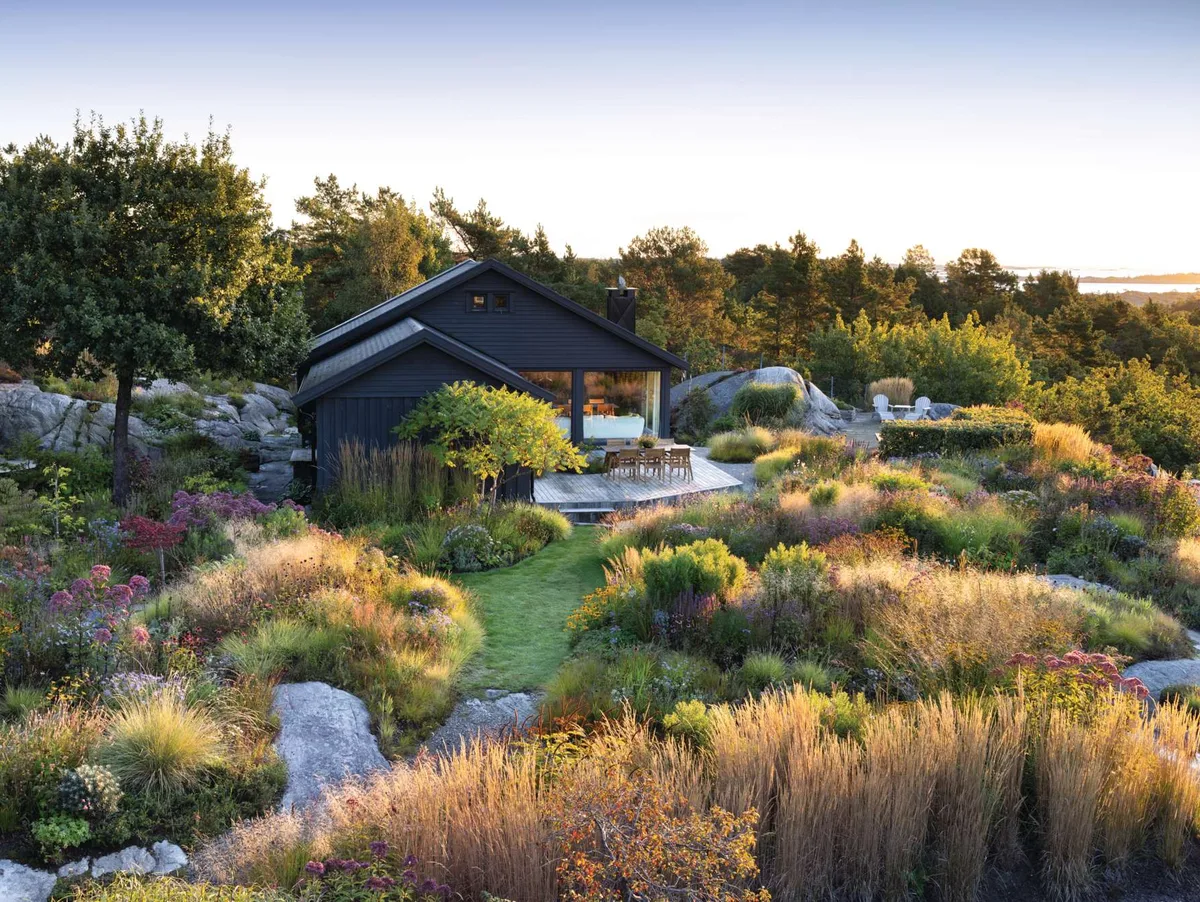
The path to Mariann Gundersen’s garden leads through a small wood of wind-shaped Scots pines, with bilberry bushes brushing your ankles. You round a granite outcrop and suddenly a tapestry of grasses and flowering perennials appears, shimmering in the Nordic light.
It’s hard to imagine that only a few years ago, this was little more than a lawn on bare granite. Today, the garden surrounding Mariann’s summer house on the island of Justøya, off Norway’s southern coast, is a masterclass in naturalistic planting – a place where ornamental grasses, resilient perennials and the surrounding landscape merge into one harmonious whole. In 2023, it received the Scandinavian Design
Award for Garden Design of the Year.
When Mariann and her partner Trond bought the house in 2016, it felt rather barren. “There was a lawn,
scattered pine trees and very little insect life,” Mariann recalls. Her first idea was to sow a wildflower meadow, but she soon realised that she wanted something richer – something that would offer beauty, movement and ecological value throughout the seasons. Discovering the work of Dutch designer Piet Oudolf was a turning point. “I was immediately drawn to the aesthetic,” she says, “and to the idea of creating something similar in our own landscape.” Mariann had gardened before, but in a more traditional way with lawns and borders. “I had no idea anything like this existed,” she says.
You may also like
- The best perennial plants for your garden
- 24 key plants from Piet Oudolf's field at Hauser and Wirth
Creating the garden, however, was not straightforward. There was almost no soil on the site, only smooth granite covered by a thin layer of earth. Everything – from compost and sand to stones and plants – had to be transported by wheelbarrow through the wood, as there is no road leading to the summer house. Rather than seeing these limitations as obstacles, Mariann allowed them to shape the garden. For the planting she created a series of raised beds of varying heights, edged with pieces of the old lawn that Mariann cut up and used as building blocks around the beds. These hold a free-draining mixture of compost and sand, so it resembles the growing medium of a roof garden more than a conventional
border. The shallow soil naturally favours drought-tolerant plants with fibrous root systems, while deep-rooted species rarely do well. “I’ve done a great deal of trialling here to find the plants that will actually
thrive,” says Mariann.
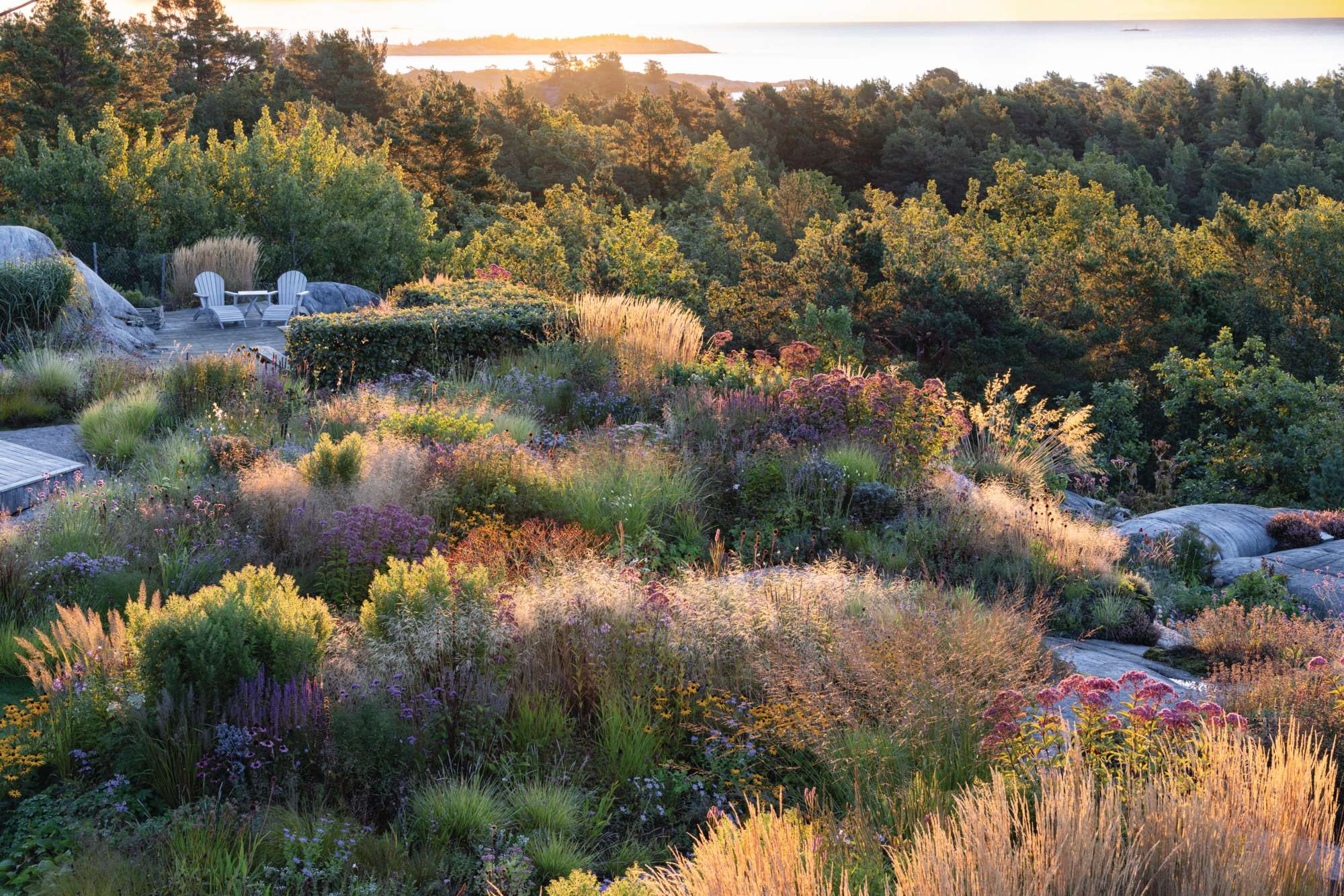
What you quickly notice is that the garden has no sharp boundaries. The planting seems to flow effortlessly between granite outcrops and the surrounding pines, as though it has always belonged here. Repetition is used with remarkable restraint. Soft drifts of Sesleria autumnalis weave throughout the beds, while taller grasses such as Calamagrostis x acutiflora ‘Karl Foerster’ and Deschampsia cespitosa ‘Goldtau’ rise above the planting, catching even the slightest breeze. Together they create rhythm, structure and movement, allowing the eye to wander naturally through the garden.
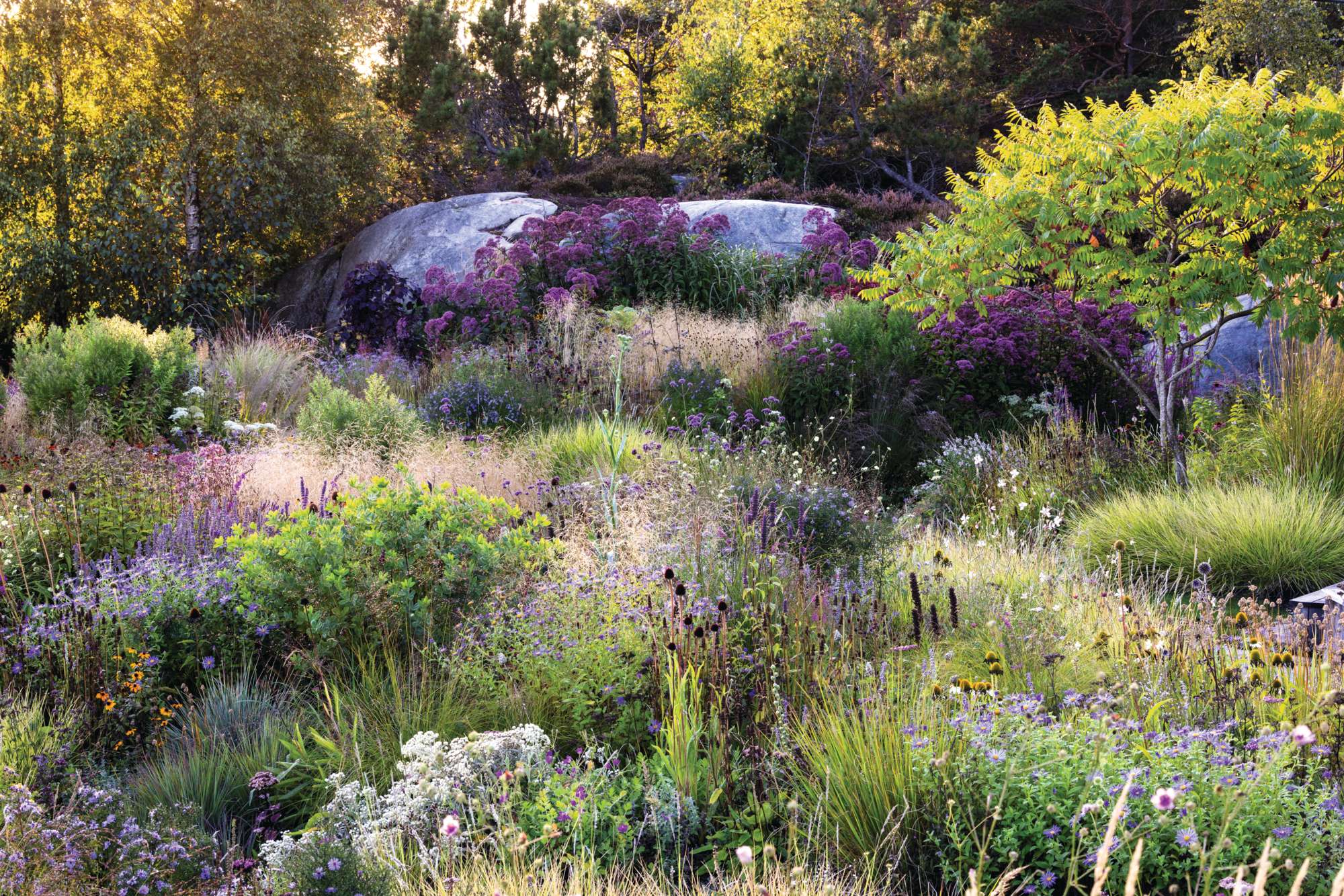
The grasses are accompanied by generous drifts of perennials, chosen as much for their character as for their resilience. Mariann prefers plants that remain close to their wild origins, creating an expression that feels authentic rather than ornamental. Umbellifers mingle with airy sanguisorbas, thalictrums, echinaceas and eupatoriums, while delicate flower stems float above a sea of green foliage. The palette is intentionally restrained. Blues, violets, pinks and soft purples dominate, punctuated only occasionally by warmer yellows and orange-reds. “These cooler colours create harmony, spaciousness and a certain quietness,” says Mariann. “They belong naturally in the Nordic light.”
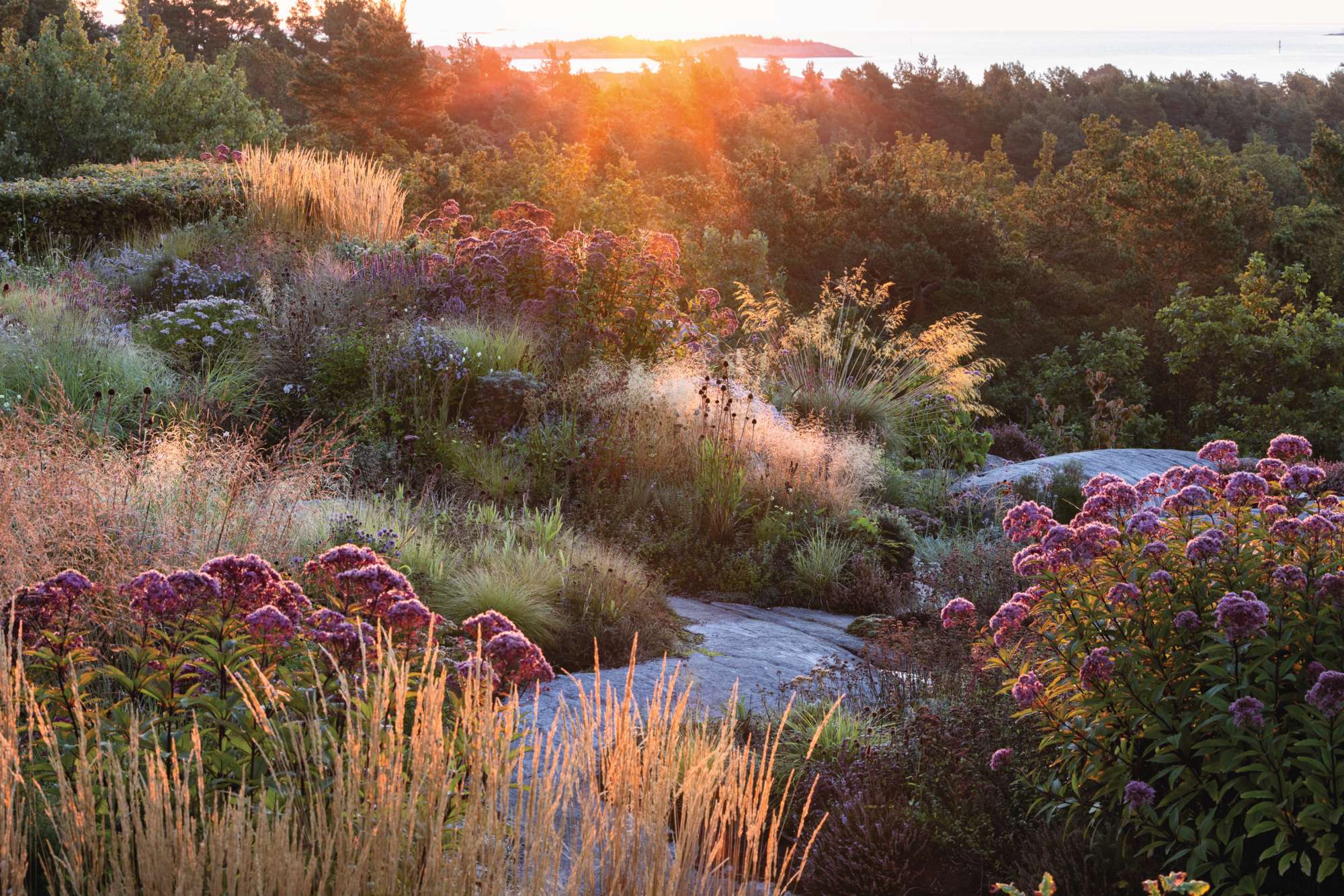
Although many of the plants originate from North America and other regions with similar climates, native species also play an important role. Digitalis purpurea, Knautia arvensis, Jasione montana, Armeria maritima and Sanguisorba officinalis all help strengthen the garden’s connection to its surroundings. The goal has never been to recreate wild nature, but to capture its spirit. “It was important to me that the planting should feel natural in this landscape,” says Mariann, “while also being drought tolerant.” But, she adds, because most of the planting is in raised beds over solid rock, with nowhere for the roots to grow deeper, she has to water occasionally – something that is a challenge, as the summer house is not connected to a mains water supply. “There’s a well here,” Mariann says, “but the water supply isn’t unlimited, and sometimes I have to choose which plants get the little water I have available.”
You may also like
As the garden has matured, so too has the wildlife. Bees hum between the flowers, butterflies drift through the grasses and dragonflies patrol the warm summer air. Birds feed on seedheads long after the flowers have faded, while insects find shelter in hollow stems left standing through winter. In early spring, the old growth is cut back, chopped and returned to the beds as mulch, allowing nutrients to cycle naturally back into the soil. “I wanted to create a lush, living landscape that would bring joy to us while also supporting insects, birds and other wildlife,” says Mariann.
Perhaps the garden’s greatest feature is not any particular plant, but the light itself. Throughout the day the planting changes character as shifting light and sea breezes animate the borders. In autumn, when the grasses reach their peak and spider webs sparkle with dew, the entire garden seems suspended between land and sea. “The Nordic light plays a central role in how the garden is experienced,” says Mariann. “Its softness, clarity and constantly changing character shape the way colours, textures
and movement appear throughout the day.”
It is tempting to think that this garden is simply about beautiful planting. It’s not. It’s about working with rather than against nature, and discovering that even the thinnest layer of soil can become the foundation for extraordinary beauty. Here, on a granite outcrop, Mariann has created not just a garden, but a place that feels as though it has always been waiting to be found.
See more of Mariann Gundersen’s garden on Instagram @vill_hageglede