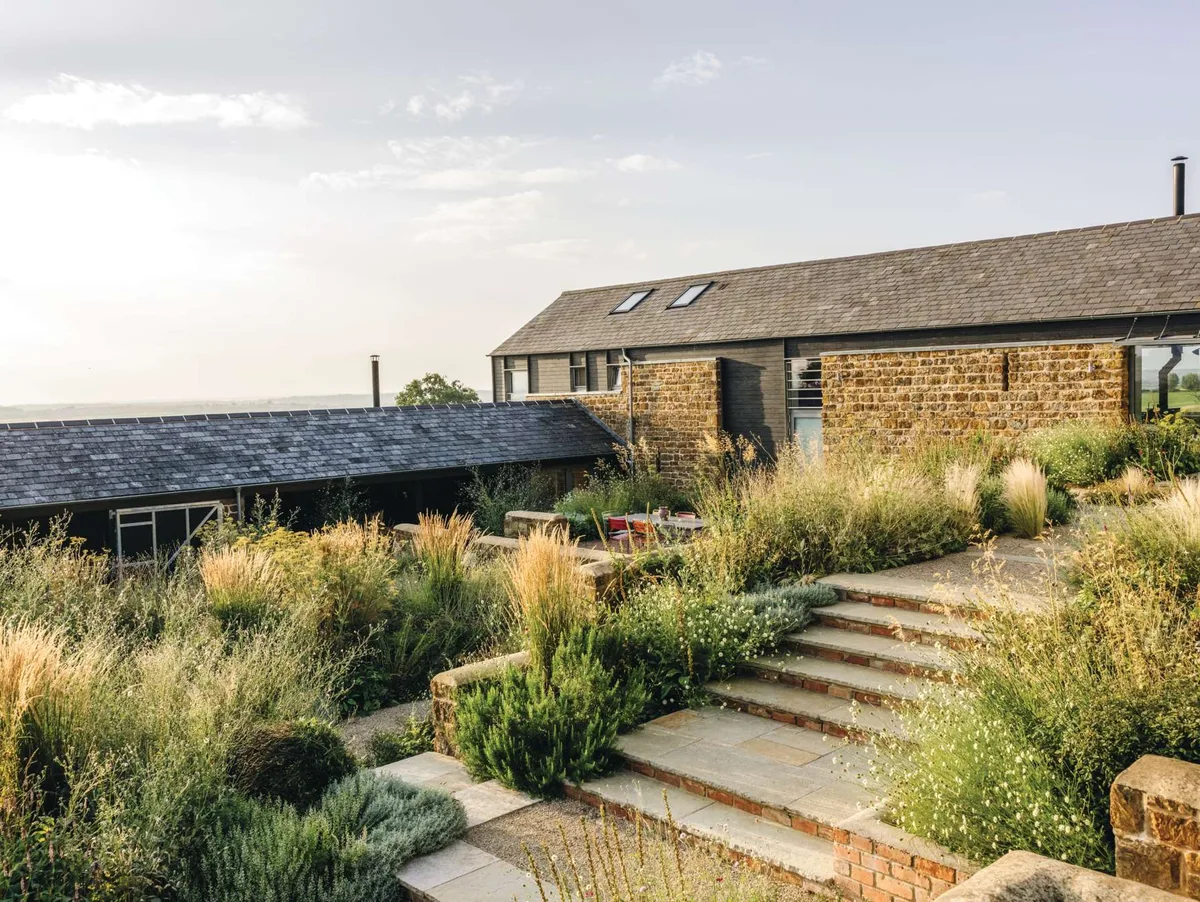
As you wind your way along country lanes, glimpses of rolling hills appear through the hedgerows. Then, as you arrive, the landscape suddenly opens onto a sweeping panorama. Perched on a ridge overlooking the north Oxfordshire countryside is a garden that feels elevated, yet also secluded. Behind the house, dense woodland provides a verdant backdrop alive with birdsong. Originally a collection of farm buildings, the U-shaped house was restored by architects Charlie Luxton Design a few years ago, and Oxfordshire-based garden designer Katie Guillebaud was commissioned to create a garden worthy of its spectacular setting.
The initial brief was to reimagine the south-facing front garden – an intimate, stepped area partly surrounded by the barn buildings. “My clients – Lori and Doug Harmon – wanted a more attractive and welcoming space,” explains Katie. “Lori didn’t like coming out here because the steps were so steep and precarious.”
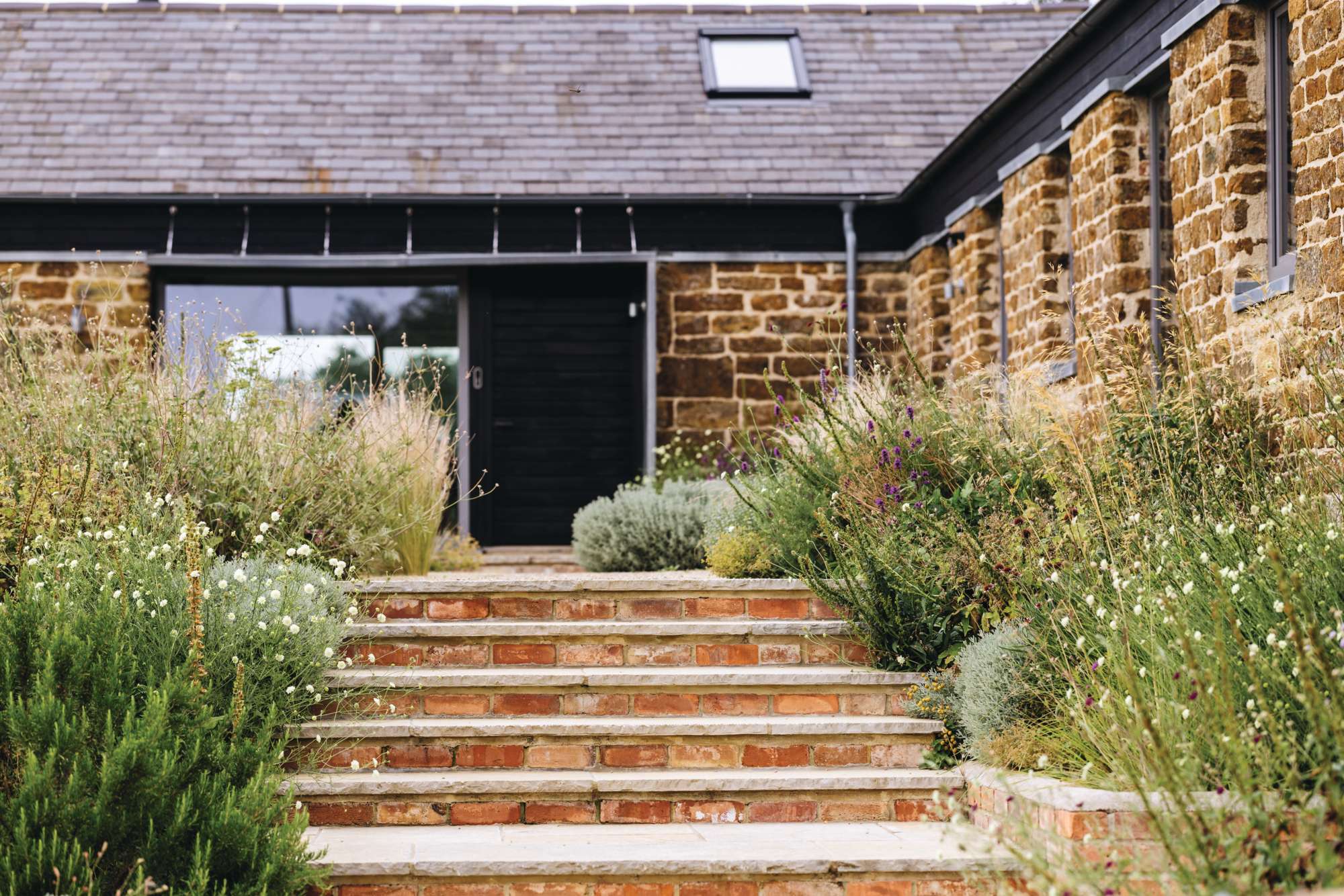
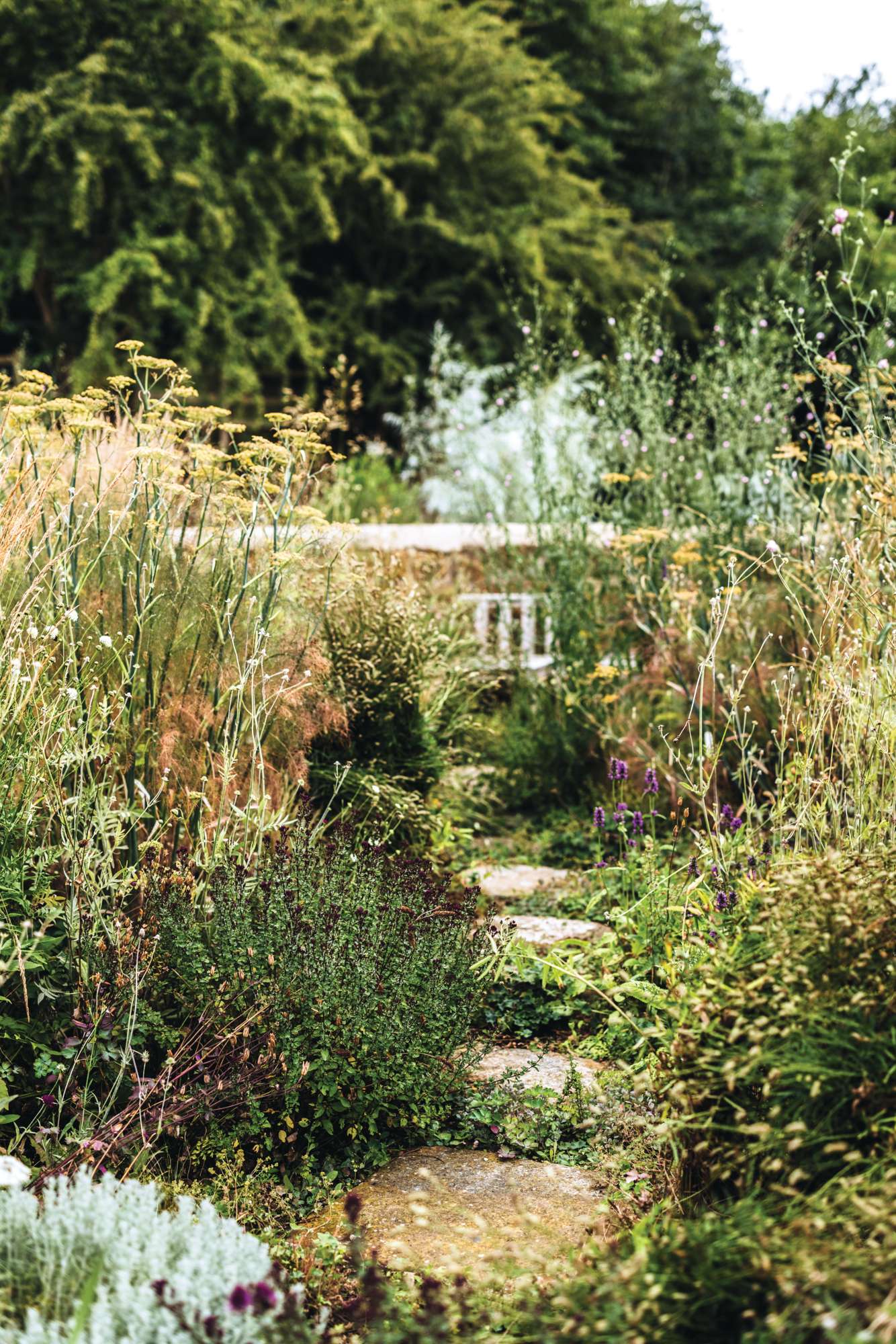
So Katie reduced the steps’ risers from 200mm to 150mm and made the treads deeper. And she kept the materials simple: red brick for the risers – echoing the existing brick terrace – and limestone for the treads – as per the thresholds to the house entrances. She also included self-binding gravel paths, “unedged so that the planting can spill out, giving an informality to the scheme, which is otherwise quite rectilinear”.
You may also like
- Combining Arts & Crafts style with New Perennial planting in this garden by Katie Guillebaud
- Designers reveal just ONE change that can transform your garden
In terms of planting, Katie swapped the “boring, square lawns, with funny narrow beds and lots of shrubs” for broad naturalistic planting intersected by snaking paths leading to seating nooks. The design is airy and elegant with a definite meadowy feel. Naturalistic staples – sanguisorbas, achilleas, rudbeckias, heleniums and grasses – mix with drought-loving Mediterranean herbs – puffs of Santolina chamaecyparissus, larger mounds of rosemary, Origanum laevigatum ‘Herrenhausen’ and dainty calamint.
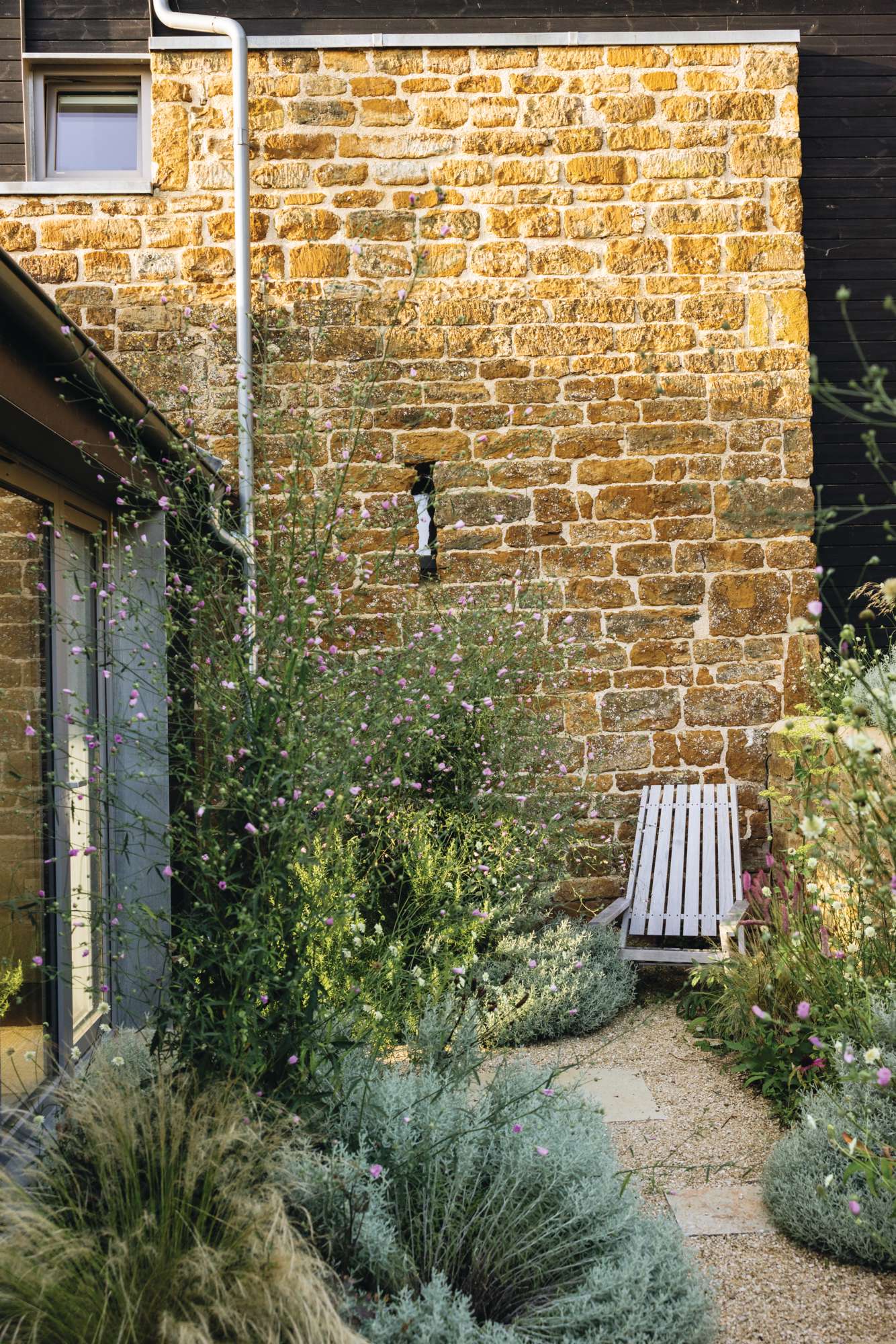
Dotted around the front garden are clumps of Scabiosa columbaria subsp. ochroleuca, its wiry stems topped with creamy pincushions. Like many of the flowers, it was chosen for its pollinator-friendliness, and on sunny summer days it is animated with bees and butterflies. A different statement plant, head-height Althaea cannabina, sways delicately in the wind with its sweetie-pink blooms. Cephalaria balansae is another key plant, used for its tall see-through height and delicate pale-cream flowers. Spikes of buttery yellow Digitalis lutea add vertical punctuation marks, while red-stemmed dwarf lady’s mantle (Alchemilla erythropoda) nudges against the paving slabs, further softening the effect.
Katie admits that a handful of plants weren’t ideal choices, particularly for the path edges. “Sanguisorba ‘Pink Tanna’, which in theory is relatively low growing, got quite high,” she says. “The idea was to create a sense of semi-secrecy, but in the second year some of the paths became pretty impassable.”
From the front garden, wide steps lead to the house entrance. French windows open into the kitchen-cum-living area. Directly opposite, through the house, another floor-to-ceiling window gives onto a second terraced garden at the back. Lori and Doug like to think of their two gardens as extra living rooms. “The house is almost like being in a covered porch,” says Doug. “We’re out in the way that we’re in. And when we’re in, we feel out.”
You may also like
- How one planting designer created a stunning green roof with year-round interest – on top of his cabin
- Is your garden on a slope? See how one designer came up with a cunning solution
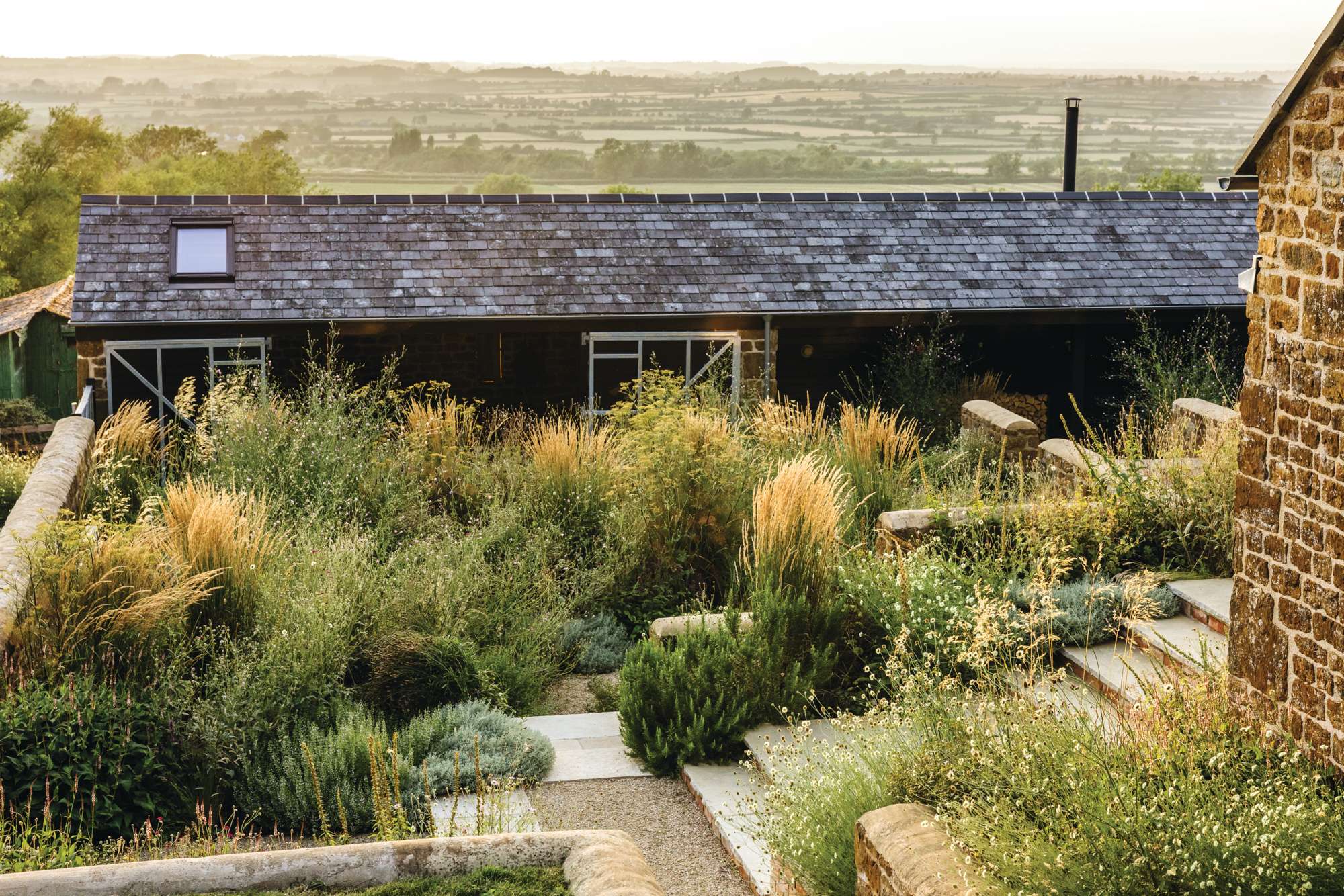
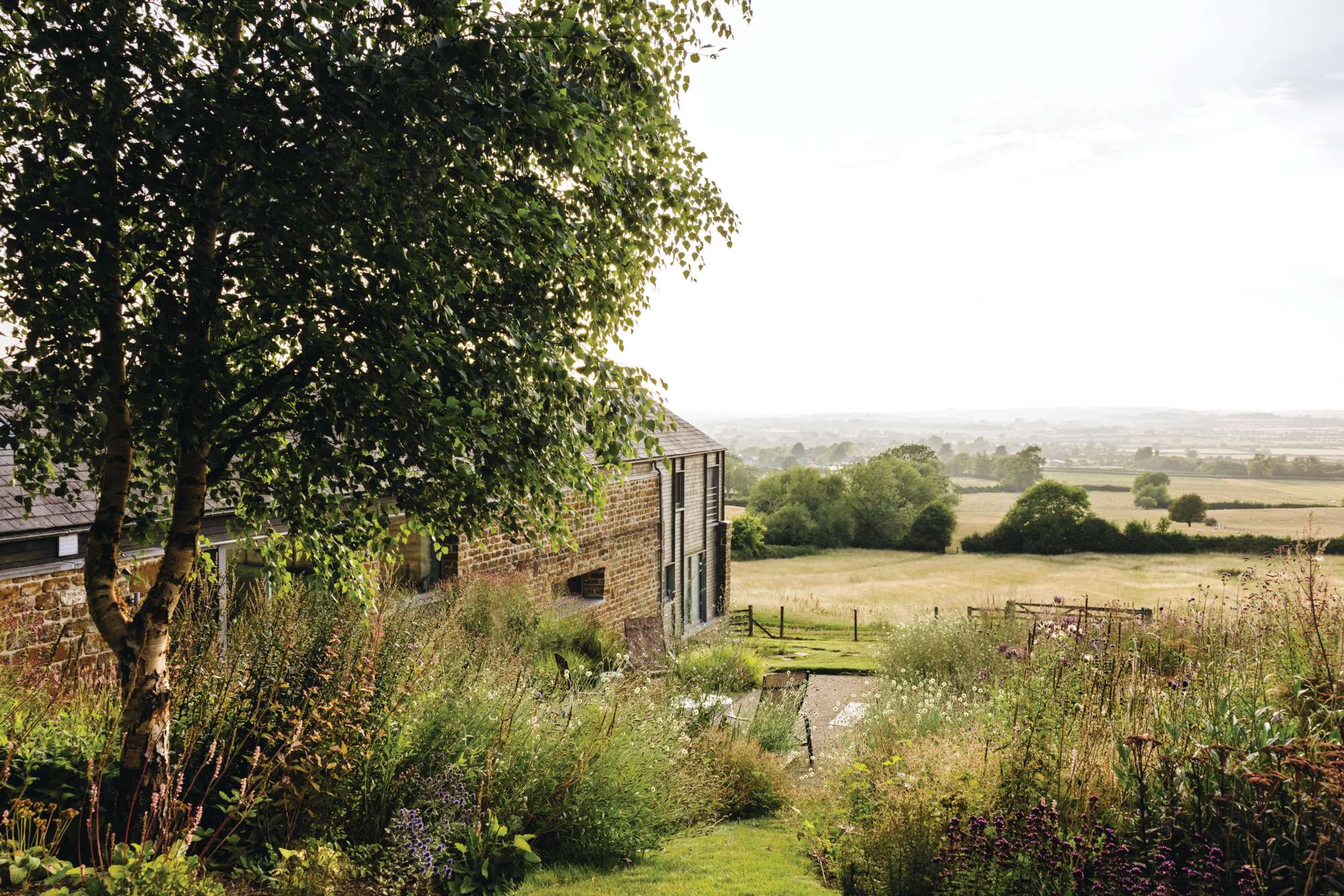
Designing the back garden presented its own challenges. The idea was to create an area of seclusion on a steep, open field, while retaining a sense of connection with the landscape. “Because this side of the house is north facing, the garden is set slightly out from the house to make the most of the views and to get more sunlight,” says Katie. “We graded it out to make it less steep and I kept the design simple, with large planting beds and flowing lines to go with the contours of the site.”
The organically shaped beds surround a small seating space. Behind the largest of these are three mature birch trees, which create a link with the woodland beyond. Because the beds are on a slope, Katie made sure to plant taller plants at the bottom of the bank and lower ones as you move upwards. “We were meant to plant out the back garden in the autumn, but we found some couch grass in one of the beds, so I said let’s just wait until the following spring and keep everything weeded. I was probably overly cautious. There haven’t been any problems since. But because it was a field, you can’t be too careful.”
You may also like
- 'It was derelict buildings and brambles when we arrived' - now it's an experimental plant nursery leading the way
- Garden events and festivals to go to this year: all the best tours, workshops, exhibitions and more for 2026
Katie repeated a few plants from the front garden, such as Althaea cannabina, Digitalis lutea and Scabiosa columbaria subsp. ochroleuca, to connect the two spaces. The planting is similarly naturalistic, with an exquisite mix of herbaceous beauties in shades of pale pink, blue and purple – Sanguisorba tenuifolia ‘Purpurea’, Nepeta nuda ‘Romany Dusk’, Echinacea pallida and Echinops ritro ‘Veitch’s Blue’ among them. Grasses Molinia caerulea subsp. arundinacea ‘Transparent’ and feathery panicles of Stipa calamagrostis add gentle rhythm, while filigree scatter plants, such as Eryngium x tripartitum, Verbena hastata f. rosea and Francoa sonchifolia, further knit the planting together.
While the back garden peaks in summer, spring brings tints of yellow and blue with Tulipa sylvestris, Primula veris and the beloved-by-bees Pulmonaria Opal (= ‘Ocupol’). Meanwhile, Hylotelephium ‘Matrona’ and Sesleria autumnalis both come into their own in autumn.
“The back garden was such a sterile space; now it’s alive with plants and insect life,” says Katie. As Lori adds: “It’s so cosy – you feel you are just perched on top of the world and surrounded by butterflies. We’re surrounded but not hemmed in.”
Katie’s sensitive redesign has anchored the garden within the wider landscape, while creating an easy flow between the indoors and outdoors. It’s a garden that succeeds not by competing with its setting, but by inviting its owners to become part of it – sharing the space with the butterflies, bees and flowers and the ever-changing rhythms of the surrounding countryside.
Find out more about Katie Guillebaud’s work at kggardendesign.co.uk